By JULIE CARLE
BG Independent News
The first ordinance passed after the Village of Weston was incorporated in 1874 was to stop people from tying their horses to newly planted trees instead of using the new town’s hitching posts.
Maybe the town was founded to protect the trees, Weston Historical Society President Jeremy Schroeder said during a recent Weston History Exhibit, jointly hosted by the historical society and the Weston Public Library.
“Were the town’s business owners so distressed over people hitching their horses to the downtown trees that they were like, ‘You know what? It’s time to form a government?” Schroeder said. “I could have used the discovery of the town’s first ordinance to strengthen my recent recommendation for planting more trees,” he added jokingly.
The collaborative event was designed to showcase Weston’s historical collections and generate community interest in local history.
“I think some people discount how interesting things were here in their little hometown, but for me, it’s just getting people to participate, he said.
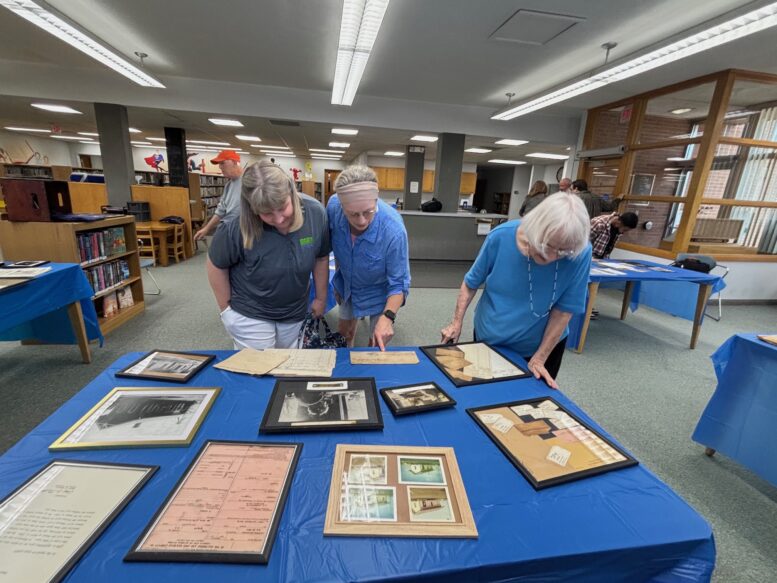
Historical society members displayed some of the items in their collections, from a Weston High School Band jacket and class photos from 1921 to a photograph of a two-horse wagon in front of the Citizens Bank and buttons from Weston’s Centennial Celebration, June 2-5, 1954.

Part of Weston’s history includes the importance of lumber in the town’s growth and development. The Oswald Brothers were involved in many different industries locally and eventually settled on lumber, said Brittney Klockowski, secretary of the historical society. “They are responsible for clearing a lot of the land downtown for the trees and selling the lumber, she said.
The Oswald’s lumber business and the area cattle industry were among the main reasons the town had a train depot and railroad.
A gallery of photographs traced the life of Pauline Bradshaw, who was born in Weston in 1885, the first daughter of C. H. Bradshaw, a local house carpenter. She married Clyde Adams, who taught and coached basketball at Weston High School.
Historical society member Larry Nelson found and purchased the series of photos on eBay and brought them to the library for the history event.
Library Director Shelen Stevens and her team filled a meeting space with items from the library’s history room. “We have a little bit of everything out of our history room,” she said, pointing to photos, descriptions and artifacts spread across tables according to topics.

Most items in the library’s history collection have been donated to the library. “Either someone is getting older and they stop in and offer their items, or family members who are cleaning out a loved one’s home don’t want to throw items away, so they’ll bring them to us,” Stevens said. “That’s how a lot of treasures have come to us throughout the years.”
Library patrons are frequent visitors to the history room to view its collections.
“Ninety percent of the people who come in use the history resources for genealogy,” she said. “They’re looking for a burial spot, a farm, for property.”
According to Stevens, she helped a Canadian man find “the last piece of his genealogy, an ancestor who had a plot of land outside Weston.”
“We were able to go to the courthouse to find the numbers (for the plot) and the next day we were able to find the plot,” she said. “And that’s just an absolute delight and treasure to give people that ability to have a piece of history or genealogy that they’re missing.”
An entire table devoted to Weston schools was set up near the room’s entrance. The original Weston “W” varsity letter and a newer version flanked both sides of the table, along with a large fabric “Weston Tigers” banner.
All six Weston School buildings were represented:
#1— Built in 1836 at the corner of Main and Mill Street. Called the Taylor or Keeler’s School, the building was in use until 1855.
#2—Built in 1855 at the corner of Taylor and Maple Streets. In 1859, the Union Church held services at the school. The building is still standing.
#3—Built in 1867 on Center Street across from the Church of Christ. The building was later used as a cooper shop to make barrels. In 2022, the school material was used to build a house on the original school site.
#4—Built in 1876 on Locust Street, where the Weston Park currently sits. The building held 200 students and three teachers. The cost to build it was $4,640.
#5—Built in 1895 on Locust Street, where the current Weston Park is located. It cost $11,673 to build the structure, which included six classrooms, a superintendent’s office, basement and the first school library in Weston. The building was remodeled in 1940 and a gymnasium was added. In 1969, the school was torn down.
#6—The last school built in Weston was built in 1916. An industrial arts building and a home economics area were added in 1952. In 1953, the final addition was made to the last Weston School, before it consolidated into the Otsego School District.

A photograph in meticulous condition of the 1915 Weston Gleaner Band shows 27 men and their musical instruments. The photograph includes all the band members’ names, representing many recognizable surnames of long-time Weston families: Dewese, Roe, Conklin, Rowe, Sanders, Spratt, Baumgardner, Irwin, Heckerman, Barton and Wade.
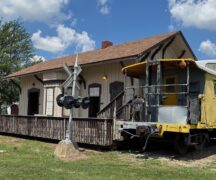
The Weston Depot, which was moved to the Wood County Fairgrounds in 1969, has its own binder of photographs, stories and artifacts. Lavonne Loboschefsky created the notebook that included receipts they paid, photographs and clippings. She donated the notebook to the library. “We even got two of the bricks from when they took the depot out,” Stevens said.

“We want to foster a greater appreciation for local history, whether it’s for Weston or other towns,” she said. “By weaving together factual history with emotional human stories, we can provide a compelling case study on the vital role small-town libraries and historical societies play as keepers of a community’s collective memory. We all want to make history truly a living history for people.