From BOWLING GREEN STATE UNIVERSITY
Across the globe, communities are experiencing the expansion of data infrastructure and artificial intelligence technologies. While these developments often promise innovation, they can also pose questions about sustainability, labor, and local agency. Bowling Green State University media scholar Dr. Clayton Rosati will explore these topics in his upcoming talk, “Server Farming: Community Sustainability and Infrastructures of the Machine Learning Age.”
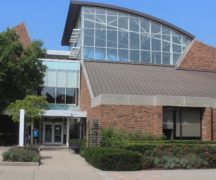
On Tuesday, Nov. 18, from 6:30 – 8 p.m., at the Wood County District Public Library, 251 N. Main St., Bowling Green, Rosati will present his research on the rise of “server farms” – the large data centers powering the global AI economy – and their impacts on regional sustainability, labor relations, and democratic participation.
Rosati’s project will connect his ongoing research on Northern Virginia, the “Internet Capital of the World,” to emerging developments in northwest Ohio, where Wood County recently authorized its first data center. He argues that while these infrastructures are often framed as technical or economic necessities, they pose social, environmental, and ethical questions.
“Server farms don’t just store data – they shape the geographies of labor, resources, and power that define our communities,” said Rosati. “By developing a framework for community dialogue around AI infrastructure, we can build more equitable and sustainable futures.”
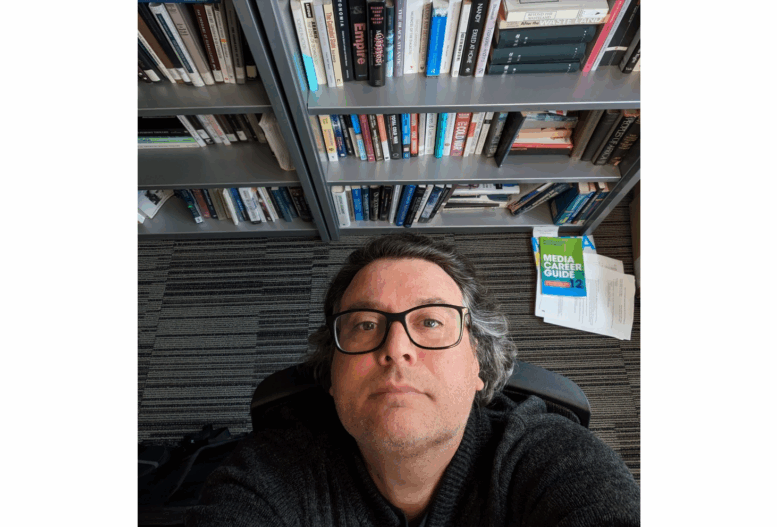
Rosati is an associate professor at BGSU’s School of Media and Communication. His research examines political economy, urban culture industries, and the geographies of media production. He is the author of the forthcoming book “Times Square’s Last Peepshow: Television, the City, and the Rise of the Interactive Age” (University of Georgia Press) and co-editor of “Alternative Spaces/Transformative Places: Democratizing Unruliness in an Age of Austerity” (Peter Lang). His recent articles appear in “Cultural Geographies,” “Online Media and Global Communication,” and “Culture, Theory, Critique.”
“Dr. Rosati’s work bridges critical media studies and community activist,” said The Institute for the Study of Culture and Society (ICS) director Valeria Grinberg Pla. “His project reflects ICS’s mission to connect academic research with public life, fostering dialogue about how technology reshapes our shared spaces and futures.”
The Institute for the Study of Culture and Society (ICS) is an interdisciplinary, public humanities center at BGSU, founded in 1996. ICS helps faculty to develop, communicate, and disseminate their scholarly and creative work to constituencies across campus and throughout the region. With its public events and outreach efforts, ICS brings issues of national and global importance to northwest Ohio and brings community knowledge back to the university.
The event is free and open to the public. The Wood County District Public Library is an accessible venue. For more information, follow ICS on Facebook and Instagram, @icsbgsu, or visit www.bgsu.edu/ics.