By JAN McLAUGHLIN
BG Independent News
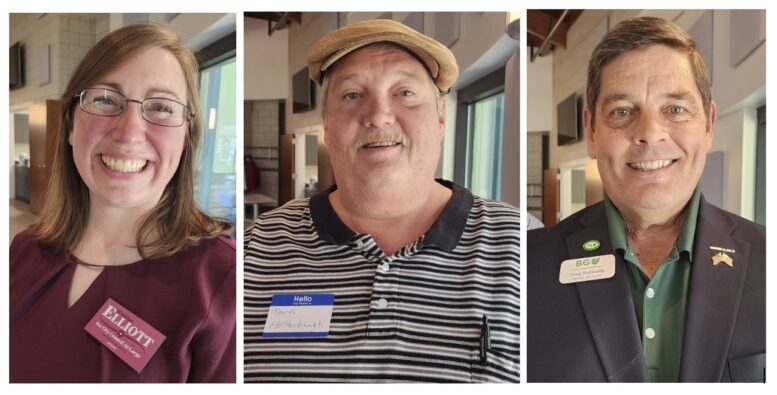
Three candidates are running for two at-large Bowling Green City Council seats. Two are incumbents – Democrat Mark Hollenbaugh and Republican Greg Robinette, and one is a newcomer – Democrat Katelyn Elliott.
Each resides in a different ward, with Hollenbaugh in the First Ward, Elliott in the Second Ward, and Robinette in the Fourth Ward.
Candidates for three of the ward seats are uncontested, so Jordan Musgrave will retain his First Ward seat, Joel O’Dorisio will retain his Second Ward seat, and Kathleen Dennis will take the Third Ward seat.
In the Fourth Ward, incumbent Republican Bill Herald is being challenged by Democrat Audrey Baker.
This story covers the three candidates running for the at-large council seats.
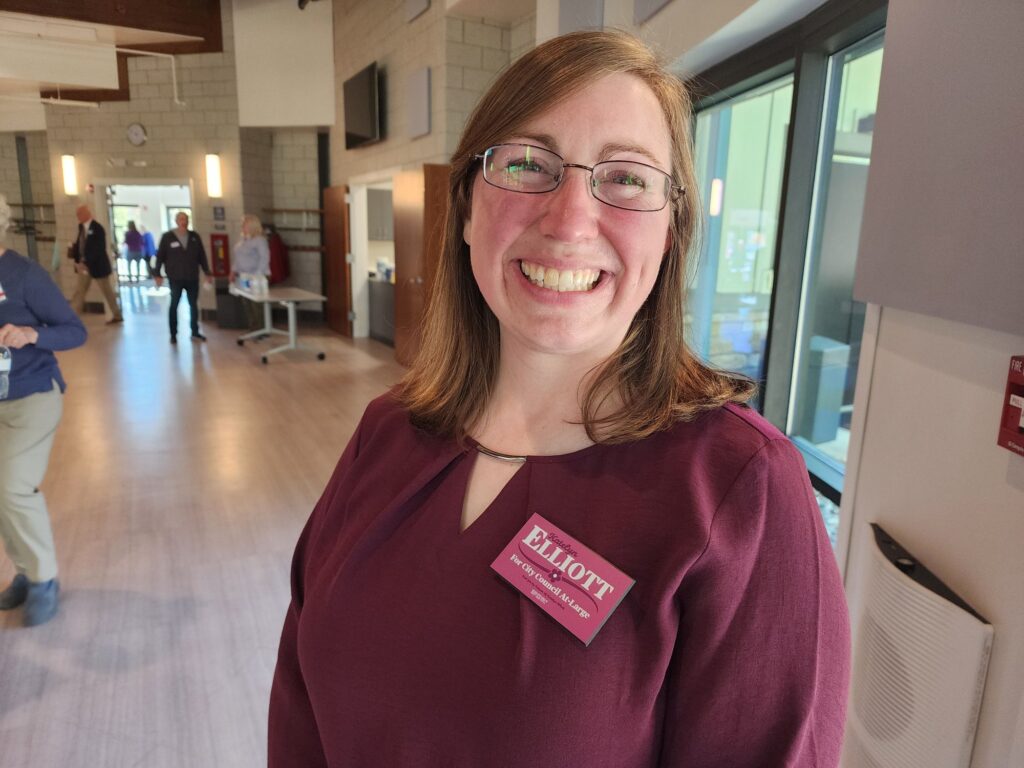
Though Katelyn Elliott has not held an elected position, she is no stranger to Bowling Green City Council – for years she has been a regular at council meetings, keeping an eye on city business. She is a member of the city’s Parks and Recreation Board.
If elected, Elliott said her priorities would include enhancing street safety. She is concerned about the lack of crosswalks in the community, and would like to see safety improvements for pedestrians, especially children.
“I’d like to see a safer environment” for those who walk to destinations such as school, she said.
Elliott said she is excited about the secured Safe Routes to School funding, which will help pay for pedestrian hybrid beacons and multi-use paths in the city.
She also supports the city’s new climate action and resiliency plan, and wants to make sure it does not just sit on a shelf.
“I’m really interested in green rain gardens, bioswales, using trees and plants as natural systems to absorb rain,” she said.
Safe and affordable housing is also top on her list of priorities.
“We have unique demographics in Bowling Green,” with the large populations of young adults and senior adults being interested in smaller housing. “We have to make sure we have housing for that whole spectrum.”
Elliott also talked about her commitment to being engaged with the community, making sure information is shared.
“I want to make sure the city knows what’s going on in the community and the community knows what’s going on in the city,” she said. “It’s important to have a way of getting out that information.”
Elliott was one of a group of citizens who pushed for draft legislation to be posted online prior to it being introduced at City Council meetings. It’s important that such information be available to all city residents, she said.

Mark Hollenbaugh, a government teacher at North Baltimore High School, has served on BG City Council for nine years, the last five as president. He has learned much during his terms.
“When you’re on council, you realize 90% of what you do is maintenance” of such core city services as utilities and emergency services, he said.
Hollenbaugh sees the top issue for the city right now as housing.
“We definitely want quality, affordable housing for everyone who wants to live in Bowling Green,” he said. “Of course that’s easy to say.”
Efforts are being made to bring “affordable” housing to the community, but city government has limited tools to provide incentives, Hollenbaugh said. Ideally, developers would create multi-use spaces, pairing residences with commerce.
“I would love for someone to come in with a proposal to build one of those,” he said.
Hollenbaugh supports the next step City Council is taking to ensure safe rental housing.
Through the rental registration program, city officials finally know how many rental housing units (7,285) there are in Bowling Green – with rentals making up 60% of the city’s housing. Before, there were apartments in basements and attics, and “no one even knew they were there – even the fire department,” Hollenbaugh said.
Now the city is moving a step further, by setting a priority for next year of performing some independent random audits of the self-inspections submitted by local landlords.
“It makes sense to me as the logical next step,” he said. “Let’s take a sample and see if what we’re observing is what’s being reported to us.”
A new priority for Hollenbaugh is being aware of the impact the Meta data center, being constructed north of Bowling Green, is having on city utilities.
“That’s something that’s on my radar now that wasn’t last year,” he said.
Hollenbaugh stressed the need to work as a team on City Council – on a wide range of issues like streets, sidewalks, housing, transportation and more.
“We’re seven people. If we’re all pulling in different directions, nothing gets done,” he said.
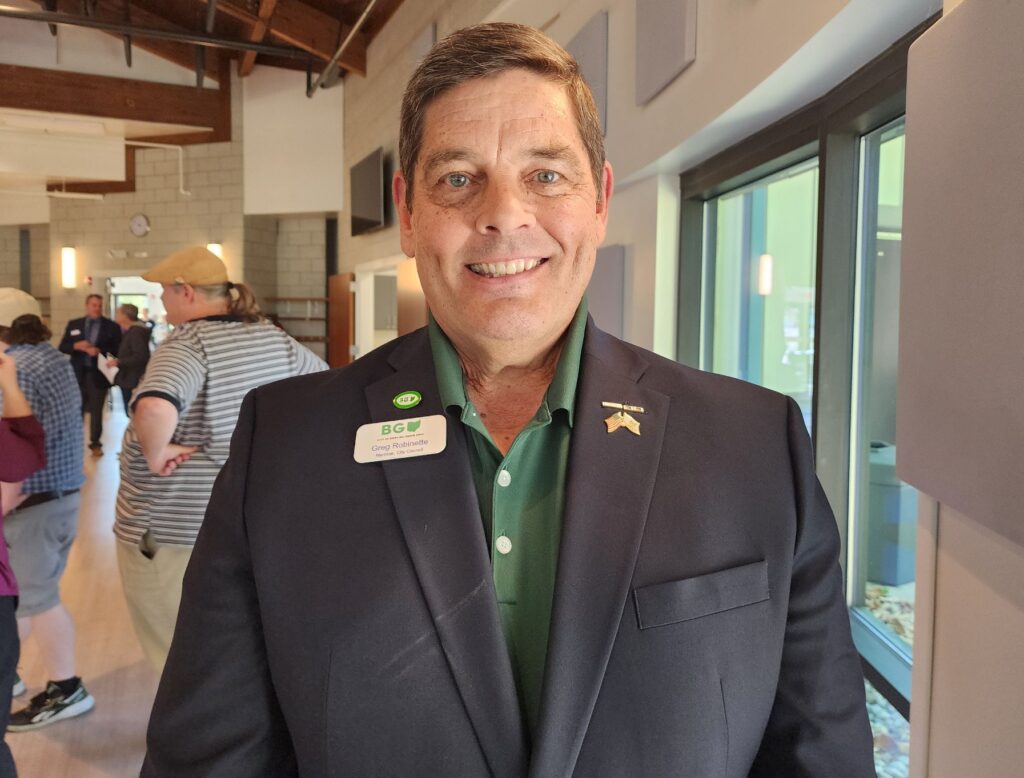
Greg Robinette, who has served 10 years on council, sees the city’s biggest priority for next year as moving forward on the two new fire stations. And as a member of the city’s budget committee, he is focused on adequately funding critical services like fire and police, street maintenance, and utilities.
Robinette – an attorney, engineer and retired Army officer, has held quarterly financial committee meetings to keep an eye on city finances.
“Things are looking good,” he said. “My goal is to make sure we have balance. I’m keeping my eye on the ball. We owe the citizens certain levels of services. We’re not sacrificing essential services.”
Robinette also talked about the importance of reviewing the city’s zoning update every year – especially regarding housing, to see if changes are warranted.
“We should be getting into the routine of reviewing that every year,” he said.
Robinette pointed out the nearly doubled number of housing starts last year as a good sign.
“I really think we have an opportunity to build on the successes in homebuilding we’ve seen in the last year and a half,” he said.
To do that, council needs to examine what measures are working and what needs to be improved.
“We can’t rest on our laurels,” he said.
If voters approve the income tax levy on the November ballot, the city has the next steps ready to go to build two new fire stations. If all goes as planned, the new stations will be completed in late 2027.
The police division will then move into the aging Court Street fire station, while the downtown police station undergoes major renovations. Once the police station is complete, the city plans to demolish the Court Street station.
And that will allow the city to focus on developing that area along East Wooster Street, between the BGSU campus and the downtown for potential economic development.
“Then we can go full bore on marketing that location. Developers have been asking questions about it,” Robinette said.