By JULIE CARLE
BG Independent News
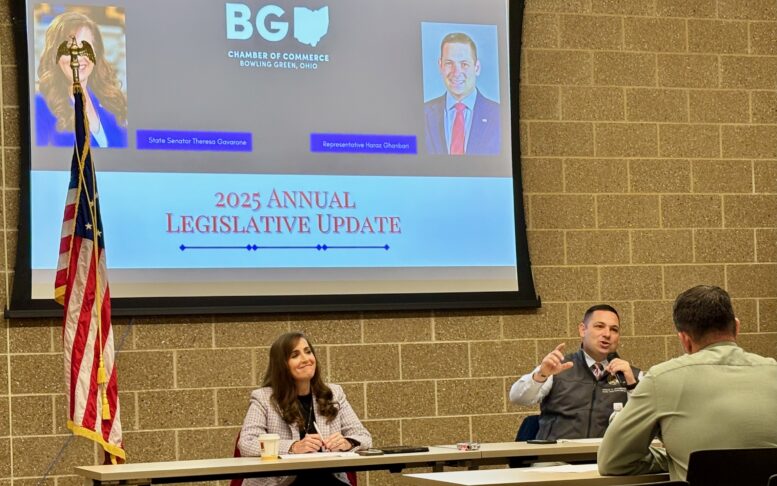
Property tax reform, retail crime, and workforce shortages were among the topics addressed by Ohio House Rep. Haraz Ghanbari and Ohio Sen. Theresa Gavarone at the Bowling Green Chamber of Commerce’s Legislative Breakfast on Friday (Oct. 24).
Both legislators agreed that meaningful property tax reform is one of the top priorities of the Ohio Senate and House chambers.
“People in my district are screaming for property tax relief,” Gavarone said.
A petition to amend the Ohio Constitution to eliminate property taxes needs more than 400,000 signatures to get on the ballot.
“What a significant hit that would be if that were to pass,” she said. The state would lose about $22 billion of the $30 billion it generates each year in tax revenue.
“Where would this money come from to make up the difference?” she asked. “Right now, if you want a little extra money for your Board of Developmental Disabilities or for your ADAMHS (Alcohol, Drug Addiction and Mental Health Services) board, you can put that on the ballot and people vote for it.”
“It would be quite easy to tell you, ‘Let’s just eliminate property taxes across the board,’ because I’ve never met someone that says, ‘I love paying taxes,” Ghanbari said. “But the taxes that we pay help pay for the goods and services that we all expect and desire based on where we live.”
If the property tax ballot initiative were to pass, schools, parks, libraries, public safety would all be negatively impacted in Wood County and across the state.
Passage would eliminate the local control and make Ohio residents rely on what the state provides. Predictions suggest the state sales tax would be increased to 18% or more, negatively impacting the state’s economy, Gavarone said.
Meaningful property tax reform is the focus of both legislative chambers.
“We need to be using the scalpel to dissect and be very targeted in the legislation that we’re working on,” Ghanbari said.
There needs to be a balance between maintaining programs and services and making sure “that people aren’t being priced out of their homes and our communities,” he said. “If that happens and people start to leave, …who’s going to want to build a business if the schools aren’t doing well, if they can’t pass a levy, if they can’t educate those students?”
“There has been a proposal in the Senate, and we’re working through some of those, making sure we have a full understanding of the implications of any of these proposals,” Gavarone said.
A 10th version of legislation to address property tax reform passed the House, Ghanbari said. An earlier version of the bill had a significant impact on schools, including a loss of $2.1 million to Perrysburg schools in the first year.
“Because of conversations with property tax owners, our superintendents, our teachers and others in our communities, we were able to get the 186-10 version passed. It still delivers property tax relief to our homeowners, but also holds harmless the schools in the first year and with the intent to hold them harmless in the second year, so Perrysburg’s not going to lose the $2.1 million,” he said.
Excess dollars in the Ohio sales tax holiday fund will be used to help keep the schools from being impacted by reducing property taxes.”I hope this sends a message that the legislature hears the taxpayers and the business owners and others in Ohio,” he said. “Property tax relief is a real concern, and we are diligently working to get it addressed by not having all these irreversible, unintended consequences that would cripple our communities if the other ballot initiative passed.”
Wood County steps up on retail crime task force
Ghanbari is working on legislation pertaining to small businesses, retail crime, “and a lot of things that we’ve seen transpire along our economic corridors, such as U.S. 20 in Perrysburg Township and other areas within Wood County and across the state of Ohio.”
The bill creates a statewide retail task force and a real-time information-sharing platform.
The Wood County Sheriff and Perrysburg Township Police departments are the two lead agencies on the retail crime task force. Shortly after the task force was operational, they had their first apprehension related to retail crime on U.S. Route 20.
The task force has determined that much of the retail crime is committed by people from outside Ohio who are traveling on Interstate 75 or the Ohio Turnpike. They will come into local communities and prey on small businesses and big box stores.
The task force also looks at patterns of behavior. Often, criminals will stop at a Lowe’s in one location and likely go to a Lowe’s in a different community off the main thoroughfares. Also, retail crime is linked to larger criminal enterprises like human and drug trafficking, he said.
“What this (bill) equates to is making sure that our law enforcement officers, prosecutors, attorney general and business owners have tools and mechanisms in place to help stymie what is going on in our stores,” Ghanbari said. Now, other parts of the state are looking to expand the concept.
The Ohio Attorney General’s office is closely monitoring the impact the retail crime task force is having in Wood County, Ghanbari said when asked what steps are being taken to evaluate the bill’s effectiveness.
“We certainly don’t want to be spending money if there’s not going to be a return on that investment,” he said. “But at the end of the day, it’s about keeping our community safe and looking how the retail crime enterprise touches all of us.”
Ghanbari, who was recently appointed chair of the House Small Business Committee, said small businesses are economic drivers in communities. “They are the ones that employ local folks and reinvest back in our communities with sports and schools and all the things they sponsor and are engaged with.”
The committee is looking at legislation that will continue to strengthen the small business enterprise, help cut red tape and incentivize more small businesses to come to the local communities.
The state is also making “strategic investments” in initiatives that prepare Ohio’s workforce, including micro-credentialing and community connector workforce programs to connect high school students with local job opportunities, internships and career professionals.
Ghanbari also mentioned the investment in the state’s defense sector, “which is really key and good for the state,” he said. House Bill 268, which is not yet finalized in the House, currently reduces the amount of time that a person must wait for a certification of qualification for employment, which allows individuals who have been released from incarceration with a felony conviction to enter the workforce sooner.
He reminded Chamber of Commerce members to reach out with ideas. “We will find ways to look at that, but not everything is a legislative fix,” he said. “I really like to get a lot of issues addressed at the local level without having to pass legislation.”
Tourism and workforce
Bowling Green Manor Administrator Brandon Hemminger, who served as the moderator at the breakfast, asked how tourism and community events contribute to the economic success of towns in the district.
Ghanbari used the example of the $600 million investment in the Cleveland Browns Stadium to talk about the importance of tourism in Ohio.
There were a lot of questions about the Cleveland Browns Stadium investment that Ghanbari was not on board initially. Once he learned more about the additional events that the domed stadium could be used for throughout the year, he better understood the impact it would make on communities.
The project eventually was agreed to be funded as a loan from the state’s unclaimed funds, to be paid back over time.
The facilities establishment fund from the unclaimed funds will help build the Cleveland stadium, but it can also be used to fund other sports centers and cultural centers, Gavarone said.
“At the end of the day, tourism is something else that drives our communities,” Ghanbari said, referencing locations such as Cedar Point, Lake Erie and Bowling Green State University.
“Tourism brings people from all over to spend their money in Ohio,” Gavarone said. “It is not only an economic driver in terms of bringing tourists there, but also when you’re looking where you want to locate your business or where you want to move your family.”
“Who would’ve thought with the hiring of Eddie George and this cat known as Pudge and the international celebrity that this cat has become, what it would do for sales at the university for ball games,” he said.
Additionally, Ghanbari and Gavarone will be working to make sure northwest Ohio is poised to attract businesses to the region, potentially using funds from the state’s capital budget to reinvest in northwest Ohio communities.
The legislature took action to make sure Governor DeWine’s vision “to have shovel-ready sites throughout the state” happens. Instead of businesses having to wait a year or two to get started, the state will have regions and communities ready for business and industries.
“It’s important that when we’re passing legislation, when we’re looking at policies, when we’re looking at how we’re going to cut red tape, that all of those things are intentional, that we don’t do it for immediate wins, but we look at it for long-term investments into our communities,” Ghanbari said.
The state’s workforce is another important issue in the state, Gavarone said. “It is hard to get people to work and to find that workforce,” she said as co-owner of Mr. Spots, a Bowling Green restaurant. “We are working on a number of different things, with our education and training.”
More than 140,000 jobs are available in Ohio and 97,000 of those are paid more than $50,000 a year, Gavarone reported. “Yet we have people who are looking for work.”
The goal is to educate and train individuals for the jobs where there is demand. There are several initiatives at BGSU, University of Findlay and Owens Community College that are working to “try and meet the workforce demands,” she said.