By JULIE CARLE
BG Independent News
For more than four decades, Ohio citizens have been fighting for fair maps for fair elections. Reform efforts date back to at least 1981, Common Cause Executive Director Caroline Turcer, said during a Bowling Green fair maps meeting on Thursday.
Bowling Green was the first stop in a three-city campaign called “What’s Mappening: A Community Conversation About Fair Maps for Fair Elections.”
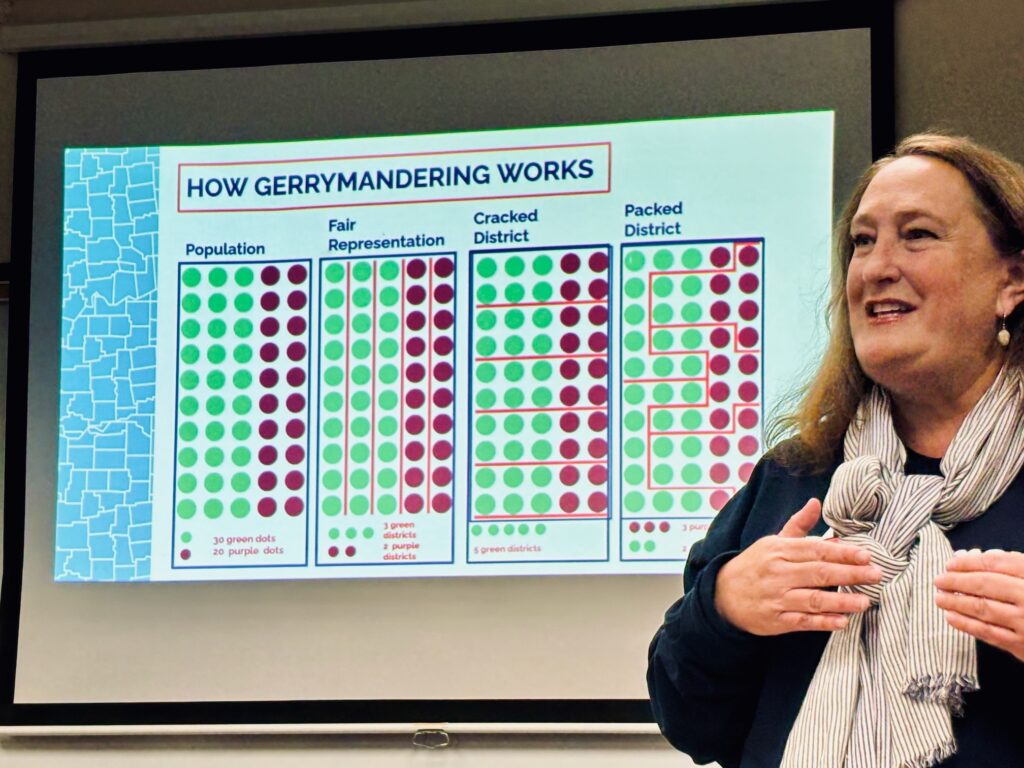
The map-making process in Ohio has failed to draw maps that allow for fair elections; instead, the maps have been manipulated by those in power to insulate one political party, or commonly referred to as gerrymandering, Turcer explained.
In general, gerrymandering can be, and has been, done by Democrats and Republicans to create unfair advantages in elections and to keep their party in power.
“Redistricting is not gerrymandering, just like cooking; you start a fire, you have something hot. It is not arson,” Turcer said several times during the meeting.
“What happened during 2024 and on Tuesday at the Ohio Redistricting Commission meeting is that the folks in power acted as if redistricting is gerrymandering, that intentionally drawing district lines is in fact gerrymandering,” she said.
The 2024 ballot initiative (Issue One) was meant to ban partisan gerrymandering and prohibit the use of redistricting plans that favor one political party and disfavor others. What happened instead was “the language that they used (on the ballot) flipped it,” she said. “And they are still doing that.”
The people who voted against Issue One last year thought they were voting against gerrymandering, and the people who voted for Issue One voted against gerrymandering.
“There is a broad consensus that we want to participate in meaningful elections, that we deserve to have a vote that reflects the way that we voted,” she said.
Despite redistricting campaigns in 1981, 2005, 2012, 2015, and 2018, there have been no successful map-making results. The Ohio Supreme Court has repeatedly struck down maps for being unconstitutional partisan gerrymanders—twice for congressional maps and five times for state legislative maps. And yet, the court’s orders have consistently been defied by the majority party, said Collin Marozzi, advocacy director for the Ohio ACLU.
“This is a long, ongoing fight, and we’re in the midst of one right now,” Turcer said.
There are two separate processes for drawing state legislative maps and congressional maps, Marozzi said.
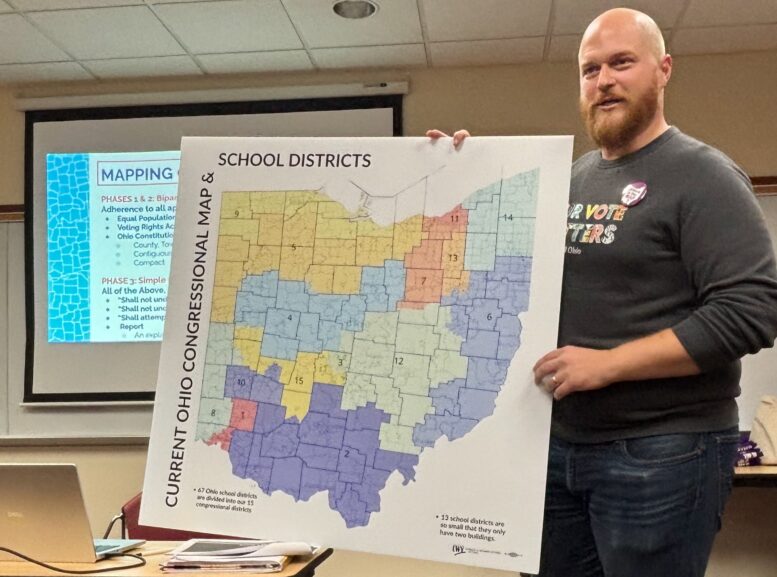
The current constitutional process for drawing congressional maps has few strict anti-gerrymandering rules. Not splitting municipalities and not pairing certain areas of the state with another are two of the rules. The basis for the process is to have bipartisan agreement to move forward.
The Ohio Constitution’s anti-gerrymandering rules focus on keeping political subdivisions together, requiring greater transparency, and banning gerrymandering. Additionally, there is a rule called proportional representation, that the districts should reflect the statewide vote over the decade—55% Republicans and 45% Democrats.
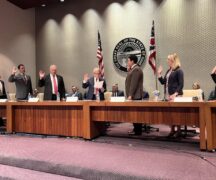
In the latest effort by the commission, a bipartisan agreement has not happened.
“The majority party has failed to produce a single proposed map for public review, shutting citizens out of the process and making it impossible to give meaningful feedback,” Turcer added.
During the meeting, Andrew Green, a map-making expert, and Trevor Martin from the Ohio League of Women Voters, talked about and demonstrated the process to make the congressional maps fair and compliant.
“Anytime you make a choice, are you going to keep a community together or are you going to focus on compactness? If you focus on keeping this area compact, how does it affect that area? And it’s a bit like dominoes,” Turcer said.
Molly Laflin, who attended the meeting, has been a longtime advocate for fair maps for fair elections. As she participated in the exercise to try to create a fair map, she noted the difficulty in doing that.
“So it feels like we’re playing around with something that’s never going to happen. Is there some way to get teeth in this?” she said.
The commission missed the Sept. 30 deadline to agree on a fair congressional map for Ohio. The next deadline is Oct. 31. If that deadline passes without an approved map, the process moves to the legislature
“We are currently at the tail end of the second phase, whereas the Ohio Redistricting Commission has until the end of October to again pass a bipartisan map. Hopefully we will see some movement on that,” Marozzi said. “In November, the legislature once again has a crack at passing a bipartisan map; however, there is an escape hatch.”
If bipartisan agreement is not reached, a simple majority is needed to approve a map that still must comply with the Voting Rights Act and county-splitting restrictions.
“That’s why we need everybody in this room to be nipping at the heels of mapmakers to make sure we hold their feet to the fire on those anti-gerrymandering criteria because they’re going to try to pass a simple majority map,” Marozzi said.
Participants were encouraged to submit maps, show up and testify at the commission meetings, submit written testimony, and reach out to legislators and commission members.
If a map is approved with bipartisan support, there is no recourse. But if that doesn‘t happen, a petition to put it on the ballot is possible. That would require collecting signatures in December, January and February, which is not the easiest time to reach people for signatures. Now is the time to be thinking how that might be possible, Turcer said
“We’re here because we believe in the power and promise of democracy. We want meaningful elections, and we’re tired of district lines, voting districts being manipulated to manipulate our vote,” she reminded the audience.