
From RIVER HOUSE ARTS
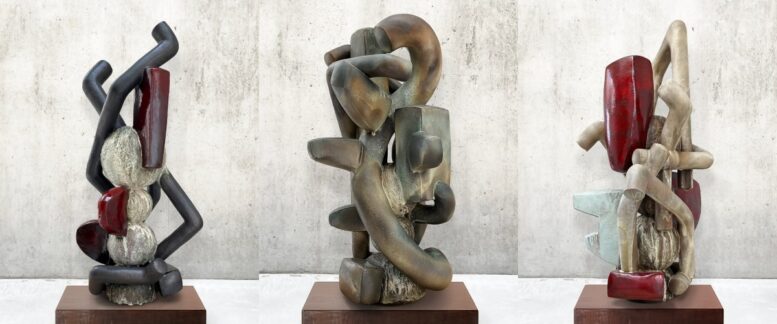
River House Arts, 425 Jefferson,Toledo, will host an opening reception for “Beyond the Boiler,” an exhibit of new work by ceramic sculptor John Balistreri, Saturday Nov. 15 from 5-8 p.m.
The exhibit continues through Jan. 17. Gallery open by appointment. Call 419-441-4025 or click to schedule.
A Colorado native, Balistreri is professor of art at Bowling Green State University, where he has directed the ceramics program since 1996.
The sculptures “Beyond the Boiler,” are drawn from Balistreri’s latest series, “Blocks, Bars and Balls,” in which he distills decades of formal exploration into essential three-dimensional forms. In his latest body of work, tthe artist distills the formal vocabulary he has developed throughout his distinguished career into essential three-dimensional forms.
When I was young, I spent a lot of time climbing inside huge boilers at my family’s greenhouse business. I would lie face down on the steel tubes washing out the slag and the scale, repairing refractory where needed. It was a dark, rusty place, filled with echoes. It was my favorite job. After starting the boiler, the 250-horsepower blower would wind up and the massive burner would ignite, shaking the room. As the water turned to steam, the steel header hammered and the whole place warmed up. It was visceral, primeval, it felt alive, and I understood it. That boiler is still in my bones when I walk into the studio. I hope that my work contains some of that spirt as it moves into the world as sculpture or painting.
John Balistreri
The large-scale sculptures feature spherical cores with blocks of various sizes radiating outward, connected by linear bars, a deceptively simple formula that yields infinite possibilities. The vertical sculptures loosely reference the figure while drawing inspiration from midcentury modernism in painting, sculpture, and design. Balistreri’s glazing techniques are equally significant, creating surfaces that evoke geologic time—as if stone were slowly melting over the forms.
The result is work that exists outside time, addressing the universal human condition rather than immediate social or political concerns. With over forty sculptures completed or in progress, the series represents both a refinement and an expansion of the artist’s ceramic practice.
Archive of Absence | Deborah Orloff
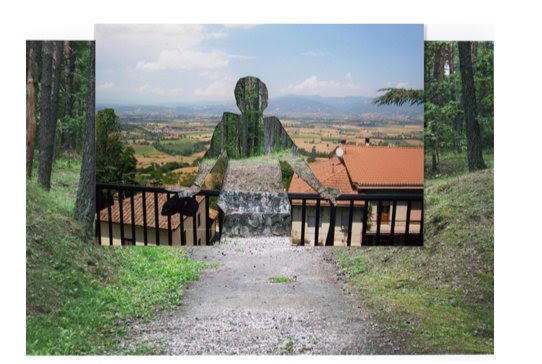
“Archive of Absence,” Deb Orloff’s new solo exhibition, will also open in the second floor gallery on Nov. 15 and continue through Dec. 15.
Orloff is a photo-based artist and educator. Originally from New York City, she moved to Ohio to accept a faculty position at the University of Toledo where she is head ofphotography & digital media, and associate chair of the Department of Art.
The exhibit includes work from several series that fall under the overarching title Elusive Memory a large body of work she started in 2013 and continues to build.
Her newest work is inspired by personal experience with genealogy research and utilizes photographs she made in Central and Eastern Europe. According to the artist: “Researching my family’s roots has led to myriad dead ends; I’ve found random facts related to a handful of ancestors, but nothing close to a complete narrative. Details of individuals have been lost as people die, and their memories disappear. This is complicated by the fact that I come from a diasporic culture where official records from Russia and Eastern Europe largely cease to exist, and histories depend on oral traditions.”
Orloff explains: “The first iteration of Elusive Memory consists of high-resolution photographs of damaged family photos that emphasize the unique details of their deterioration. These large-scale prints serve as metaphors for the unreliability of memory and the experience of trying to access it.” She continues: “Conversely, the photographs in Elusive Memory: Lost Histories are small still-life images that deny the viewer most of the visual information photographs are expected to reveal. With only selected areas in focus, they allude to lost stories and identities – especially in situations of forced migration (the case for my ancestors who fled Russia during the pogroms of the late 19th century).”
Her new series, Elusive Memory: Constructed Histories, is a physical collage project. Of this work she says: “In these intimate assemblages, I juxtapose physically altered family photos with images I made in European locations relevant to my ancestry and Jewish history including the Holocaust. Conflating time, people, and places, these pieces start to suggest stories and relationships that could have transpired but, like my family history, can never be fully known.”
Orloff initially embarked on her European odyssey to make “source material” for the collage project she was planning last summer. However, while photographing concentration camps and other sites related to her Jewish heritage, she was particularly struck by “spaces that had traumatic histories but little to no visual evidence of what took place at the sites.” Thinking about this “erasure of history,” she sought and photographed such areas. These images are part of a parallel body of work, Elusive Memory: What Remains, that will be represented in the River House Arts 2nd Floor Gallery exhibition as well.
“Elusive Memory” has been supported by the University of Toledo’s office of Research.
