By JULIE CARLE
BG Independent News
Reciprocity with nature is the root of an art exhibition at Bowling Green State University’s Fine Arts Center.
The exhibition, “In the Roots: Ohio’s Native Plants,” fills the Willard Wankelman Gallery with messages, large graphics, and touchpoints that explore northwest Ohio’s plants and landscape, and the history of the region’s environmental change from Indigenous settlement to the current day.
Undergraduate and graduate students in two courses—Collaboration and Community Engagement, taught by Jenn Stucker, professor of graphic design, and Museum Studies in Public History, taught by Cheryl Dong, assistant professor of history—produced the exhibition that aligns with the 2025-26 In the Round Speaker Series.
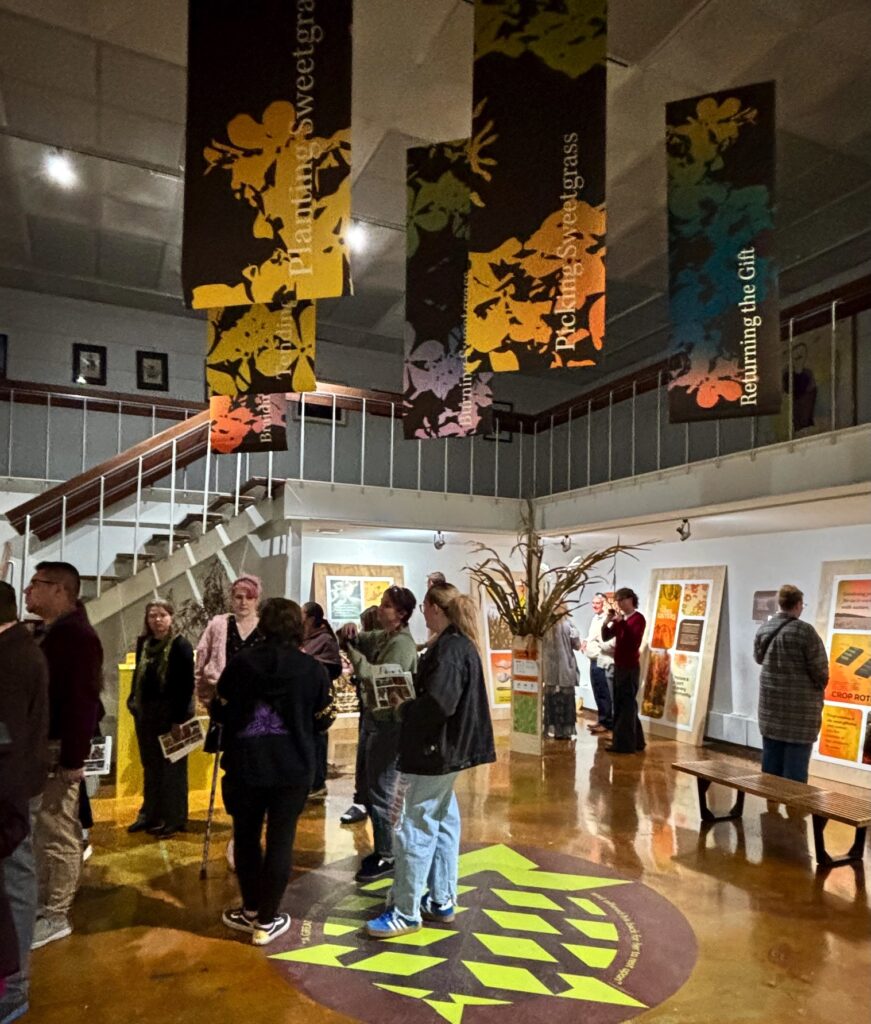
Inspired by “Braiding Sweetgrass: Indigenous Wisdom, Scientific Knowledge, and the Teaching of Plants” by Dr. Robin Wall Kimmerer, the collaborative show incorporates the foundation of her essays and stories. Her work reflects the concept of reciprocity between humans and nature, which stems from the philosophies of Indigenous cultures.
The importance of practicing mutual care to enable all living beings to thrive is about restoring our relationships to the land. Plants take care of us, and it’s our turn to take care of them.
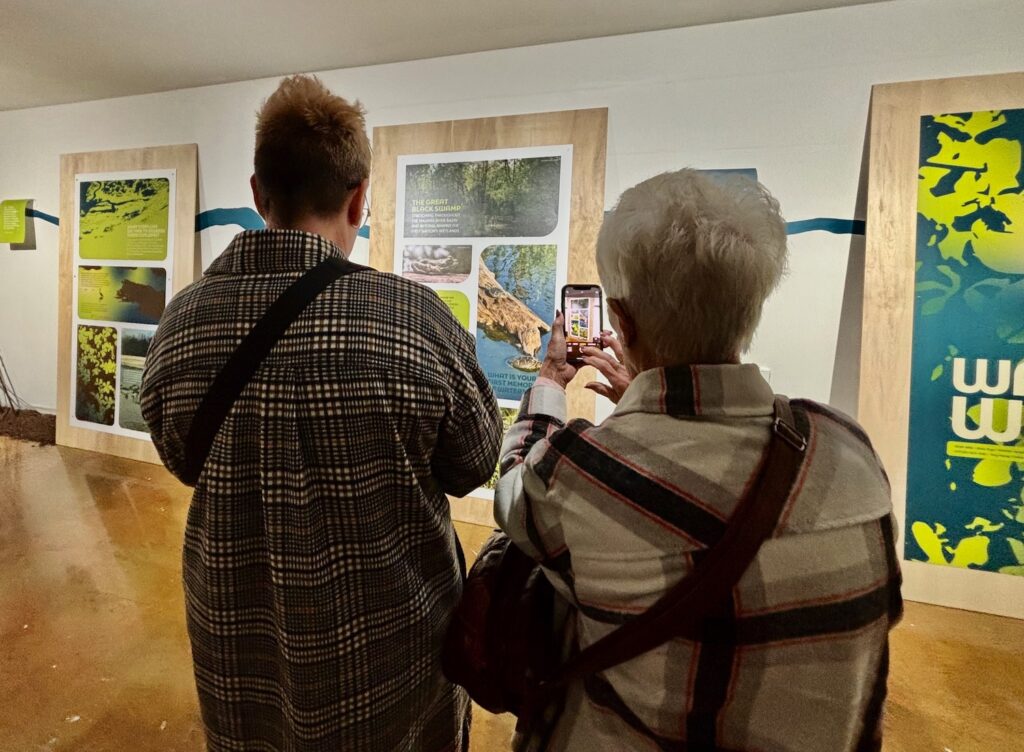
The artwork throughout the gallery embraces Kimmerer’s messages and localizes them for impact in northwest Ohio. Examples illustrate how to establish sustainable and mutually beneficial relationships with the natural world, comprising plants, animals, and microorganisms, in what was once the Great Black Swamp and home to many Indigenous communities, including the Odawa, Kickapoo, Wyandot, Myaamia, and Potawatomi.
The displays showcase how Indigenous cultures were deeply ingrained in sustainable agriculture and gardening.
A board about the “Three Sisters” (corn, bean and squash) offered “a classic example of reciprocity.” Corn provides a structure for climbing bean vines to reach sunlight. Bean fertilizes the corn and squash by releasing beneficial nitrogen into the soil. The broad, spiny leaves of squash prevent weeds, shade the soil to hold moisture, and protect the other plants against predators. Guests picked up packets with each of the seeds to start the work in their own gardens.
The local organization, Black Swamp Conservancy, works to restore the Black Swamp that has been destroyed in the Midwest. According to the Black Swamp display board, “Often the land serves us humans, and we can repay that debt by protecting the natural habitats of the swamp. As we take from the land, we should only harvest what we need.”
“The students were conscious of the environmental impacts” of the show, Stucker said. All of the hanging boards were repurposed so students can use them for art projects. The large posters were hung using magnets instead of adhesives, which will allow all the paper used in the show to be recycled.
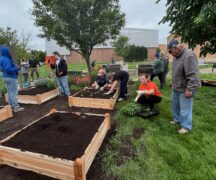
The soil that was placed around each of the large boards to visually connect the earth to each of the topics, “will be shared with the BGSU Community Garden for the May planting event,” Stucker said.
Madelyne Junk, a fourth-year graphic design major and member of the Honors College, took charge of designing the layout for the exhibition’s broadsheet newspaper and a handy takeaway leaf identity chart for visitors that is “a call to action for community engagement with nature,” she said.
She was also a member of the Agriculture and Sustainable Gardening team that determined how to best present the information in a narrative walkthrough of the gallery space.
“I loved being part of this because I’m really involved in environmental advocacy. Talking about Ohio’s native plants really piqued my interest,” she said. “I also loved reading ‘Braiding Sweetgrass.’ It was the inspiration for this exhibition.”
After reading the book, she and the team wanted to convey the book’s “powerful words” and “lesson of reciprocity,” she said. “I think that it’s something that we really need right now. It’s really beautiful, and it needs to be shared with others.”
Fostering environmental change “must start with small-scale community engagement,” Junk said in explaining the purpose of the exhibition.
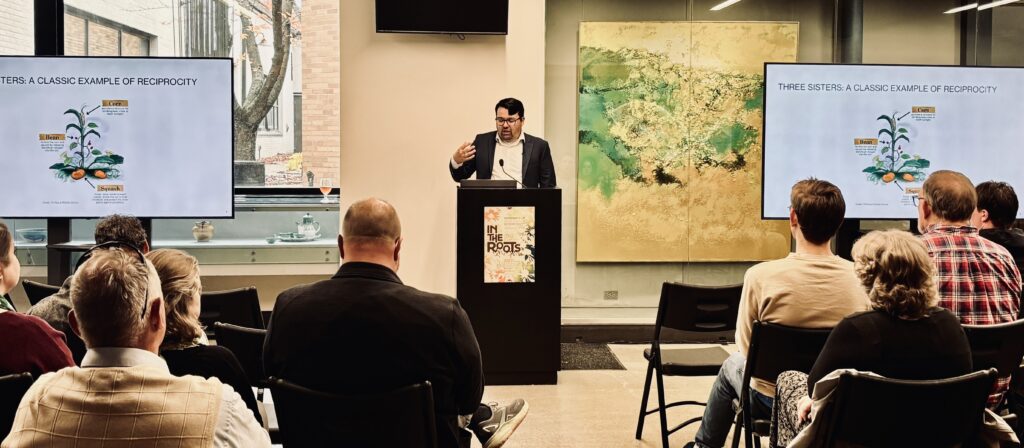
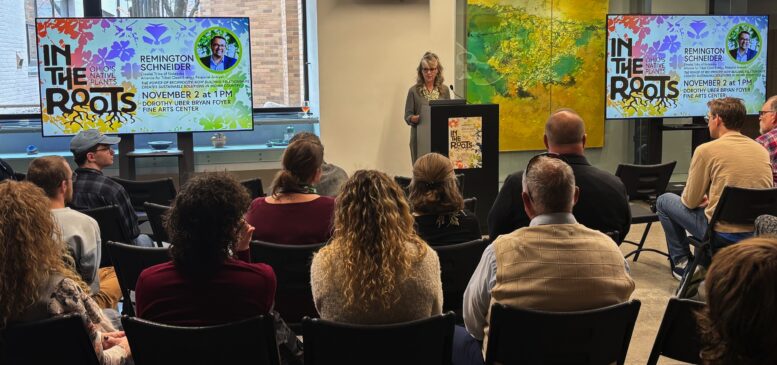
Before the exhibition opening, reciprocity was also the theme of a talk by Remington Schneider, a citizen of the Omaha tribe of Nebraska, a financial analyst with the Alliance for Tribal Clean Energy, and a 2021 BGSU alumnus.
He defined reciprocity as “an exchange of gifts between entities with the obligation of continuing relationships into the future,” which is different than the transactional nature of modern Western economics.
The “Three Sisters” (corn, beans, and squash) is “a classic example of reciprocity in nature,” Schneider said. “It is one of the early examples of traditional ecological knowledge that many Native communities would use.”
They didn’t have the current Western scientific knowledge to understand how the nitrogen flows through the beans into the soil, but the Native American communities simply knew that the three plants combined their efforts to achieve optimal outcomes.
“With these three systems as an example of reciprocity, I believe we can see how we are able to care for one another in a long-term sustainability,” he said.
Schneider also explained how the Omaha tribe’s clan system, where each clan had specific responsibilities for the community’s physical and spiritual well-being, was a model of social reciprocity.
In talking about the vast differences between tribal and Western economies, Schneider said wealth is measured in traditional Tribal nations by the availability of natural, intellectual and human capital for the entire community and future generations. However, modern Western economies are transactional, focused solely on monetary capital and profit.
In his role with the alliance, he is aware of how tribal nations face severe energy and economic challenges, such as “a lack of consistent electricity and rapid economic leakage,” where a dollar leaves a native community in four hours compared to a week in Western economies.
Additionally, poverty is a “21st century problem that tribes continue to face today,” he said. Widespread unemployment and underemployment result in families experiencing poverty at disproportionate levels compared to other minorities.
The alliance has examined food pyramids and food webs to see how resources flow in and out of different ecosystems. “I think what’s not acknowledged through a Western perspective is the relationships we have as humans,” he said.
Growing up in the Omaha tribe, he saw that reciprocity existed every day. “We have been participating in commerce and trading since time immemorial, whether that is within the tribe or with other tribes,” he said. “We have always used reciprocity as a foundation to our understanding of how to survive, not just for the Omaha but for other tribes as well.”
There is also a history of exploitation by outside entities offering transactional, often failed, solutions.
He argued that sustainable solutions required a paradigm shift from transactions to relationships. His organization prioritized building trust and long-term partnerships with tribes, meeting them where they were to help them achieve self-determined energy sovereignty.
They have always used reciprocity as a foundation to understand “how to allow, not just our tribe, but other tribes as well, to thrive.”
“Understanding tribal economics requires you to have this kind of shift about capital within your mind, what you think of ways to transfer values,” Schneider said. “How much money or finances can you provide?”
Finances may not be plentiful, but time and talent are considered human capital and can be used to push a project forward, he said.
“Braiding Sweetgrass” author Kimmerer will be the featured speaker for the university’s In the Round Speaker Series of Native Creatives at 5:30 p.m. on Friday, March 27, in Kobacker Hall, Moore Musical Arts Center. She will also speak at the Wood County District Public Library at 10 a.m. on Saturday, March 28.
The art exhibition runs through Friday (Nov. 15). Gallery hours today (Nov. 12) through Friday are 11 a.m. to 4 p.m.
Additional “In the Round” events are listed at bgsu.edu/in-the-round. By engaging contemporary Indigenous and Native American Artists, the series challenges erroneous and harmful stereotypes that continue to permeate American society today.