

By JAN McLAUGHLIN
BG Independent News
Sandra De Steno is seeing families in the region being buried under snowballing crises.
One flat tire, one sick child, reduced hours at work can set off a chain reaction.
Not being able to pay electric bills can lead to utilities being shut off, which can lead to eviction.
“It’s really hard to talk about food security if they don’t have a working refrigerator or they don’t have gas to cook food.”
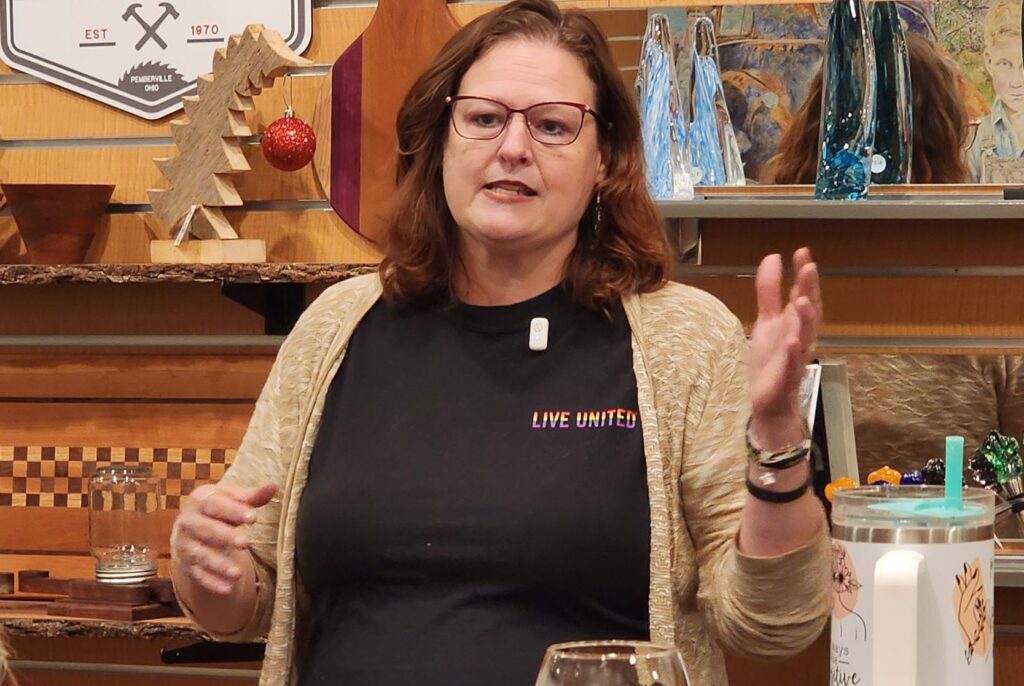
De Steno, director of the United Way 211 program in this 16-county region, was asked by the organization BG Persists to talk about the increased needs being seen by the call center that connects people to help.
This has been a year of increasing hardships for many families – and the temporary halt of SNAP food benefits exposed more weaknesses.
“There was already so much more need before this. It’s compounding a lot of issues,” De Steno said. Many local residents are living month to month. “A lot of people are living more narrowly than that.”
“I know a lot of this is doom and gloom, and it’s going to get harder,” she predicted.
For the counties covered by the local United Way 211 program, calls for help have jumped from 2,881 in 2024 to 3,671 in 2025. Following is a comparison of 211 calls for help during the year of 2024 compared to 2025.
- Housing and shelter: 1,099 in 2024 to 1,406 in 2025.
- Food: 479 in 2024 to 770 in 2025.
- Utilities: 374 last year to 461 this year.
- Healthcare: 109 last year to 139 this year.
- Employment and income: 150 last year to 174 this year.
- Transportation assistance: 142 last year to 184 this year.
“People didn’t need one more problem, and 2025 has given them a whole bunch of problems,” she said.
“Right now we’re hearing from seniors torn between housing and medications,” De Steno said.
“We don’t talk about utilities a lot, but we should,” she said. “People trying to choose between heat, lights and groceries. That’s how food insecurity starts.”
“Food scarcity is absolutely a community concern. But these numbers show us the bigger truth – food insecurity doesn’t stand alone. It’s tied to rent, to utilities, to living costs. If we want to solve hunger, we have to stabilize households.”
In 2023, 14% of Ohio households were below the federal poverty level and were considered financially insecure. This measurement failed to account for an additional 25% of households that were also experiencing financial hardship – with income above the poverty level, but not enough to afford basic expenses.
That means an estimated 39% of Ohio households were forced to make difficult choices, “like deciding whether to pay for utilities or a car repair, whether to buy food or fill a prescription.”
Workers below this threshold (ALICE – which stands for asset limited, income constrained, employed) often perform jobs that keep the economy functioning smoothly. They are child care providers, food service workers, cashiers, personal care aides and delivery drivers.
Oftentimes, members of this population have multiple jobs, so they earn too much for public assistance, but too little to keep up with rising expenses, De Steno pointed out.
Child care eats up a big chunk of some paychecks, and already expensive health care is set to rise rapidly.
“It’s discouraging to do everything right and still fall behind,” De Steno said.
During most years, there are cyclical surges in needs. But this year, with the end of ARPA funds – the last meaningful investments in communities, De Steno said, the needs seem to all be escalating at once.
“Some of these funds are just running out now,” leaving obvious gaps in services, she said.
Medicaid expansion is ending, utility costs are rising, USDA slashed funding for food banks, and cuts in SNAP shook many households.
“Non-profits and community households have been pushed to the edge,” she said. “It’s destabilizing to people just on that edge.”
United Way 211 is seeing an uptick in homelessness, utility shut offs, and transportation needs.
“It’s expensive to have transportation. It’s expensive to not have transportation,” De Steno said, noting that public transportation options in Wood County are quite limited.
While homelessness may not be visible in Wood County, it does exist, she said.
“There’s been a lot of hidden homelessness in the last 20 years,” as family and friends double up during hard times, De Steno said.
There are no shelters for unhoused people in Wood County, and very few in the region. Shelters in Toledo are currently full, she said.
“The unmet need for shelter is sitting at 29%. That means nearly one in three people calling for a safe place to sleep, we can’t connect them to anything. Not because they don’t deserve help – because it literally does not exist.”
“People are now sleeping outside. They are finding places that aren’t meant for habitation. There’s no place to go.”
A ripple effect from these difficult times is “compassion fatigue” for those trying to help, De Steno said.
“It’s hard,” she said. “211 gives us a front row view of the struggles and strengths of our community.”
Helping families who are sleeping outside, going hungry, or choosing between medication and rent can cause “vicarious trauma,” she said. “It’s listening to the hardest stories.”
De Steno suggested that those able to help in communities look for ways to fill in gaps through volunteering or gathering resources. For example, SNAP benefits can’t be used to buy toilet paper or toothpaste, so donations of those items to local food pantries are important. People can “adopt” food pantries, establish car repair pools, share leftovers, and check in on elderly neighbors, family and friends.
“Don’t assume anybody’s helping,” she said.
And they can stand up for those struggling, by pushing for a local shelter or other resources, she said.
“Advocacy matters,” De Steno said.