
Review by CARROLL McCUNE
According to the Organization of American Historians, television has become the medium through which most Americans now get their history.
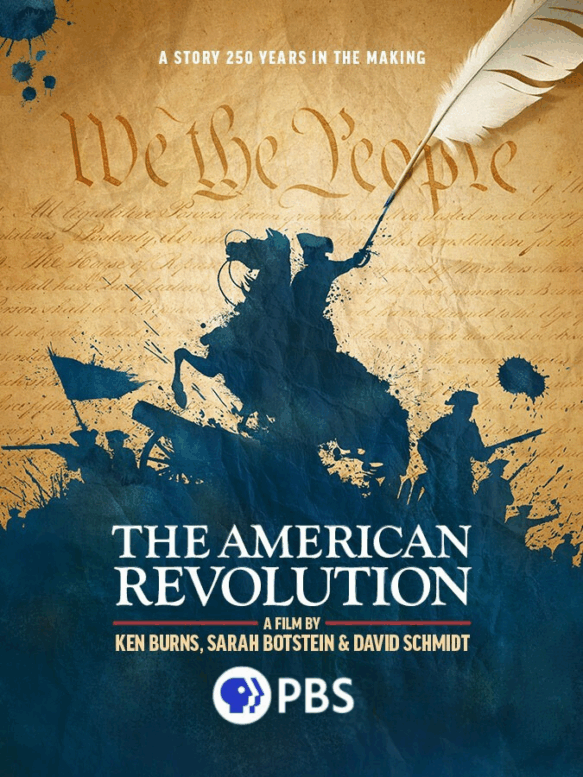
The collaboration between producer Ken Burns and writer Geoffrey C. Ward, undisputed masters of television documentary, released their latest program on November 16, 2025. The twelve-hour, six-part PBS series on the American Revolution can be called a diversity, equity, and inclusion undertaking in historical revisionism. The Hollywood Reporter critic Daniel Fienberg praised its attention to “the internal conflicts and hypocrisies of the American Revolution, particularly its celebrations of equality that excluded Blacks and Native Americans and left women in the background.”
“It’s a way of reminding us of the complexities of our founding.” —Ken Burns
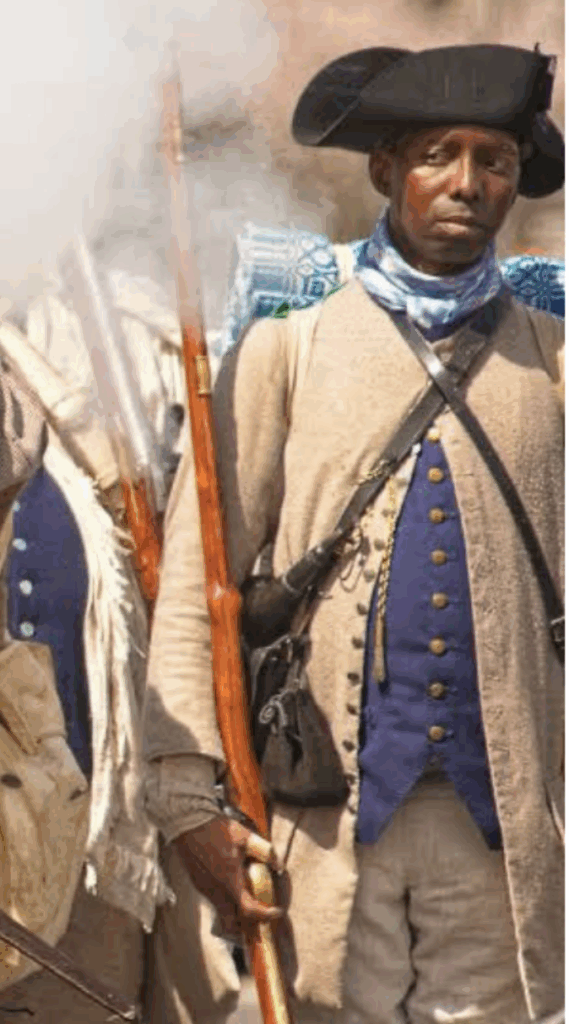
One of Burns’ complexities was the exploitation of the Black population by both the British and American colonies. Up to 20,000 Blacks served with the British forces and 5,000 fought for the Continental Army. “Enslaved New Englanders were not recruited for the rebel forces. Since the Provincial Congress insisted that it was engaged in a struggle for freedom from what they called British slavery, it declared that enlisting them would be inconsistent. But free Black men were welcome.”
The British promised enslaved Blacks freedom for their service, but after the war, George Washington ordered the capture of Blacks who fought for the British to be returned to their former owners.
Another revisionist insight was the crucial role of revolutionary era women. It often quotes Abigail Adams, wife of the future president John Adams, and Mercy Otis Warren, one of the first historians of the Revolution, who played an important role in promoting resistance. The enslaved Black poet, Phyllis Wheatley, emerges as a poignant voice of the times. Betsy Ambler, a teenager from Yorktown, Virginia, writes about a time of “great confusion when most of the men were away at war.”
Narrator Peter Coyote said that women saw their horizons broadened and were forced to develop skills and strengths they hadn’t known they possessed. “Some acted as spies or couriers. A handful disguised themselves and fought as men until they were found out. Hundreds, perhaps thousands, followed the armies. But most stayed at home and struggled to keep their families together. The wives of absent farmers, already caring for children and households, now slaughtered hogs, cut and stacked firewood, harvested corn and wheat, and managed finances.”
The war elevated their importance in preserving the social order amidst the disruptions of war. In the Continental encampments, women, either soldiers’ wives or paid laborers, were a constant presence. Some cooked or acted as nurses, but many more washed and mended clothes.
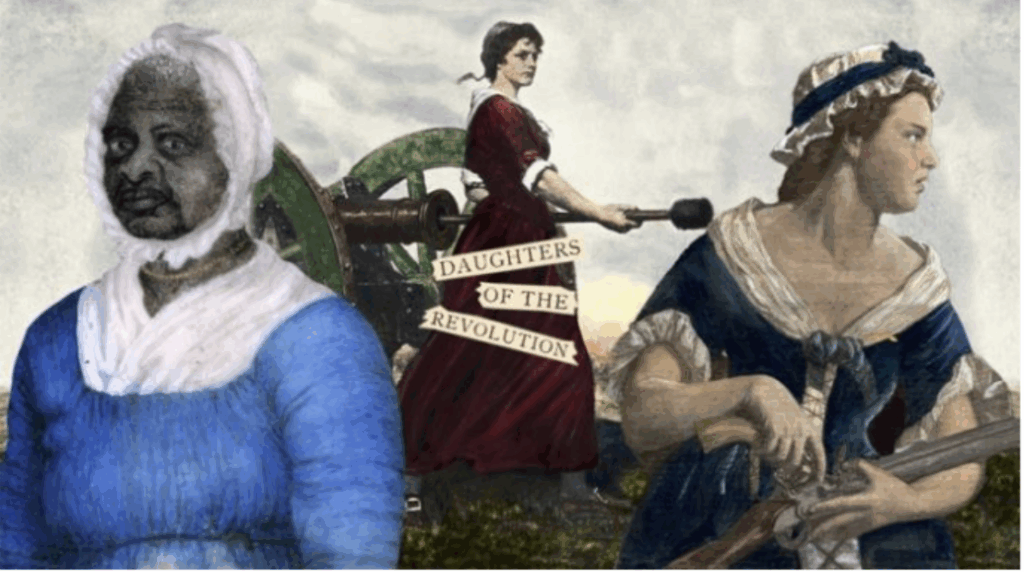
the Daughters of the American Revolution, Molly Corbin replaced her husband, felled on the battlefield. Illustration credit
The docuseries also challenged the familiar explanation that the cause of the war was primarily a tax revolt. It insisted that the underlying impetus for the rebellion was control of the interior of the continent. After the British won the French and Indian War, they issued a proclamation declaring all land west of the Allegheny Mountains off limits to white settlement, ordering settlers already there to withdraw.
“The American Revolution was all about land.” —Philip Deloria, historian
To the colonists, the pursuit of liberty was driven mostly by their insatiable desire for land. Speculators (including Benjamin Franklin, Thomas Paine, Thomas Jefferson, and George Washington) knew no bounds. Writer Geoffrey C. Ward reveals that Washington saw the proclamation line as an “irritating but impermanent obstacle.
“Four years after it was issued, Washington directed a man he hoped would become his land agent to defy it and quietly secure for himself the most valuable lands.”
British Major General John Gage, whose job was to enforce the proclamation and protect Native American land from settler encroachment, wrote that he became “fully convinced that the Boundary Lines never will be observed. The Frontier People are too numerous, too Lawless and Licentious ever to be restrained.”
“We have great reason to believe that you have come to drive us away. Why do you come to fight in a land that God has given us? Why don’t you fight in your own country…on the land and in the sea? —Teedyuscungi, negotiator for the Lenape
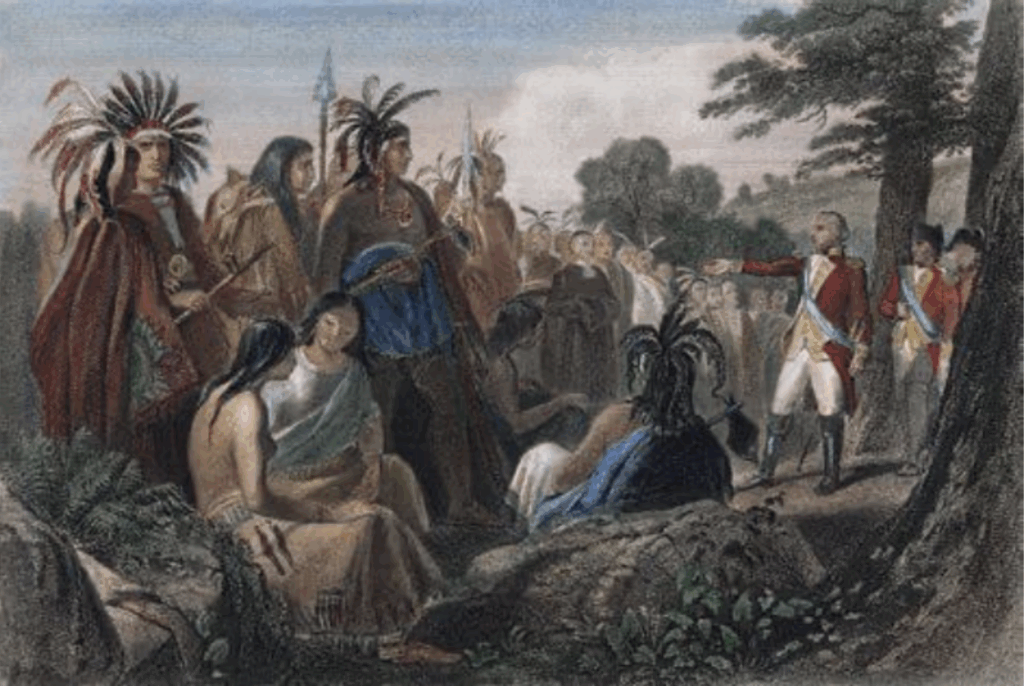
Writer Joseph Ellis opined that the biggest losers of the war were the Six Nations of the Iroquois, and the estimated 150,000 inhabitants of the eastern woodlands and Ohio Country. Fully aware that their land was at stake, most warriors allied with the British, but some served as scouts and soldiers for the Continental Army.
The producer/directors, Ken Burns, Sarah Botstein, and David Schmidt, characterized the Continental Army as starved, frozen, disease-ridden poor immigrants who were cheated out of their pay. They reported that twenty percent of some units deserted and a few lost half their men. Mutinies were suppressed, some brutally. The Canadian incursion and the winter at Valley Forge wreaked unspeakable hardships on the recruits.
“Let us have a respectable army, such as will be competent to every exigency,” — George Washington
A respectable army was not what Washington got.
Peter Coyote announced that the Continental Army was made up predominantly of the poorest of the poor, jobless laborers and landless tenants, second and third sons without hope of an inheritance, debtors and British deserters, indentured servants and apprentices, felons hoping to win pardons for their service, immigrants from Ireland and immigrants from Germany or their descendants who had never learned English.
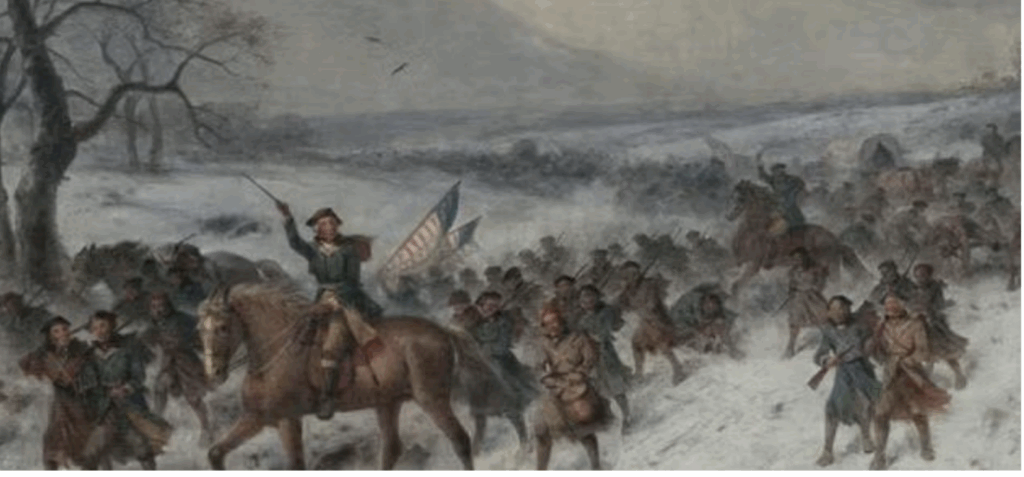
Another revisionist insight of the documentary is that the revolution was also “a savage civil war that pitted brother against brother, neighbor against neighbor, American against American, killing tens of thousands of them.
Partisan guerilla warfare between Patriot militia and Loyalist irregulars accounted for nearly one-fifth of all the battlefield deaths suffered during the entire war and almost one-third of all casualties came at the hands of other Americans.
The bloodiest infighting occurred in South Carolina. In one incident, 1500 mounted infantry made up of Loyalists from Pennsylvania and New Jersey massacred 380 Virginia Continentals at Camden, South Carolina, who had been sent to help defend Charleston.
The leader of the green-coated Loyalist dragoons, Banastre Tarleton, had his horse shot out from under him during the assault on the Virginians, temporarily trapping him under his horse. His men thought he’d been killed and sought revenge by slaughtering the surrendering Virginians.
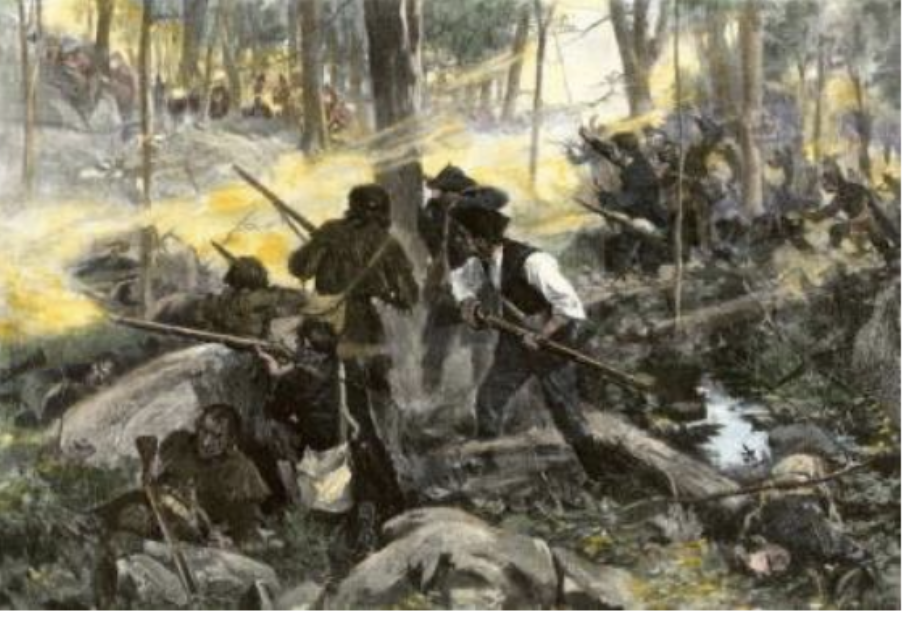
But for all its revisionist social commentary, the documentary will not disappoint military history devotees. It’s focused primarily on the major battles of the eight-year-long war that it illustrated with maps, diagrams, stunning photographs, historical paintings, imaginative illustrations, and re-enactments, analyzing the reasons for victory or defeat without prejudice to either side.
As a television program, “The American Revolution” is unparalleled in its cinematic beauty and engrossing storytelling. Praised for its exhaustive research, soulful music, compelling, many-voiced narrative, and common man perspective, the genius of “The American Revolution is its transformation of academic history into high drama. As a historical documentary, it’s invaluable for debunking popular mythologies. As a reminder of the tenuousness of constitutional democracy, it’s remarkably timely.
***
(“The American Revolution” can be purchased on DVD and Blu-ray and is available to stream with the PBS app. A 581-page companion book is available from PBS and in bookstores.)
