
By JAN McLAUGHLIN
BG Independent News
It’s not often that people are awarded for arguing.
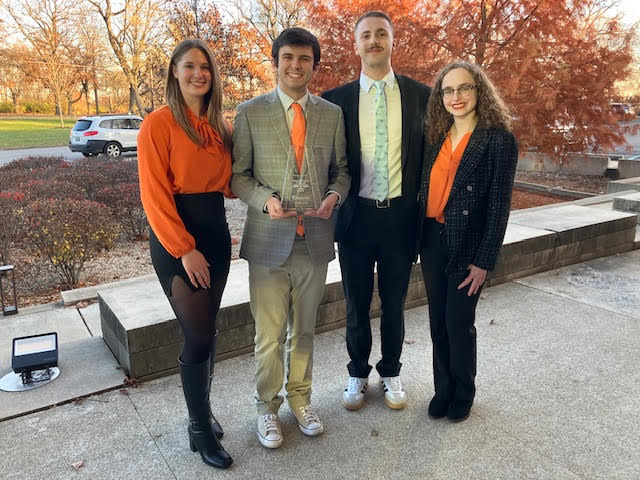
But a team of Bowling Green State University students – particularly adept at wrangling words – recently brought home first place in the Central States Ethics Bowl Competition.
The top team, coached by BGSU philosophy professor Ian Young, is made up of Isabella Folio, Kayleigh Kordish, Carson Snyder and Andrew Young.
“They all enjoy arguing about things,” Ian Young said.
In March, the BGSU team will be taking its verbal sparring skills to the national ethics bowl in St. Louis.
For anyone who has not watched skilled debates, Young described it as more than just wars of words. Months ahead of the competitions, teams are given 15 or so scenarios of ethical dilemmas.
“There’s plenty out there,” he said about ethical issues in the U.S. and beyond.
Some case examples from this past regional event at Marian University in Indianapolis included:
- A Michigan community with a large Muslim population banned LGBTQ+ flags from being flown on city property. “When is it justified to ban a flag that people find offensive?” Young said.
- SNAP payments are reportedly used by some to buy unhealthy items like processed foods and sodas. Is it defensible to have strict standards on what type of foods can be purchased with the SNAP benefits?
- The Taliban regime in Afghanistan is far from democratic ideals, but its people are very poor and dependent on assistance from the U.S. “Is it justifiable to cut aid?” Young asked.
“One of the tricky things is they don’t tell you the exact question,” he said. “So you’ve got to study up on all of them.”
At the beginning of the bowl, the first team pulls an issue out of an envelope and is given a few minutes to devise a philosophical and logical argument supporting one side. Then the opposing team is given a few minutes to develop its critique.
Once one issue is completed, the team switches roles for the next ethical dilemma.
“It can be very nerve wracking for them,” Young said.
Leading up to the bowl competitions, the teams have weekly practices, fine-tuning the main moral issues involved, he said.
BGSU’s two teams practiced by competing against each other, plus holding skirmish matches with the University of Findlay and Ohio North University teams.
“I think that really helped the teams,” Young said.
When splitting up the seven BGSU students to create two teams, Young faced his own dilemma. Should he pair some of the experienced debaters with the novices, or put all the practiced debaters on one team?
“I decided to give it our best shot to win the competition,” he said. So the four seasoned debaters were on one team and the three newbies were on the other. “Like a varsity and JV team.”
The strategy paid off. “They worked really well together as a team,” Young said of Folio, Kordish, Snyder and Young.
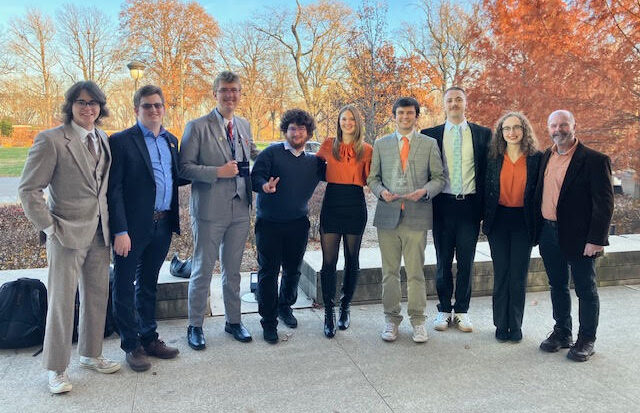
The JV team included Braden Munson, Miles Krygielski and Aidan Minch. Also attending was assistant coach Nik King.
Ian Young has been coaching ethics bowl teams since 2008, with his teams qualifying for nationals three times. But this is the first time they will be heading to nationals after securing the top regional spot. That competition will pit 20 to 30 teams against each other.
Ethics bowls got their start nearly 40 years ago by a professor at the Illinois Institute of Technology, who was confident students were grasping the latest technology, but “he was concerned they weren’t thinking of the ethics of it,” Young said.
Oftentimes teams are made up of a majority of philosophy majors, but BGSU’s team is quite eclectic. The top team consists of majors in political science, criminal justice, creative writing and aviation studies.
“I’m quite proud of the fact we have a broad background of students,” Young said. After all, the most important quality is the power to parlay. “It’s for someone who enjoys arguments about things – always debating.”
