
By JAN McLAUGHLIN
BG Independent News
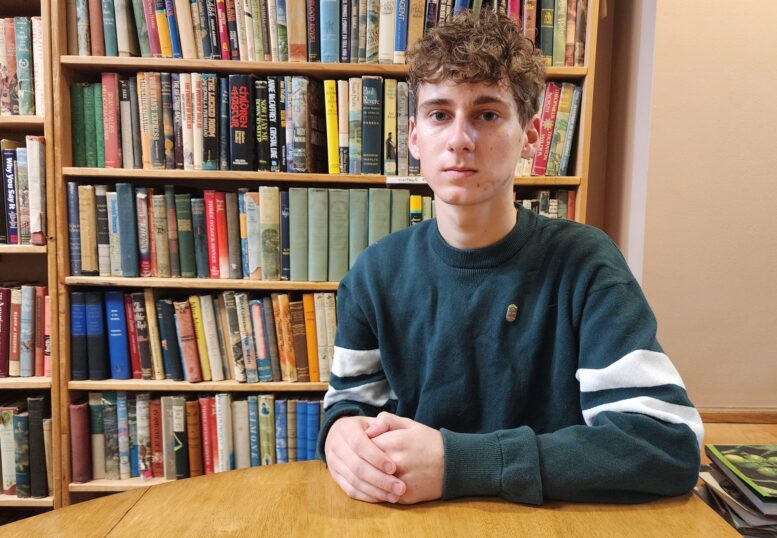
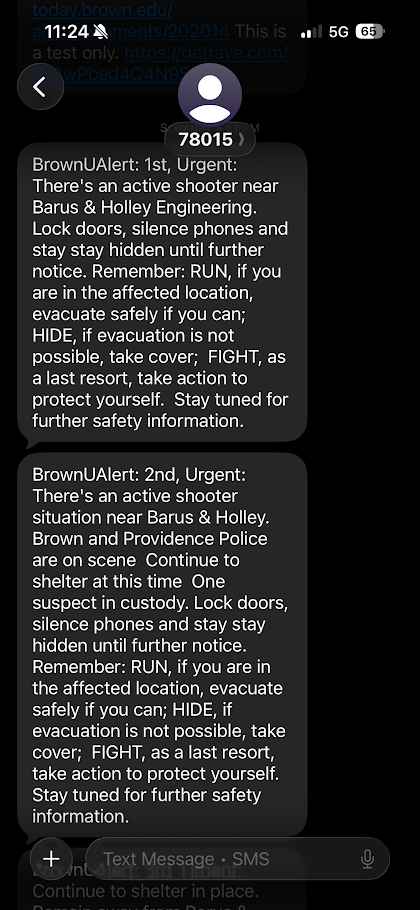
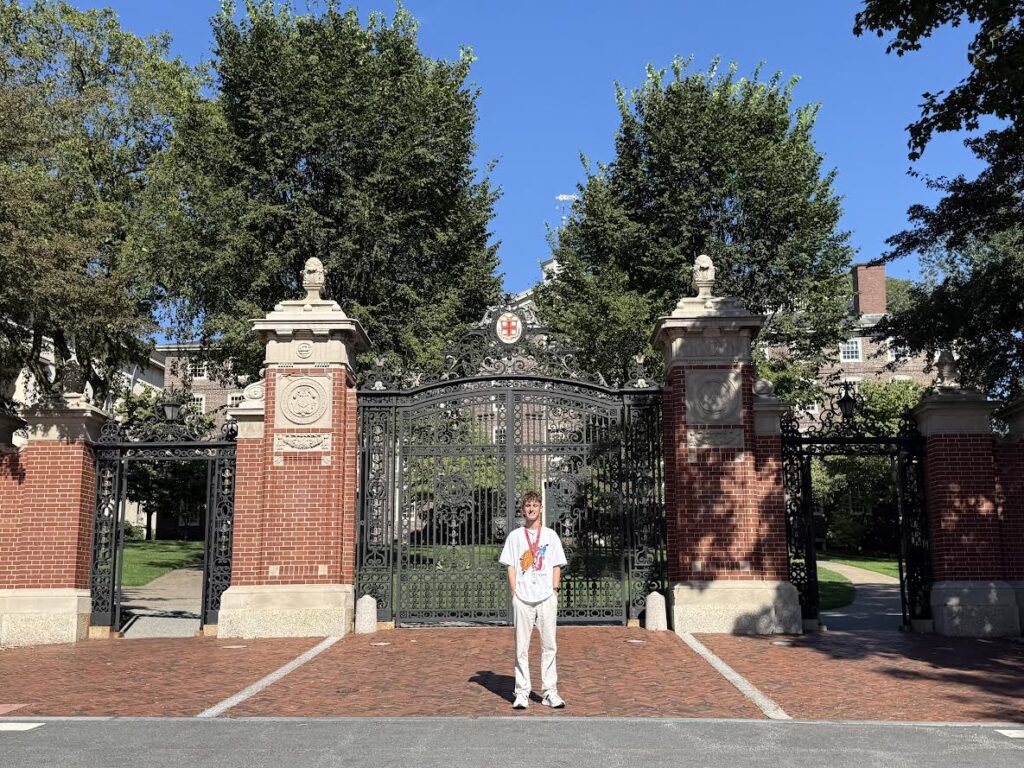
Sam Challu was on his way to study with a friend Saturday at Brown University when he got a text.
“She was in that building waiting for me when she heard shots,” Challu said Wednesday morning, back in his hometown of Bowling Green.
That text was the beginning of several hours spent barricaded in a room – waiting for word about what had happened, where it was safe to be, and whether or not the shooter had been apprehended.
Challu knew some steps to take from the active shooter drills at Bowling Green Middle School and High School.
So for the next two hours, he and up to 10 people barricaded themselves into a dorm room of someone he didn’t know. They blocked the door, turned off the lights, stayed away from the windows, and tried to be quiet.
Challu, a 2025 graduate of BGHS, was able to find some comfort in the knowledge gained during mass shooting drills at school back in Bowling Green. But students from other nations were not prepared. “There were a lot of international students who hadn’t been trained,” he said.
At some point, Challu moved to a friend’s room, where he and four other students stayed until about 4:30 Sunday morning. During that time, he was able to communicate with his family back in Bowling Green.
“We were safe in hindsight. But we didn’t know if the shooter would come back,” he said.
The police escorted him to his dorm, where Challu and a friend were able to get Uber transportation to the airport. “We took the first flight out,” he said.
Five days later, the Brown University campus and the Providence, Rhode Island, community are still waiting for answers to some of those early questions. The shooter is still at large, and security measures on campus are being scrutinized.
But the facts are that two students were killed – MukhammadAziz Umurzokov, who lived in the same dormitory as Challu, and Ella Cook. Nine people were injured. And the Ivy League campus and surrounding community are shaken.
The shootings took place during a pre-finals study session for an introductory economics course – a course Challu is signed up to take next semester. Umurzokov wasn’t a member of the class, but was attending the study session to help a friend, Challu said.
“Seeing someone like him taken away from us,” is difficult for Challu to digest. “It could have been any of us.”
Umurzokov, an 18-year-old freshman from Brandermill, Virginia, decided at a young age that he wanted to go into medicine. He made up his mind after suffering a neurological condition that required him to undergo surgery as a child and having to wear a back brace due to scoliosis. With a double-major in biochemistry and neuroscience, he hoped to go to medical school.
Cook, a 19-year-old sophomore from Mountain Brook, Alabama, was an accomplished pianist who was studying French, math and economics at Brown, where she also served as vice president of the college Republicans.
Challu, home now for Christmas break, is determined to make use of his time away from school to talk about the inadequate response in America to mass shootings. He is frustrated that the solution to mass shootings in the U.S. is always adding more security. While security is important, it usually reacts to shootings rather than prevents them.
“The solution isn’t to have better responses,” he said. “I find that very disappointing.”
The fact that the U.S. has more mass shootings annually than there are days of the year ought to be eye-opening. As of Dec. 14, the U.S. had 391 mass shootings, with 75 of those attacks being at schools.
Challu reflected on the fact that if the nation lowered its flags at half staff for every mass shooting, the flags would never be at full staff.
He noted that despite the recent mass shooting in Australia, the bold gun reform taken decades ago in that country has drastically limited shootings to a tiny fraction of those occurring with frequency in the U.S.
“That speaks volumes to the priorities in Australia. It demonstrates a desire for public safety,” he said.
The response to gun reform in the U.S. is usually met with caution about reacting with emotion after mass shootings. “We’ll worry about that at some point,” is the typical response, he said.
But Challu said now is the time to act.
He stressed the importance of Brown students talking publicly to “burst the bubble” of safety at schools when shootings are so commonplace. “We don’t react to things unless they start to affect us. This is a struggle we’ve been drawn into.”
Challu said he now has a duty to work toward reform.
“This is a struggle I want to carry for many people that may not have a platform,” he said. “I want to channel what I’m feeling into something meaningful. We want this to change, but we’re not seeing that from our legislators.”
“My sense of security was shaken,” he said, adding that Bowling Green is a good place to reflect. “I do appreciate being here.”
One of the reasons Challu chose to go to Brown University was the emphasis on collaborative learning and community interaction on campus. He worries that the shooting may change those qualities.
“We were a place for the community as well as the students,” said Challu, who is majoring in international public affairs and economics. “I think that might be something impacted in the future.”
Unlike most Ivy League institutions, Brown students aren’t isolated from their surrounding community. The university allows the public to take classes, and encourages students to connect with their community.
“I would be very surprised if that doesn’t retract significantly,” as openness is sacrificed for security, Challu said.
When classes start up again in mid-January, Challu plans to return to Brown.
“I want to remain a part of that community,” he said.
