

By JULIE CARLE
BG Independent News
Rebecca Ferguson and Martha Mazzarella didn’t let a little cold or the smell of “penguin poo” keep them from exploring one of the least-visited continents on Earth.
Their December trip to Antarctica for the two Bowling Green women was nothing but awe-inspiring and hope-inducing.
Mazzarella’s travels have taken her to Africa five times, Peru, Thailand, China, Japan, Taiwan, all of Europe and now Antarctica. Australia is the only continent remaining she needs to visit to complete the seven-continent bucket list.
After visits to China, England, Wales, Ireland, France, Spain, Greece, Italy, Argentina and now Antarctica, Ferguson’s seven-continent bucket list is down to Africa and Australia.
The two Bowling Green women had never traveled together before this trip. During an event they both attended at the BGSU President’s house, Mazzarella’s husband, Roger, mentioned that Martha couldn’t find anyone to go to Antarctica with her. Ferguson piped up that she would love to go.
That chance conversation turned into a trip of a lifetime and a newfound friendship.
At 67 and 78 years old, respectively, Ferguson and Mazzarella didn’t miss a day of the excursions off the boat that included Fort Point, Mikkelsen Harbor, Fournier Bay, Gourdier Island, Recess Cove, Brown Station and Danco Island.
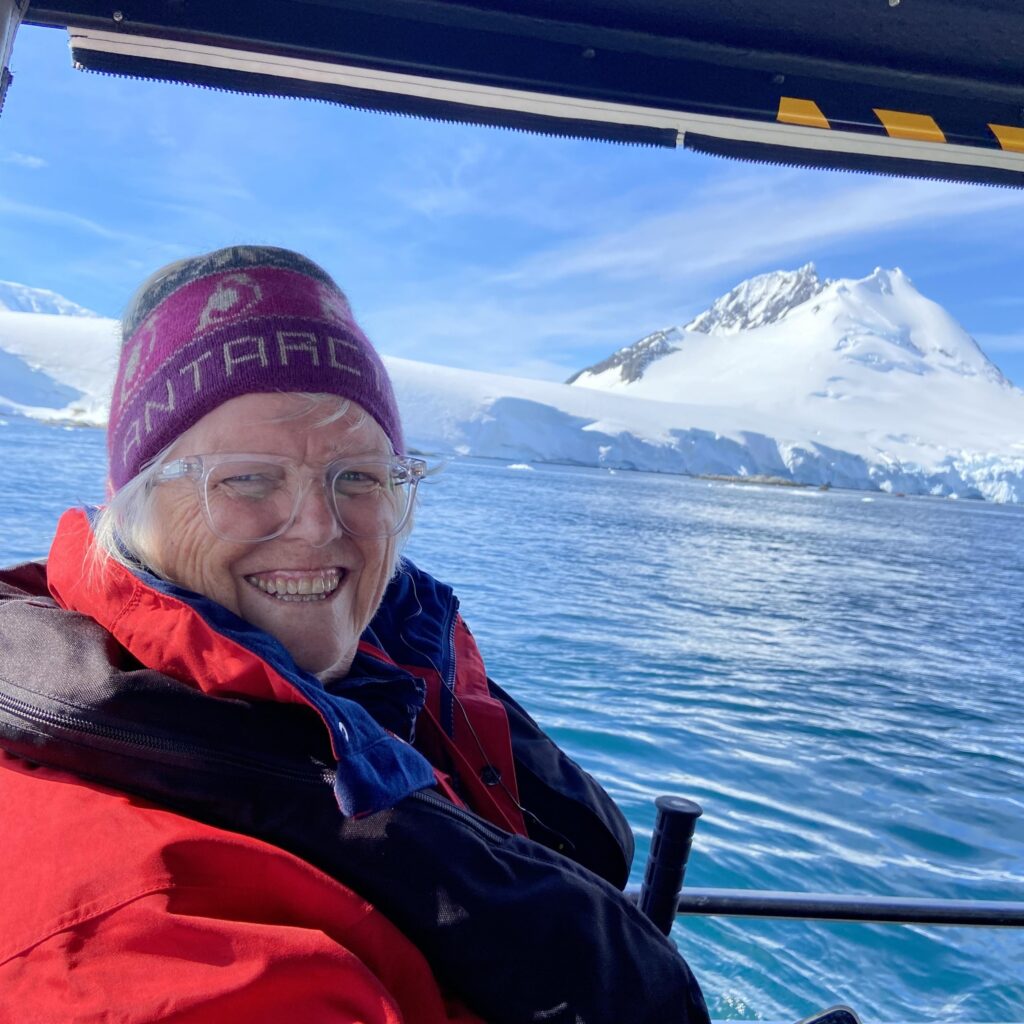
They were issued cumbersome, but necessary, heavy weatherproof pants, boots up to their knees, and heavy, red parkas for their daily excursions off the ship.
“It took an hour to get dressed,” Ferguson said. “And then you put this huge life preserver on and waddled down to the boat. It was really awful.”
“Everything else was wonderful,” Mazzarella added. “And I think both of us just fell down once. They gave us hiking poles,” for walking during the excursions.
“The gear was a hassle, but it was necessary for our protection and the safe and environmentally responsible protection of Antarctica’s wildlife and land,” Ferguson acknowledged.
Before they ventured onto the land, and once they got back to the boat, they were completely disinfected from head to toe.
Antarctica is governed by a treaty of nations, so there are strict rules when it comes to interfacing with the wildlife to make sure to keep it as pristine as possible.
“We had to follow strict disinfection procedures to prevent contamination,” she said. “They called it the perp search,” comparing it to the search done before individuals are booked into jail.
On land and from the boat, they witnessed an extraordinary amount of wildlife.
“Every day, we interacted with some kind of wildlife,” Ferguson said, including a record-breaking number of Orca whales on one day, seals, birds, and vast colonies of Gentoo, Chinstrap, and Adélie penguins.
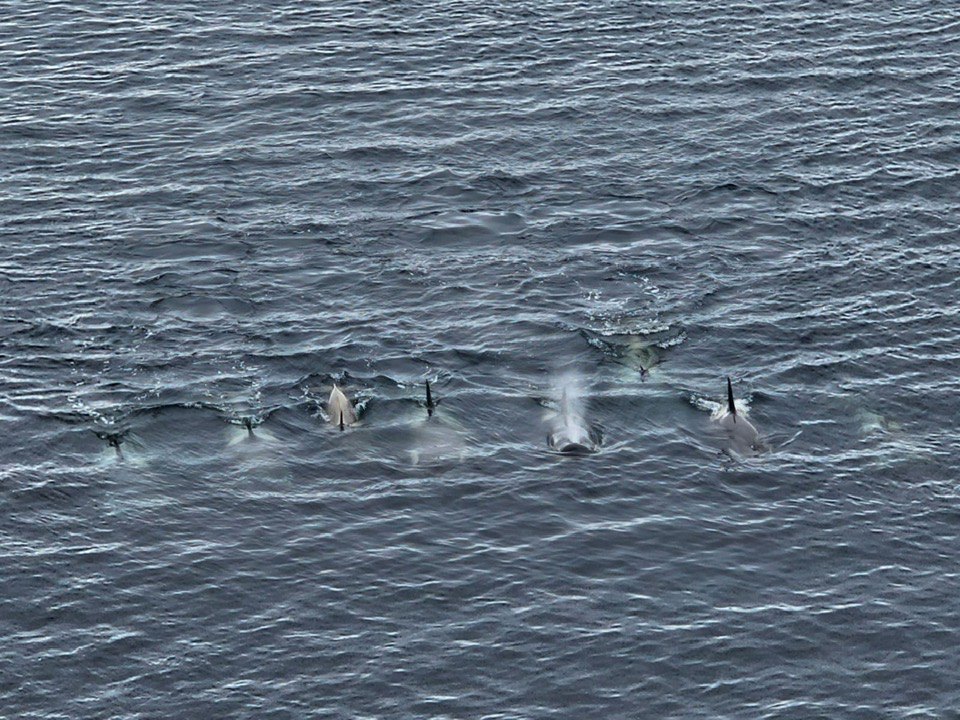
They sighted the large pod of whales while they were on the boat. Olivia Dellow, the expedition leader, reported it was the largest pod they had ever seen in that stretch of water.
“There were approximately 15 of them that were swimming in a line directly at the boat and went down right before they got to the bow of the boat,” she said.
“It was like magic,” Mazzarella added.
Between the hours of 10 a.m. and 8 p.m., the ship’s crew would alert passengers if they spotted something interesting.
“We’d hear a ‘bing-bong’ and an announcer would say, ‘Go to the front of the boat if you want to see… something interesting,” Ferguson said.
Everyone on board seemed to have similar reasons for being on the Antarctica expedition.
“We’re all interested in science,” Mazzarella said.
The ship is not strictly a tourist trip. 24 hours a day, seven days a week, the ship is providing research data to numerous research entities such as NASA and the University of Colorado. Information about the salinity of the water, the health of the populations is transmitted regularly.
A group of people from Oceanites were on the ship, whose purpose is to hand-count the number of penguins every season. They have been counting penguins at more than 250 Antarctica locations since 1994.
“They were allowed to walk among the penguins. We were not. We had to stay 15 feet away,” Ferguson said.
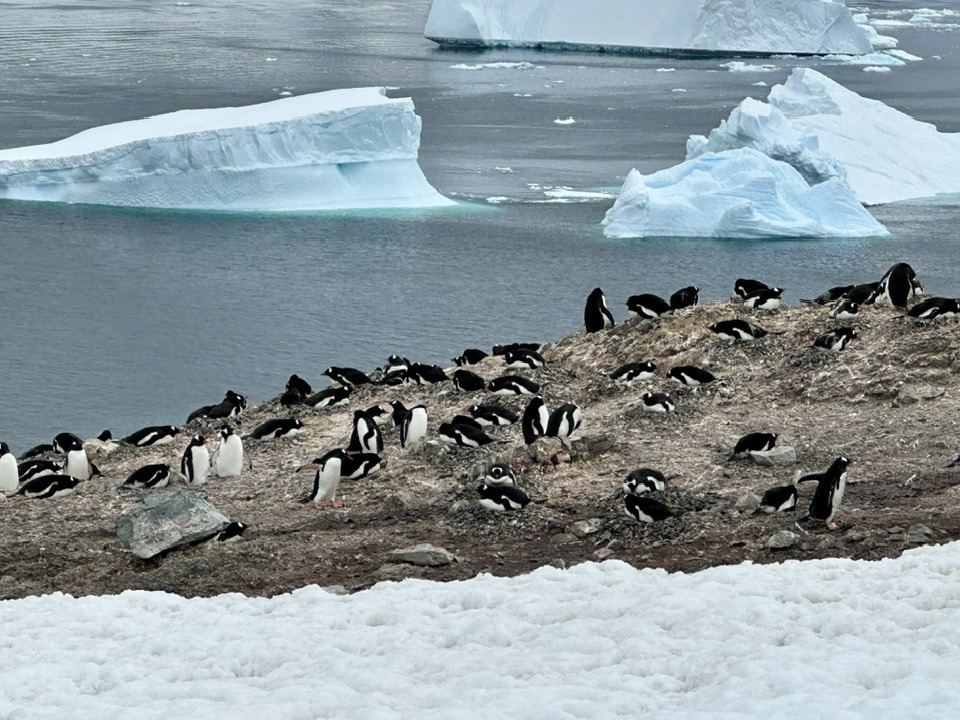
They saw mostly Gentoo and Chinstrap penguins, and some Adélie penguins. The Gentoo penguins are on the rise and the Chinstrap penguins are on the decline.
“They think it’s got to do with climate change, that the Gentoo penguins are just adapting quicker than the other two breeds,” she said. “It’s absolutely fascinating.”
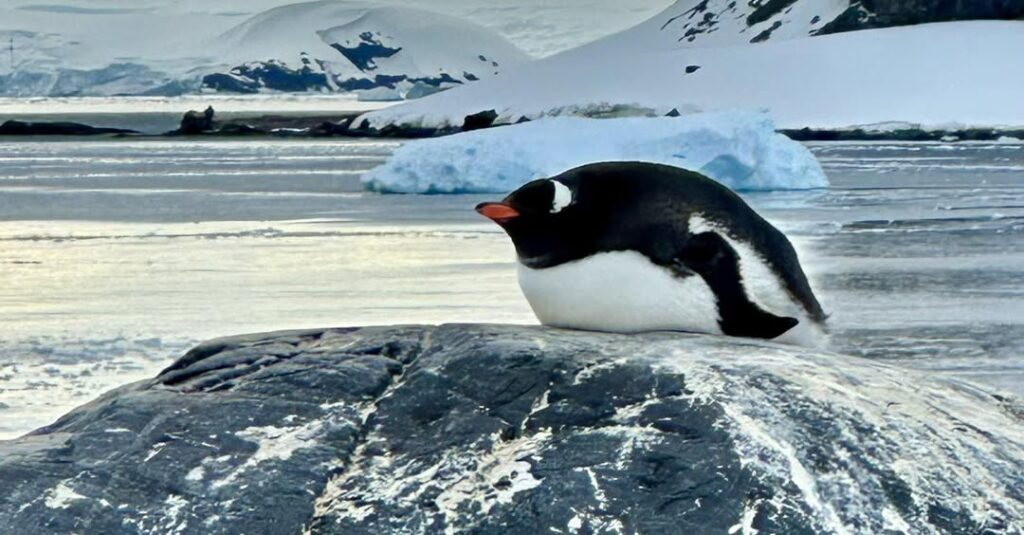
The penguins were very curious. “They would look at us and walk by, but we couldn’t touch the penguins or anything,” Mazzarella said. “They even had to cut the pom-pom off my hat so that it wouldn’t shed.”
One of the biggest threats to wildlife is nanoplastics, and fleece is one of the biggest culprits of leaving behind nanoplastics.
Ferguson and Mazzarella participated in a scientific research opportunity, collecting plankton and what plankton eat. “The krill eat the plankton, and then everything there eats the krill, so they test the health of the plankton.”
“They’re doing all kinds of research on how it’s showing up in the water, then the animals are living in the water and eating it. That leads to another, which leads to another. Andnow they’re clearly because we’re seeing it in mankind,” Ferguson said.
One of the biggest surprises was the warning that they would smell the penguins about the time they would see the penguins.”
“No, you smelled the penguin poo before we saw them,” Ferguson said. “The penguin poo smells like nothing you can imagine.”
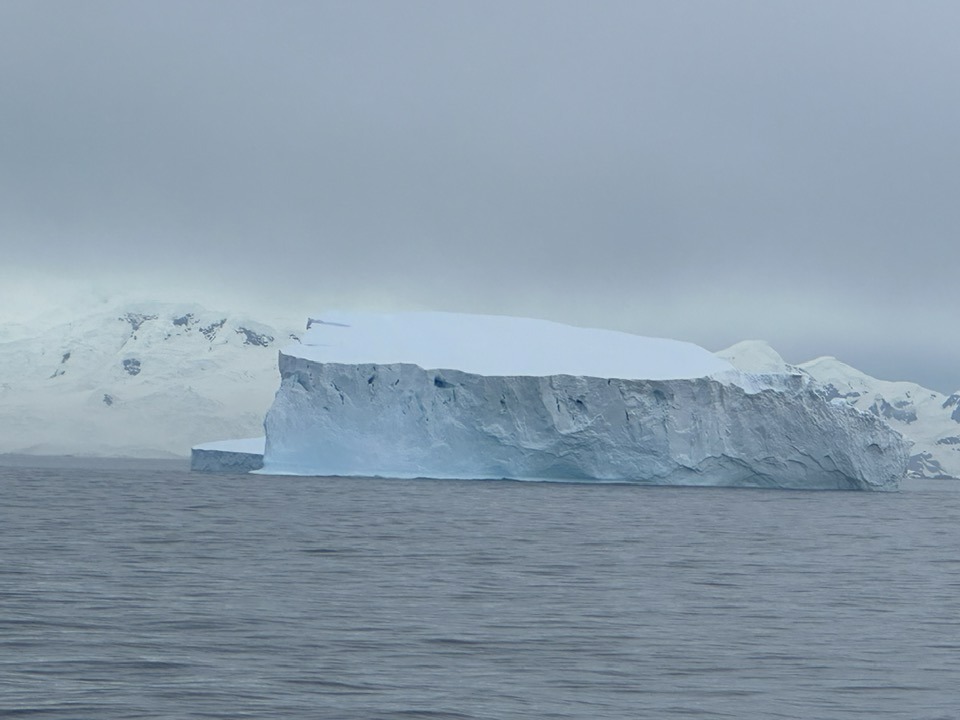
“I was fascinated by the vastness of the land and the blue icebergs,” she said.
One of the researchers pulled a small block of dimpled ice from the water that had fallen off an iceberg and explained that the dimples are caused by the bubbles coming off the bottom of the iceberg as it is melting.
“It’s just gorgeous,” Mazzarella said. “It’s the clearest piece of ice I’ve ever seen in my entire life.”

While the impact of climate change was visible, both women said the expedition left them feeling more hopeful.
“The icebergs are not melting as fast as the glaciers in the northern hemisphere, which I found absolutely fascinating,” Ferguson said. “We know that we’re all interrelated and interconnected, but to go there and actually see and photograph the beauty of the land and the wildlife is stunning and awe-inspiring.”
“Maybe we can see our way out of all this in another couple of centuries,” Mazzarella said. “It was hopeful and really amazing, the extent to which they were respectful of the continent.”

