By JAN McLAUGHLIN
BG Independent News
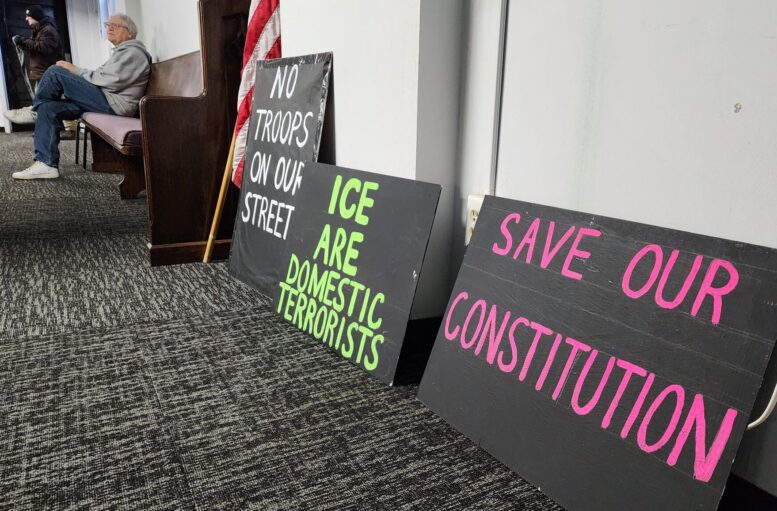
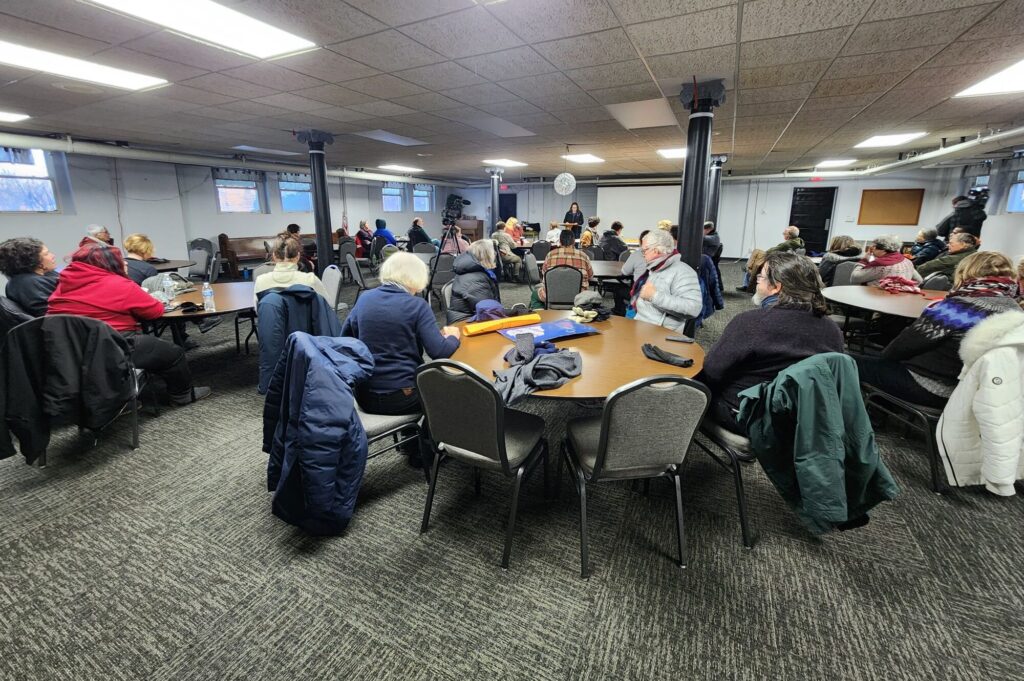
On Tuesday, the one-year anniversary of President Donald Trump’s second term in office, local residents gathered to hear how America has changed in 365 days.
They heard about the safety net disappearing for people in need, about reversals of environmental policies, about the loss of respect for America across the globe, and the fear of immigrants here legally.
Sandra De Steno, director of the United Way 211 program for this region, talked about the increase in people seeking help with necessities of food, shelter and utilities.
“They call when the fridge is empty and the power is off,” De Steno said.
Added restrictions to SNAP food benefits were enough to push people past their already stretched budgets. “When you’re living paycheck to paycheck,” it’s easy for folks to lose their footing.
Housing instability can lead to job loss, which leads to income loss, which can result in eviction. At the same time, Medicaid narrowed its eligibility, and many people are now priced out of health insurance, De Steno said.
Federal and state safety nets have become punitive policies, with stricter work requirements, and confusing layers of paperwork.
“Missed rent doesn’t wait for paperwork. Neither do utilities,” De Steno said.
Health and human services programs have been gutted, she said. Public health systems have lost funding, leading people to turn to hospital emergency departments, or ending up in jails.
“Our everyday people are paying the price,” De Steno said.
Meanwhile, non-profits are trying to fill the gaps. “211 will keep answering the phones,” she assured.
Joe DeMare, co-chair of the Wood County Green Party, talked about the environmental damage created with the federal government’s opposition to past protection policies.
“This year of Trump has been a disaster for the environment,” he said.
On his first day in office, Trump issued several executive orders attacking the environment – many which were illegal since the policies had been passed by Congress, DeMare said.
“It’s an attack on science itself,” he said, using the “big lie strategy” behind the theory that “global warming isn’t real.”
The administration has fought to ban offshore wind farm projects, and open the Arctic National Wildlife Refuge to oil drilling.
“It’s an insane energy policy,” focused on fossil fuels, and isolating the U.S. from much of the world, DeMare said.
Kristie Foell, who has taught international studies at Bowling Green State University for 25 years, talked about the shift in U.S. influence in the world, and the damage it has caused for the nation’s reputation.
It began quickly with the gutting of USAID, which ended humanitarian and health aid to other countries. Foell pointed out how the program had benefitted the world and the U.S. – with every package delivered to other nations being printed with “from the American people.”
That good will is now gone, and the U.S. standing in the world has taken a nosedive. “It’s a knife to me,” she said.
Among the “tragic losses” has been the end of U.S. assistance to prevent AIDS in the world.
The U.S. standing as a world leader has been greatly damaged, with Trump pulling out of 66 international organizations, Foell said.
Trade relations have plunged. And Americans are acknowledging the “big lie” that tariffs will bring back manufacturing and jobs to the U.S., she said.
“No sane businessman is going to make that investment.”
Instead, the former trading partners with the U.S. are now finding new trade partners. Despite Trump’s threats to other nations, “the rest of the world will be fine without us,” Foell said.
Several other Trump policies are shaking the bedrock of what the U.S. stood for in the past. As for Greenland, “do we respect the sovereignty of other counties?” In Venezuela, it is unclear of the targeted goal of oil or democracy. And the discontinuation of the U.S. asylum program – a promise to the world that America will offer safety to those oppressed. “That took my breath away,” Foell said.
And Lucia Myers, executive director of LaConexion of Wood County, talked about the fear in the immigrant community as ICE intensifies its tactics to round up people regardless of their citizenship.
LaConexion offers support to immigrant families to fill the gaps created by program cuts and rapidly changing rules. The organization links people to legal aid and mental health support.
Many local immigrant families are afraid to seek help that is available, since it could lead to encounters with ICE, according to Myers. Several families have disengaged from schools and health care out of fear.
“We see this everyday,” Myers said.
Myers shared some needs of the local LaConexion program, for financial donations, youth tutoring volunteers and adult English language aides, and transportation to education programming.