By TOM GERROW
BG Independent News
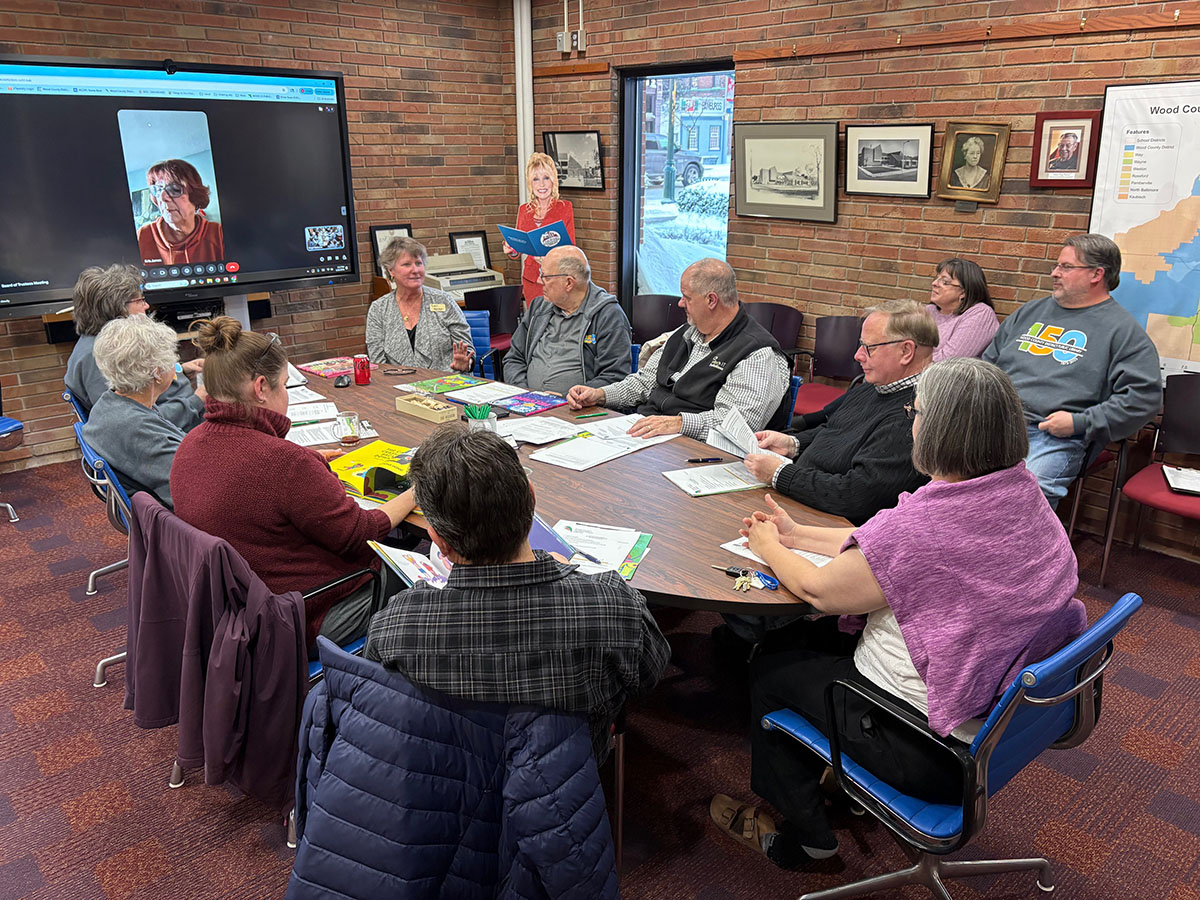
Gifts are always welcome, especially when they provide vital support. At the first meeting of the New Year for the Wood County District Public Library’s board of trustees, the board members had the opportunity to review and accept many of them on Jan. 26.
“One of the specific functions of the board of trustees specified in the Ohio Revised Code is the board is required to accept all gifts,” said Michael Penrod, library director, noting that some library boards do this monthly, but that the WCDPL’s long-term practice has been to do one blanket gift approval.
The board reviewed both monetary gifts to the general fund, which totaled $225,373.42 and included $211,991 from the WCDPL Foundation, as well as a number of in-kind donations from area businesses and local patrons. Another $1,278 in interest accrued from a trust fund established by the Wood County Genealogical Society was also transferred to the WCDPL.
“A lot of people help us in very many diverse ways throughout the year,” Penrod said. “And that is a huge amount of community support.”
“In addition to this, we have three small estate gifts that came directly to the library that we spend down,” he said.
This past year, the library spent $37,000 from the estate of Elfreda Rusher to buy books. The estate of Julia Rentz provided about $2,050 for various adult programs, particularly supporting the author visit of Paterson Joseph in the spring. And from the estate gift of Audrey Rentz, which is designated to support materials on women’s history and investing resources, $3,803 was spent to subscribe to the Value Line print subscription ($1,300 a year), the Value Line database ($2,300 a year) and to buy some books. o
“The local investment clubs can get access to Value Line remotely thanks to the gift from Audrey Rentz,” Penrod said.
“When you add that all together, that was about 9 percent of our expenses for this last year,” he said. “It accounts for about 35 percent of our materials purchases. Private philanthropy is making a big difference.”
Ken Frisch, board president, noted that though the estate gifts have had an impact, the board also needs to look to the future. “We’ve been utilizing those gifts over the last few years, but there will be a point when those will be exhausted,” he said. “Replacing those additional dollars through other sources will be an important part of our budget.”
“But we’re going to continue to hear throughout the year, and I think going forward for many years, the key role that private philanthropy is going to play in terms of addressing things that certainly started in our materials, but it has expanded greatly,” Frisch said. “You can see it in our programming, our speaker series, and many other things that are being done.”
The board of trustees voted unanimously to accept all the gifts.
Penrod also informed the board about public library circulation trends at the national level and at the WCDPL. He referenced a 2024 article by Tim Coates, “The Quiet Crisis Facing U.S. Public Libraries,” which reported that physical circulations at public libraries were down about 40 percent from 2010 to 2022. Library visits nationally were also declining, falling by nearly half over the last decade. In the article, Coates contended that this drop was primarily due to libraries’ shrinking print book collections.
“For a couple of years now, Michelle (Raine, deputy director) and I have been talking about how we need to double down on print books,” Penrod said.
Penrod pointed out that changes in technology have certainly been a factor, with digital collections making up an ever-increasing share of library resources. Digital items borrowed from 2010 to 2025 increased by 9,511 percent.
“In 2010, we checked out 2,101 eBooks and other items. In 2025, 201,930 digital items,” he said. “That’s e-books, e-audiobooks, streaming video, and music. When Michelle and I have looked at these statistics of what is being used each month, it’s consistently 80 percent of our digital use is for e-books or e-audiobooks.”
Circulation of physical items at the WCDPL has declined, but not as precipitously as at the national level. For print books, and books, movies and music on disc, 2010 saw 511,832 items borrowed. In 2025, that number was 440,401 – a decline of 14 percent. For print books in particular, the decline in usage was just 3.6 percent.
Combining total digital and physical circulation, 2010 saw 513,933 items borrowed, and 2025 saw 642,331 items borrowed – an increase of 25 percent.
“We are a community of readers,” Penrod noted.
The decline in national public library usage was concerning to board member Brian Paskvan, who wondered whether other public libraries were hearing the message about focusing on their print book collections to forestall declining usage rates.
“Are people listening to this?” Paskvan asked. “Because there’s a ripple effect here. If we’re not buying the books, more Baker & Taylor’s are on the horizon.”
Baker & Taylor was a book distributor that served libraries and schools, and it ceased operations in 2025. WCDPL had used Baker & Taylor in the recent past, but had migrated to Ingram, another distributor, prior to Baker & Taylor’s cessation of operations.
“And as that shrinks, then our ability to get materials is going to be impacted,” Paskvan said. “We’re going to just be in a vicious cycle. And then cost and everything else is going to go crazy out there.”
“It makes me very nervous to see what’s going on in this industry,” Paskvan said. “Because those were pretty ugly statistics in my estimation, and I was really glad to see that we’re not following that trend.”
Penrod noted that the WCDPL dedicates 15 percent of its budget to new materials, compared to the national average of 10 percent, which helps the library meet local reading demands.
Penrod also reported that Hylant, which provides property insurance to the WCDPL, recently performed an insurance risk analysis. The analysis produced no recommendations or actions required to reduce risk.