By JULIE CARLE
BG Independent News
President Donald Trump saw the world taking advantage of the United States’ power, finances and military strength. His solution was to impose tariffs in an effort to level the global playing field.
Trump is “extoling the wisdom of President William McKinley’s high-tariff regime from the beginning of the 20th century,” Dr. Douglas Forsyth, associate professor of history at Bowling Green State University, said during the third Great Decisions talk on Saturday at the Wood County Senior Center.
Yet Forsyth questioned, “Why has he jettisoned the U.S. commitment to open trade that has been a constant of U.S. government policy since the era of Franklin Delano Roosevelt and Cordell Hull, his Secretary of State?”
Trump’s claim that the U.S. was being taken advantage of by other nations doesn’t hold true when looking at economic data, Forsyth said. The U.S. maintained the world’s largest Gross Domestic Product, the total monetary value of all final goods and services produced within the country.
The United States has one quarter of world GDP, followed by China at 19 percent.
“Allegedly, the country that constitutes a quarter of the whole GDP is being taken advantage of by the others,” he said. “Not only does the United States have the top spot, but six of the next nine countries belong to the nations that were closely aligned with the United States.”
The administration’s universal application of tariffs against allies and competitors alike was a “strategic failure” that is “based on a flawed understanding of the global economy,” Forsyth said.
Trump’s obsession with the merchandise trade deficit contributed to his decision to place tariffs on allies and competitors. His perspective was “misguided because it ignored the significant value of American service exports,” he said.
From World War I until the Reagan era, the United States had the largest net financial creditor position in the world economy. Since then, it has become the world’s largest debtor, a position it also held prior to World War I before it flipped to become the top creditor.
The U.S. trade deficit at nearly $1 trillion, in 2024 was the largest negative balance among the 10 largest economies, according to the figures from the World Bank. India was in second place with $100 billion. Japan, with a $42 billion trade deficit, and Britain with a $32 billion trade deficit were in third and fourth place, respectively.
Oppositely, in 2025, China had a trade surplus of nearly $1 trillion, “or about as large as the American trade deficit,” Forsyth said. Germany was in second place in trade surpluses with $179 billion and Russia, with $93 billion in trade surpluses ranked third.
Many economists believe trade deficits are aligned with large government budget deficits, Forsyth said. At the current level, the U.S. deficits are high and unsustainable.
“If the country runs trade deficits year after year, sooner or later, it’s going to get into trouble. It may have to borrow money or sell assets to make up the difference,” he explained. “At some point foreigners may become unwilling to acquire any more debt from a country with a huge structural trade deficit.”
The premise is that a cut to the budget deficit will reduce the trade deficit.
“Trump doesn’t care about the budget deficit, at least when he’s in office,” he said. When Democrats are in office, Republicans “agonize over the budget deficit and demand Draconian cuts in government spending.”
When Republicans regain office, “they cut taxes and spend like sailors,” he said. “Curing a government debt problem with tariffs is nutty.”
Forsyth admitted tariff revenues have increased dramatically since Trump’s liberation day last April, but the tariffs functioned as a regressive tax, disproportionately harming poorer Americans who spend a larger share of their income on consumption.
Research by Germany’s Kiel Institute and the Peterson Institute for International Economics found that U.S. consumers paid for the tariffs and that the policies would harm U.S. economic growth, resulting in higher prices and reduced wages.
“It’s going to be harder for future administrations to claw the tariffs back, given how hard it is to raise other kinds of taxes, especially taxes on rich people in this country, in this day and age,” he said. “This is our real problem. We no longer seem to be capable of taxing rich people.”
“I think you implied that the rich don’t pay their fair share, but I’ve read that the top 1% pay 40% of the taxes,” one attendee pointed out. “I think it’s fair that 40% of our taxes are paid by 1%.”
He also suggested that the top 1% ”that we are critical of,” are also providing jobs at the companies and factories that they own. “So, the rich people aren’t bad,” he said.
Forsyth responded that Warren Buffett once pointed out that his cleaning person paid a larger percentage of her income to taxes than Buffett. And Buffet thought that was unfair.
The other outcome of the administration’s trade war, which was waged “indiscriminately against the entire world” with steep tariffs placed on allies and competitors, had the counterproductive effect of isolating the U.S. and driving other nations closer to China.
Data on world manufacturing capacity showed China leading with 27.7% followed by the U.S. at 17%. A direct consequence of U.S. policy discussed throughout the talk was the strengthening of China’s strategic and economic position.
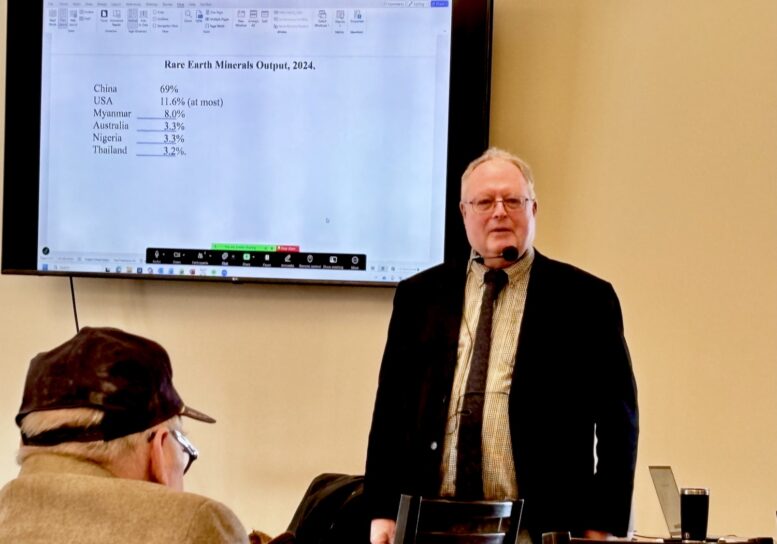
“The United States has already lost the trade war with China,” he said, because China “held better strategic cards,” in its near monopoly on the production of rare earth minerals, which are essential to advanced manufacturing.
China successfully used its control over rare earth materials as leverage against U.S. pressure on advanced chips.
At 69% of the world’s output of rare earth materials, China dominates. The U.S. falls in second at 11.6%, which explains China’s leverage in the trade war.
The rest of the world did not follow in Trump’s footsteps of imposing tariffs, but instead moved forward to create and strengthen multilateral trade agreements without the U.S.
“While the U.S. is becoming isolated, the rest of the world is trying to save multilateralism as much as possible. They are making new deals independently of the U.S.,” Forsyth said, concluding that America is being “left on the sidelines.”
As an academic historian, Forsyth said he is not prone to, or very good at, predicting the future, but he said the threat of diminished U.S. economic power, the loss of global leadership, and an increased risk of unmanageable financial crisis, “feels more immediate and tangible.”