By JAN McLAUGHLIN
BG Independent News
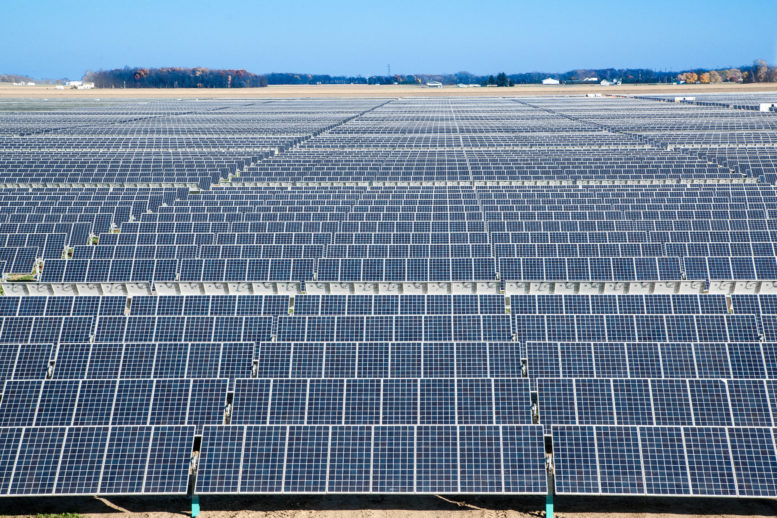
As Bowling Green’s four iconic wind turbines come down this year, approximately 80 acres of solar panels will go up to help power the city.
On Monday, the BG Board of Public Utilities voted to authorize the utilities director to lease land and select a solar development partner for the project which will operate behind the meter for the city. That means all the 10 to 12 MW of electricity generated on the acreage will go to Bowling Green – powering an estimated 2,000 households in the city.
The utilities board voted more than two years ago to authorize the city to pursue another solar field site, in addition to the 165-acre solar field on Carter Road that generates 20 MW, which the city shares with other communities.
Initially, city officials planned a possible solar field on acreage the city already owned near the county landfill. However, that plan fell apart when Plain Township officials passed an ordinance banning solar fields, explained Jim Odneal, the city’s assistant utilities director.
So the search began again, and this time some partners voiced interest in leasing farmland to the city for the project.
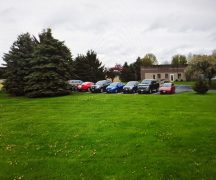
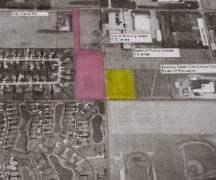
Those partners are Bowling Green State University, which plans to lease 50 to 60 acres for a solar field southwest of the Newton Road dead end at Interstate 75, and an affiliate of Principle Business Enterprises, which plans to lease 20 acres at the southeast corner of Devil’s Hole Road and I-75.
These properties are strategically located adjacent to the city’s electric distribution system, which helps minimize interconnection complexity and associated costs, Odneal said.
BGSU and Principle Business Enterprises will continue to own the land. The developer will own and operate the solar arrays, which will be purchased locally from First Solar. And the City of Bowling Green will buy all the power generated at the two fields. The cost is expected to range between 5 cents and 7 cents per kilowatt hour, Odneal said.
“This is very exciting,” said Board of Public Utilities President Andy Wagner. “I think this is fantastic.”
The new solar project is expected to help in managing system peak demand and reducing transmission and capacity costs, Odneal explained. And it is intended to replace the renewable energy previously supplied by the wind turbines, which accounted for approximately 4 MW of wind capacity prior to their retirement.
Construction is anticipated to occur in the fourth quarter of 2026, with a target in-service date in spring 2027.
City officials have worked with American Municipal Power, which helped facilitate discussions with experienced solar developers and provided preliminary market information. In addition, the city also engaged in discussions with a local solar developer to compare development approaches and validate indicative pricing.
Through this process, Eitri Foundry emerged as the preferred developer capable of working with municipal utilities on projects of this scale. Eitri is currently developing projects with AMP member communities including Bryan, Painesville, Deshler and Minster. They have completed similar projects with other municipal utilities, including Grafton, Wapakoneta, Carey and Montpelier.
Many solar projects marketed today operate under a “community solar” structure where individual customers buy or subscribe to a portion of the project’s output. While these models can work in certain markets, they often create uneven participation and may shift costs between participating and non-participating customers, Odneal said.
Bowling Green’s municipal utility operates to serve all customers equitably, he said. By developing solar generation as a system resource, the benefits of the project will be shared across the entire electric system. This approach avoids creating subscription programs that can result in cost shifting and eliminates the need for complex billing structures to track individual customer participation.
Instead, any operational or economic benefits from the solar resource – such as peak load reduction or portfolio diversification – support the utility system as a whole and help maintain stable and equitable electric rates for all customers, according to the city’s proposal.
Alternatively, customers who wish to support renewable energy today may participate in Rider C – EcoSmart Choice, which allows customers to voluntarily support renewable energy as part of their power supply through renewable energy attributes. Because this program already exists, there is no need to implement a separate community solar program.
This utility-scale approach reflects the core mission of the municipal utility: providing reliable and affordable service for the entire community, Odneal said.
The proposed solar generation project also supports several goals outlined in the City of Bowling Green’s Climate Action and Resiliency Improvement Plan. The CARIP identifies strategies for reducing community greenhouse gas emissions, strengthening local infrastructure, and improving long-term resilience to changing environmental and economic conditions.
The utilities board voted to allow the utilities director to:
• Select Eitri Foundry as the preferred solar development partner for the project.
• Negotiate and enter into land lease agreements with Bowling Green State University and The Principle Project Initiative for solar development, subject to legal review.
• Negotiate and execute a power purchase agreement and related development agreements necessary for the construction and operation of the solar facility, subject to legal review.
• Execute any additional agreements, easements, or development documents necessary to implement the project, subject to legal review.
This will allow the project to move forward while final engineering, permitting, and contractual details continue to be refined.
As for the wind turbines, the 10 governmental partners in that project will split the costs to dismantle the towering structures. BG Public Utilities and Infrastructure Director Brian O’Connell said the city has already collected its share of the costs through customer rates.
Though he did not know the specifics of how the turbines will be disposed of, O’Connell said it would be contracted to be in an EPA-approved manner.
Rooftop solar
During the last Bowling Green City Council meeting on March 16, three city residents expressed their opposition to the rooftop solar fee established by the BG Board of Public Utilities.
Prior to their comments, Council President Mark Hollenbaugh asked that citizens follow “rules of decorum” and refrain from making disparaging comments about others. City Council, he said, wants everyone to “speak their truth,” but do so civilly.
Former council member John Zanfardino encouraged council to consider action to remove the surcharge on city residents with rooftop solar. While rooftop solar systems are very expensive, Zanfardino noted that the city fee makes it even more difficult for residents to take the right steps for the environment.
Resident Jennifer Karches said that while she is proud of the city’s commitment to renewable energy, she believes it damages the city’s reputation to charge a fee that makes it difficult for the 10 or so households with rooftop solar to recoup their costs.
And Joe DeMare repeated his concerns about the surcharge preventing residents from installing rooftop solar.
City Attorney Hunter Brown said city rules give the power to set utility rates to the Board of Public Utilities. City Council taking over that authority would require council to become the city’s utility board.
O’Connell has explained that the fee is necessary to make sure other electric customers in the city aren’t paying for those who choose to install rooftop solar panels.
Solar customers pay a monthly facilities charge based on their system size. The electric rates in the city are based on customers buying their energy from the city. A smaller portion of the rates is based on fixed electric system costs for such items as meters, poles, wire, transformers, switches and linemen – items needed for all homes including those with rooftop solar, O’Connell has said.
“Those fixed costs don’t change just because someone decides to put rooftop solar on their home,” he said.
Without that fee being charged to homes with their own solar power, “the other customers are subsidizing their energy sales,” O’Connell said.
With the current policy, the average rooftop solar residence pays anywhere from $12 to $20 for the monthly fee.