
By GEOFF HOWES
BG Historic Preservation Commission
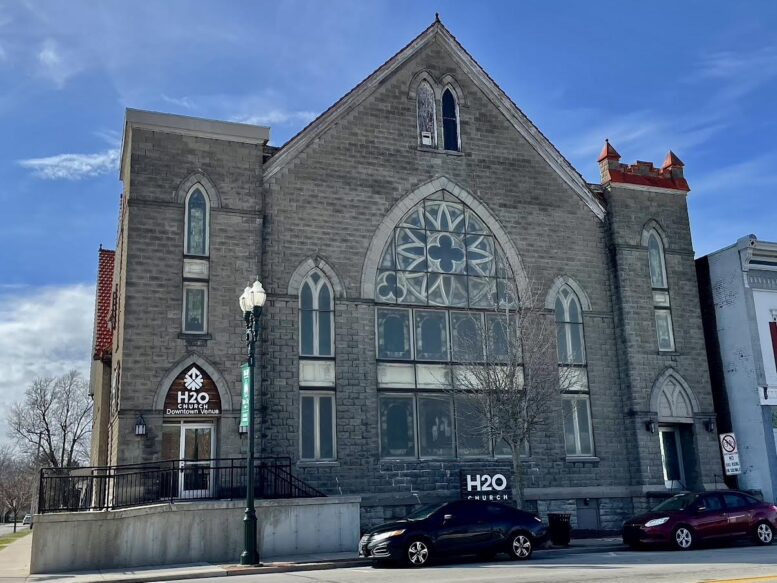
The Gothic Revival style church at 252 S. Main St., home to several different congregations over the last century, is the April Historic Building of the Month in Bowling Green.
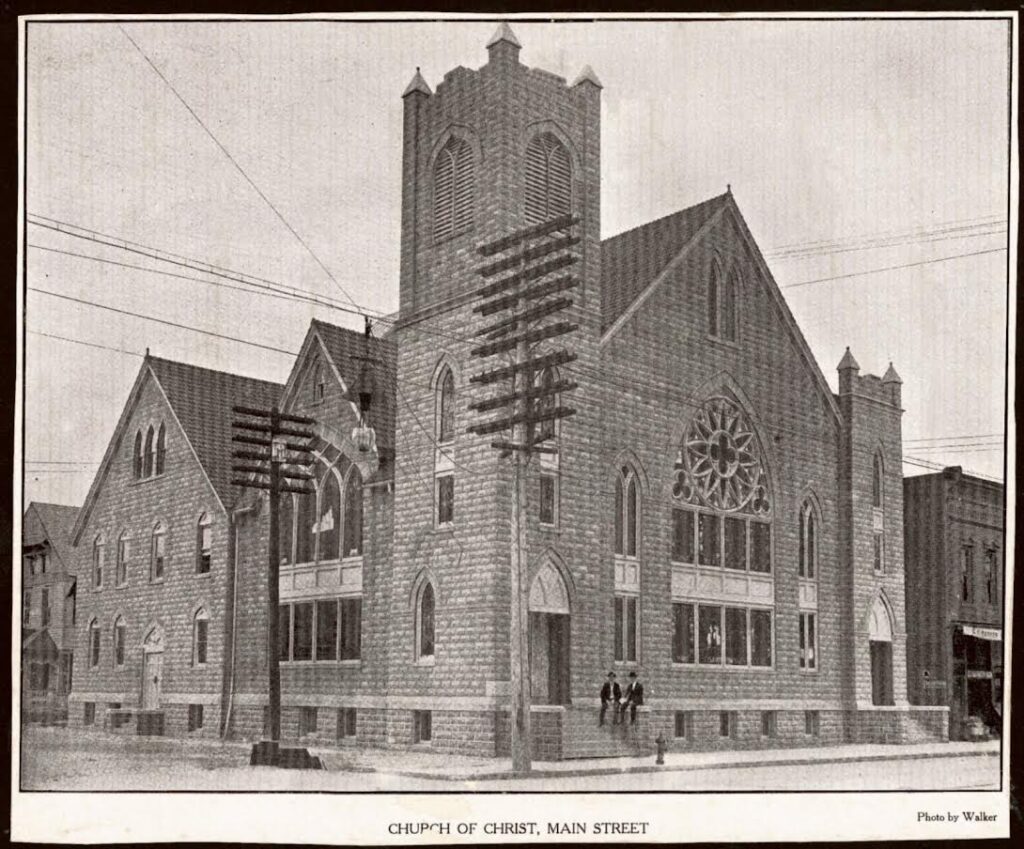
Readers of the front page of the Daily Sentinel Tribune for Friday, June 7, 1907, learned that the Church of Christ in Bowling Green would open its new building the next Sunday: “This structure, while little effort has been made to beauty, is one of the most convenient, commodious, and attractive houses of worship in this section of the state.” The reporter acknowledged the hard work done by Pastor Clyde Darsie and the building committee of Delascus Mercer, J. W. Knight, Fred Sharon, John Wood, and Robert Place.
That church, on the northwest corner of South Main and West Washington, now houses the Downtown Venue of H2O Church. Though at first glance it may seem to be built of stone, it is a frame structure with cement block veneer that imitates hewn stone. This allowed for quicker and less costly construction while ensuring the durability and stately appearance of masonry.
The style is Gothic Revival, as seen in the steeply pitched roof and pointed arches over two large stained-glass windows, three doors, and a number of smaller windows. The crenellated parapet and small turrets on the north tower are further Gothic features. The roof is made of terra cotta tiles with small finials at the peaks.
The absence of certain Gothic elements such as towering spires, an asymmetrical layout, and intricate masonry patterns may be due to economizing. It may also account for the reporter’s aside about the lack of beauty in this otherwise impressive church. It is a bit plain and boxy for Gothic Revival.
In 1846, on this site, the Methodist Society put up the first church ever built in Bowling Green. In 1868, the Methodists sold that frame structure to the Congregationalists, who rented it out to various denominations over the years.
After worshipping there with other religious groups, the local Church of Christ was organized in 1882 and chartered in 1883, under the Rev. J. V. Updike of Celina. The new congregation purchased the building and, after reroofing, repainting, and replacing doors and shutters, they formally opened their church on June 10, 1883.
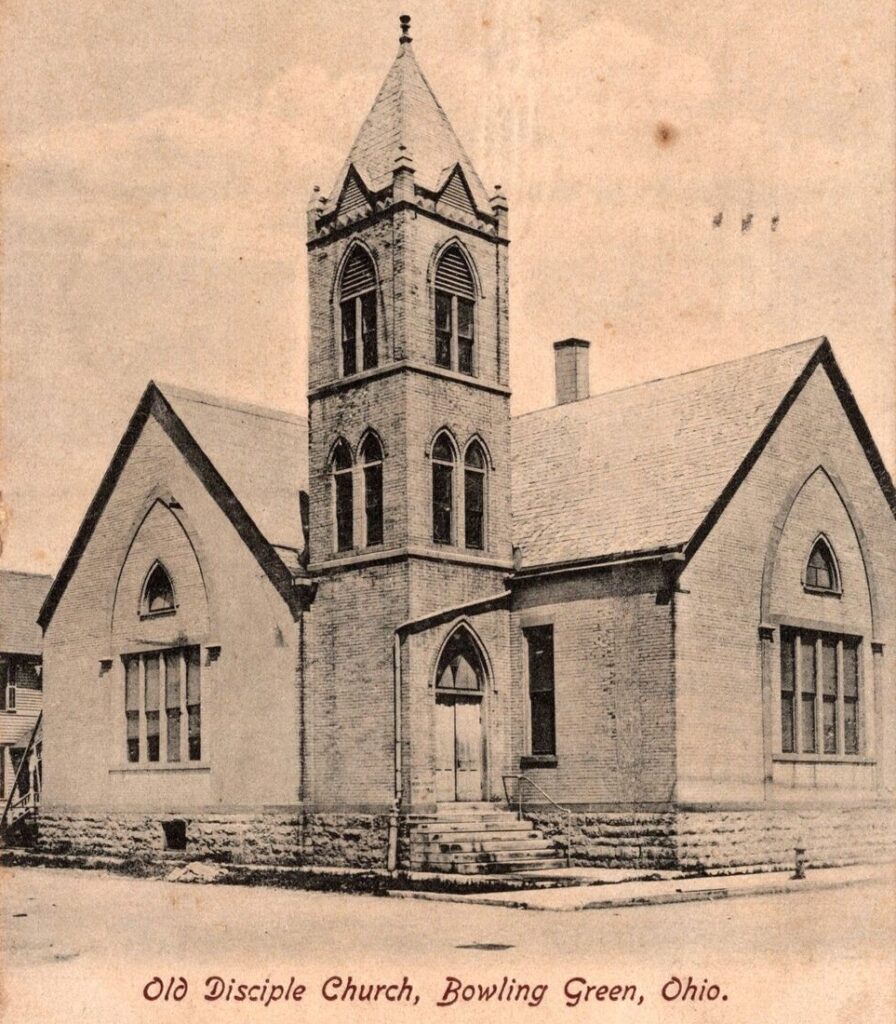
By the late 1880s, under its pastor Rev. Nathan Johnson, the congregation was growing and the frame church was proving too small. The church started raising money for a new brick building in the Gothic Revival style, with a single pointed steeple. Dedicated in 1890 and popularly known as “Disciple Church,” it was demolished in 1906 to make way for the 1907 building we know today.
It should be pointed out that the sign “Historic Churches,” installed by the Historic Preservation Commission on Wooster Green in 2024, mistakenly states that the present church was built in 1890. The sign committee drew on a source that attributes the date of the 1890 “Disciple Church” to the later building.
The 1907 church was built by contractor A. L. Oldham to accommodate the expanding congregation. The Sentinel-Tribune noted: “With the exception of the Methodist church, the building will admit the largest congregation in the city, the seating capacity being a thousand or more.” (That big Gothic Revival Methodist church, torn down in 1968, was on the northwest corner of North Prospect and East Wooster, where Circle K is now.)
When Rev. W. C. Prewitt was pastor (1916-1920), the recently revived Ladies Aid raised $4,850 (about $79,000 today) to fund a “long desired and needed pipe organ,” installed in 1920. In 1955, this organ was replaced by a Wurlitzer Electric, “trade-in cost, $3,700” (about $45,000 today).
In 1943, Rev. F. Elwynn Peace arrived from Virginia. Under his pastorate, the church began to call itself the First Christian Church (Disciples of Christ), a change that reflected a division that began in the early 20th century between more conservative and more liberal congregations of the Church of Christ.
The more liberal groups began referring to themselves as the First Christian Church (Disciples of Christ), while the conservative ones kept the name Church of Christ. This change took place gradually and locally over several decades. The investment in an organ in 1920 reflects the schism—the conservatives did not use musical instruments in their services, believing there was no precedent for it in the New Testament.
In 1955, the First Christian Church began raising money to remodel the building’s interior. J. Oliver Hallock was pastor and Ashel Bryan was chair of the finance committee. Classrooms, a nursery, and a fellowship hall were added. The sanctuary was reconfigured to seat 356 worshippers, and a 100-seat chapel was built. On Oct. 5, 1958, in honor of the congregation’s 76th year, board chairman Floyd LeGalley presented the renovated building to new pastor Jerry M. Sullivan for rededication.
The upper, bell-tower portion of the south tower shifted in the summer of 1970, endangering both churchgoers and passing pedestrians. The belfry was dismantled, which also removed Gothic parapets and turrets matching those on the north tower. While this work proceeded, church services were temporarily held in the high school cafeteria.
In 1971, the First Christian Church sold the building to Christ the Savior Evangelical Lutheran Church, a congregation led by Paul M. Lehenbauer, who had been pastor at Grace Lutheran Church in Weston. The First Christian Church shared the church with the Lutherans while building their new house of worship at Haskins and Poe, which was finished in 1974. They remain there to this day.
The King’s Way Christian Church formed in 1977 and first met at the United Christian Fellowship church near BGSU. After moving to the Women’s Club on North Prospect, the young church found a permanent home when it purchased 252 S. Main St. on Dec. 30, 1979. In 1981, the Rev. David A. Young became the first full-time pastor of King’s Way.
In 1997, King’s Way Christian Church merged with Christ’s Church in Bowling Green and continued under the latter name. In 2005, still under its legal name King’s Way, the church sold 252 S. Main St. to Robert and Patricia Maurer. In 2006 it moved to its new facilities at 14455 Campbell Hill Road. Since 2007, the church building on South Main Street has belonged to R P M Commercial LLC.
The church stood vacant for a brief period, but in December 2007 the Turning Point United Methodist Church moved in. Founded in 2001, Turning Point first met at Woodland Mall, but lost their lease there in 2007. Bob Maurer heard that Pastor Larry Whately, also a traffic reporter and weatherman for WTOL-TV in Toledo, was looking for a home for his congregation.
Maurer had plans to convert the church into an apartment complex, but was glad that the building, where he had once attended church, could stay a church. After much discussion and much renovation, Turning Point moved in and remained there until 2013.
H2O was established at Bowling Green State University as a campus ministry in 1984. Over the years, they expanded to other universities, and in 2016 they complemented their meeting place in the BGSU student union with a downtown venue at 252 S. Main St. H2O continues to hold services there.
(Written by Geoff Howes of the Bowling Green Historic Preservation Commission, with thanks to the Sentinel-Tribune and the Wood County District Public Library.)
Would you like to nominate a historic building or site for recognition? You can do this through the city website at – https://www.bgohio.org/FormCenter/Planning-13/Historic-BuildingSite-Nomination-Form-83
You can learn more about the Historic Preservation Commission by attending meetings (the fourth Tuesday of each month at 4 p.m.) or by visiting the webpage at – https://www.bgohio.org/436/Historic-Preservation-Commission
