
By HEIDI GASSER
BGSU Student Journalist
As the spring planting season begins and temperatures warm, local gardening experts say gardening is within reach even for those with limited space and no green thumb.
For growers who may not have yard access to plant directly in soil, or simply want a smaller-scale garden, container gardening, which uses pots, planters, boxes or recycled containers to produce veggies, herbs, or flowers, is an option for new and veteran gardeners alike.
Horticulturist Samantha Day from Perrysburg’s 577 Foundation and family and consumer science educator Patrice Powers-Barker, from the Ohio State University Extension Office, told the BG Independent what beginners should know to get started.
Getting started
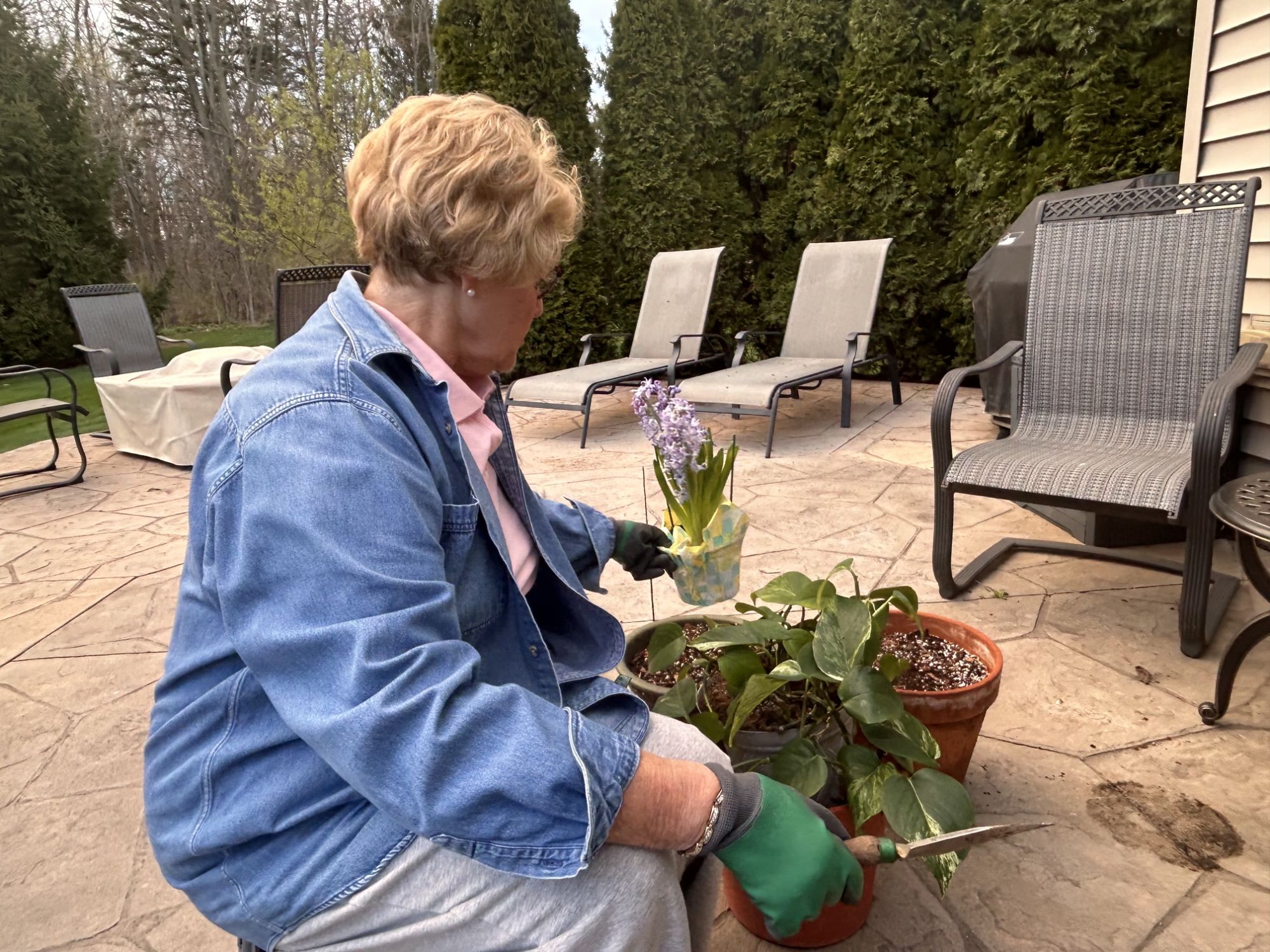
Powers-Barker has kept some form of her own garden for years, along with helping community members work on their own passion projects.
“People use gardening for different reasons: to stretch the grocery budget or to beautify the space,” Powers-Barker said.
She suggested that new gardeners start out with patience and keep the joy of gardening in mind.
“It’s not always going to look picture perfect. Even if you’ve gardened every year of your life, you are learning something new. Maybe there’s new weather, maybe there’s a new plant variety you are working with, maybe you’ve learned about a new pollinator insect. If you’re in the habit of tending to your garden containers, you’re taking that time and interacting with nature, and that’s what is being shown to have emotional and physical benefits,” Powers-Barker said.
Day, who holds a master’s degree and is an expert in soil science, said that her “spidey-sense intuition” did not develop until later in her career, and that practice makes perfect.
“Every time you grow a plant, you know what it has done in different years, in different places. A reality of gardening, in my personal experience, is that it becomes intuitive over time as you practice. You start to have a feel for things. The more time you put into this, the more you have a ‘spidey sense.’ But the spidey sense doesn’t happen without that repetition,” Day said. “It’s a willingness to start, a willingness to try. And if you end up starting, you will get somewhere.”
What plants will thrive in containers?
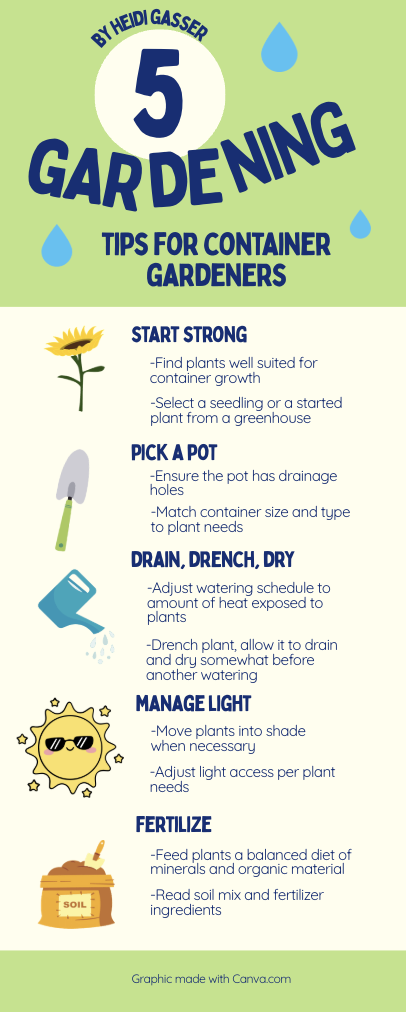
Once gardeners adopt a growth mindset, Powers-Barker suggests beginners always start a new project by researching each plant’s care requirements.
Novice gardeners should look for the germination period, growing season, and temperature thresholds for successful planting. Growers also need to decide if they want to start their plants from seed or purchase a baby plant.
“Especially for plants that need warm weather, our summer does not have a long enough growing season, so seeds have to be started indoors. Or, you can go to a greenhouse for a plant that has already been started. Ask: how long does it take for the plant to flower and produce?” Powers-Barker said.
Powers-Barker also said there is no shame in purchasing seedling plants from a greenhouse to skip the seeding process.
Day recommends plants with a “compact root network” for container gardening. She also advised to use varieties known as “determinant,” or set in their growing, flowering and fruiting cycles, as opposed to “indeterminant” plants that sprawl unpredictably over the growing season.
“For example, there are various types of tomatoes that are indeterminate, where the plant will keep growing and producing continuously, and there are types that are determinant, where there is a set shape, size, and production in the fruit and plant itself. If you keep an indeterminate plant in a pot, it will look like crap! Make sure to know what varieties do well in containers,” Day said.
How do I know what container to use?
The size of the container used for each plant should be selected based on each plant’s root density and breadth. Pot size, style and function can vary between plants, as the size of container needed for small, indoor herbs differs from larger, vegetable-producing varieties.
“If you’re growing outdoor vegetable plants, the bigger the container, the better,” Powers-Barker said.
Day agreed, noting that one of the most common mistakes made in container gardening is not providing a growing space with enough room to accommodate plants’ needs.
“The most common thing I see is people choosing a pot that is too small for the plant they are trying to grow. The plant will yellow and stop growing, and fruits will stop being produced. When I see that, I think: that plant doesn’t have any food (in the soil) left. I would recommend to err on the larger side of a pot for vegetables. A 5-gallon bucket size would be good; anything smaller would be fine for peppers or herbs,” Day said. “This gives plants enough food to chew on for an entire growing season.”
Containers are also useful for gardeners to “contain” fast-growing varieties from taking over an entire yard, Power-Barker said.
What type of soil or fertilizer do I need?
Day said that the soil mix used in the containers can make or break any gardening operation. Just like a well-balanced diet, she advised to “diversify what you put in your pots.”
Day also suggested that gardeners read soil bags carefully, as many brands will label each bag as a stronger mix than what is actually provided inside. Plants need 17 essential nutrients to produce veggies, flowers and maintain general health.
“When a soil is called ‘garden soil’ or ‘organic gardening soil,’ that is usually going to be a peat moss-based soil. This soil is good to have in a mix, but think about it like you are feeding someone that’s hungry just a salad. You also need the mineral components of soil, like clay, silt and sand mixes,” Day said. “Compost is always going to be a well-balanced food source. It’s like your Chipotle protein bowl with a little bit of everything: rice, greens, meat, salsa. You’re taking this biomass and turning it back into nutrients.”
Day suggests using mixes with one part heavy-soil to two parts mossy soil. Gardeners can also opt to include a small layer of gravel at the bottom of each pot to allow excess water to drain and aerate roots.
According to Powers-Barker, nutrients in potted plants or container gardens are leached out of the soil when watering occurs, and must also be replenished artificially. Gardeners can start out by looking at what fertilizer may already be mixed into their potting soil. Then, they can opt for a slow-release option to mix in with new soil, or a light, water-soluble fertilizer to add intermittently, depending on fertilizer and plant qualities.
“Levels of nutrients in fertilizer can benefit different plants in different ways. Some make the blooms look good, and some support leaf growth or vegetable production,” she said.
How much, or how often, do I water?
“The biggest challenge with containers is making sure they are moist enough if they are outside. The soil in a container outdoors will dry before ground soil in the heat,” Powers- Barker said.
Day and Powers-Barker agreed that outdoor pots should be kept moist but well-drained. While underwatering can lead to dehydrated leaves and roots, overwatering or water pooling in pots for long periods of time can cause root rot.
Day said she checks her pots daily. After a large rainstorm, pots often need to have excess water dumped out.
To deal with hot summer days, Day said frequent watering in the warmest temperatures is crucial for a well-hydrated potted plant.
“Because you are growing in a pot, your soil, and thus your root temperature, are going to be higher than growing in the ground. Those roots are going to be right on the other side of that hot clay [of the pot],” Day said.
Plants located in shade, or plants that need less water can get away with just one watering daily, or on alternating days. Plants in bright sunlight may need to be watered twice daily, Day said.
Light
Sunlight is another key variable to consider amongst plants that may dislike direct summer light, or need moderate light throughout the day.
Container gardening allows gardeners to move their plants to escape the hottest rays and avoid potentially harmful effects on sensitive sprouts. Powers-Barker said that she moves pots into sunnier or shadier spots to adjust sun exposure, or she replants her pots with appropriate varieties for different temperatures.
“That’s an advantage of containers: once it starts getting hot for cooler-weather plants, you can swap out for heat-loving plants,” Powers-Barker said.
However, Day recommended against growing vegetables indoors, even if to escape the intense heat. Some indoor gardeners can have success growing lettuces, sprouting varieties, or other cool-season plants with a grow light supplement. Otherwise, plants won’t have enough light access to maintain vegetable production.
“Growing vegetables inside is not something I would typically recommend. I have a greenhouse to work in, and we have had to purchase additional grow lights to supplement light where trees’ shade was preventing enough light getting in,” Day said.
Day also recommended against moving pots indoors in the middle of a hot summer to preserve cool-temperature varieties. Instead, she suggests keeping them in the shade, watering more, or simply uprooting and starting over in the early fall.
“The issue with bringing in a pot in summer can be several things; it can be gnats that lay their eggs in the soil and come out in your home. It can also be that plants will not get enough energy that they need, even with a window,” Day said.
Get growing
Growers should keep an eye on the weather to ensure frost temperatures have passed before planting outdoors. In Northwest Ohio, gardeners are advised to kick-off in mid-May.
The 577 Foundation will host a plant sale for started seedlings on May 2, and OSU’s Extension Office welcomes questions and provides growing assistance here https://extension.osu.edu/https%3A/extension.osu.edu/ask-an-expert/ask-master-gardener-volunteer.
