By JAN McLAUGHLIN
BG Independent News
With 50 years in politics and just eight months left in office, Ohio Gov. Mike DeWine has leadership skills that are no longer the norm in government.
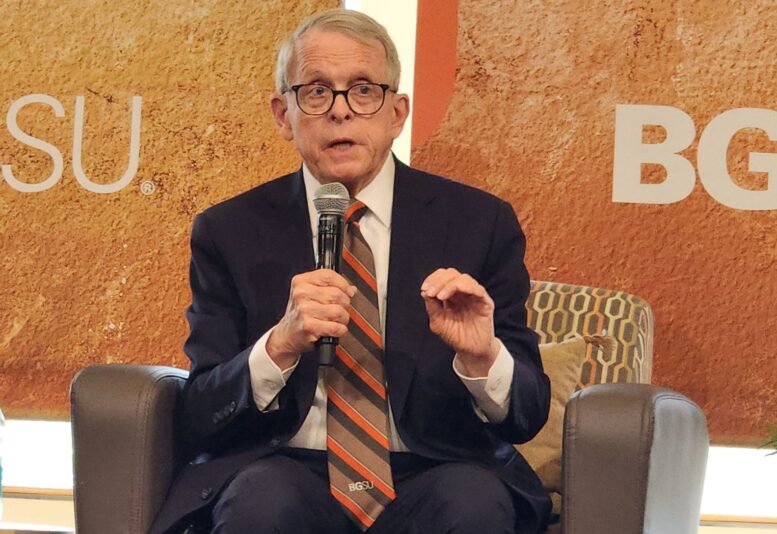
As he spoke to a crowd of 600 at Bowling Green State University’s Democracy and Public Policy luncheon on Tuesday, DeWine shared the disappearing qualities of good governing – talking to a wide spectrum of people, being brave enough to act, and owning up to mistakes made in the process.
DeWine, a Republican, was joined on stage by former Ohio Attorney General Betty Montgomery, a Republican who also served as Wood County prosecuting attorney, and by Jan Allen, a Democrat, who served on the staffs of former Ohio governors Richard Celeste and Ted Strickland.
The women, described as “trailblazers” in state government, took turns asking DeWine questions. The goal was to conduct civil dialogue – “something that is sorely needed in these times,” said Rob Alexander, founding director of the BGSU Democracy and Public Policy Network.
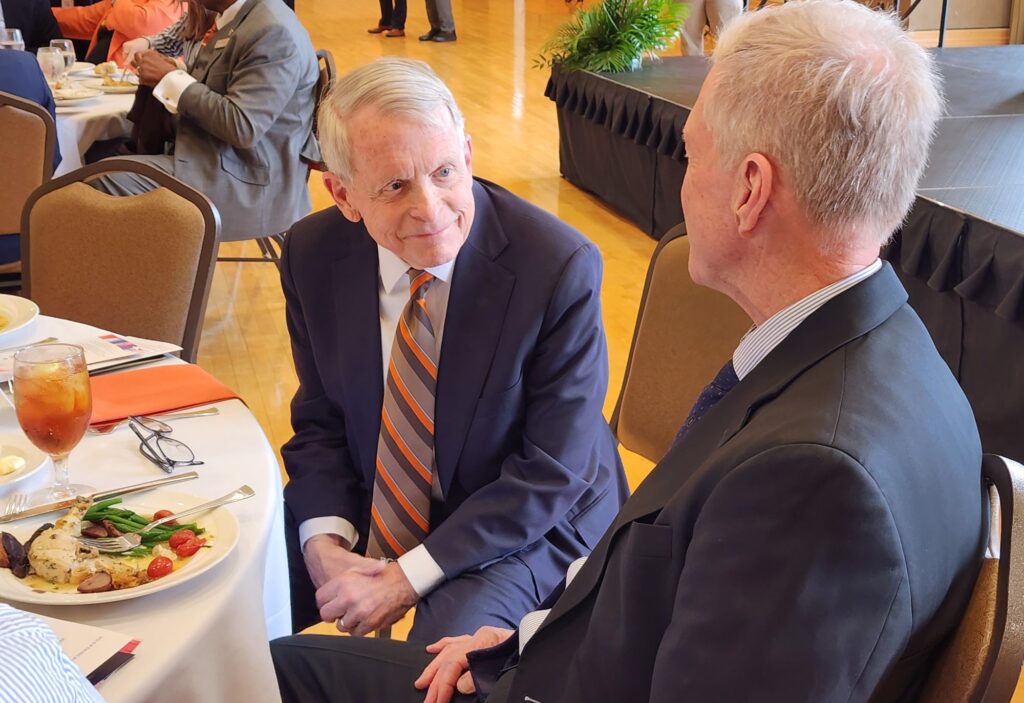
The ballroom at the student union was packed with BGSU faculty and students, area middle and high school students, and local elected officials.
DeWine spoke of cooperation between political parties – bringing back memories for the older attendees, and presenting a foreign concept for the youth in the audience.
“I think leaders need to be good listeners,” DeWine said. “You never learn anything when you’re talking.”
Starting out as a county prosecutor, DeWine went on to serve as a state senator, U.S. congressman, U.S. senator, state attorney general, lieutenant governor, then governor. Along the way, he learned he wasn’t always the smartest person in the room.
“There’s always somebody who knows more than you do,” he said.
When Covid hit, DeWine was relentless in his search for information, said Allen, who was called into service during the pandemic.
Most mistakes are the result of not talking to the right people, and not gathering the best information, he explained. During the pandemic, DeWine was on the phone every morning at 6:30 with hospital officials, followed by an 11 a.m. call with mayors throughout the state, and periodic calls each week with Ohio’s 88 health commissioners.
“Nobody really had all the answers,” DeWine said.
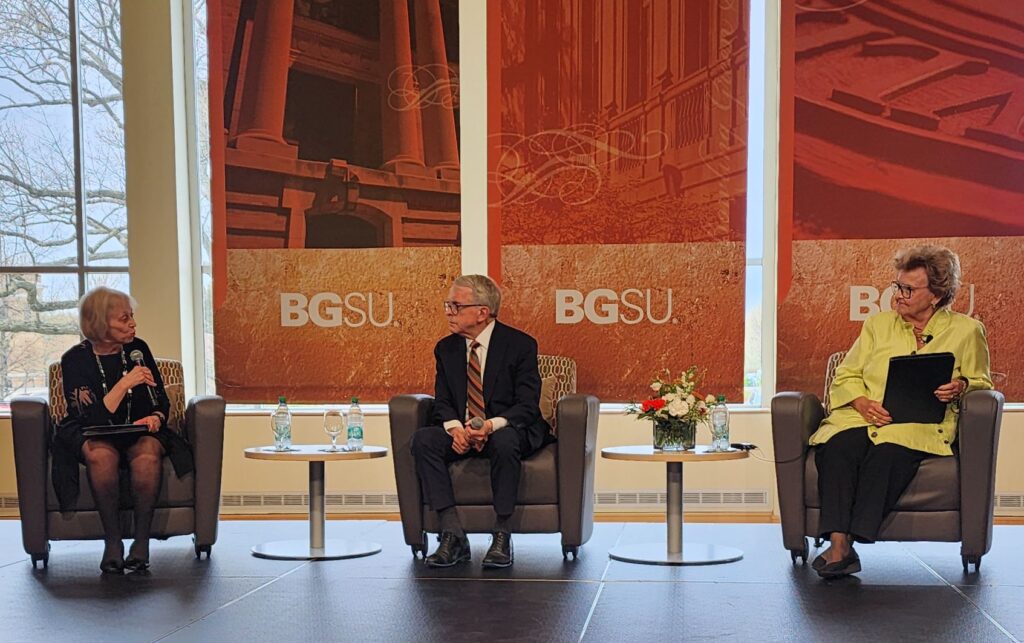
Montgomery, who called DeWine the most “underestimated” political leader in Ohio, asked why the governor went into public service. In junior high, DeWine said he followed the presidential race between John F. Kennedy and Richard Nixon. “It was absolutely fascinating.”
While his original plan was to be a high school social studies teacher, he decided instead to try law school. He went on to be elected Greene County prosecuting attorney, starting his five decades in public service.
DeWine acknowledged that the politics of today are much more polarized than when he began.
“It is a different period of time,” he said. The secret was “keeping your eye on the ball,” and remembering why he ran for office.
Tangible results could only be achieved by working with people on the other side of the aisle. During his 12 years in the U.S. Senate, he found Democrats who shared his passion for certain programs. He teamed up with Dick Durbin to fight AIDS, with Jay Rockefeller on foster care and highway safety, and with Chris Dodd on children’s health issues.
Those types of relationships have disappeared.
And differences are exaggerated on the internet, where “the loudest voice is magnified.”
“Sometimes I get the feeling people run for office because they want to be on TV. They want the sound bites,” DeWine said. “But at some point, you have to govern.”
And to do that, politicians can’t be paralyzed by fear of failure, he said.
Allen talked about the governor’s “bias toward action.”
“Government generally has a bias toward inaction,” DeWine said. “You’ve got to be willing to fail.”
“You darn well better surround yourself with smart people,” willing to tell you when you’re wrong, he said.
At the end of the discussion, BGSU President Rodney Rogers presented DeWine with the “President’s Award for Public Good.”
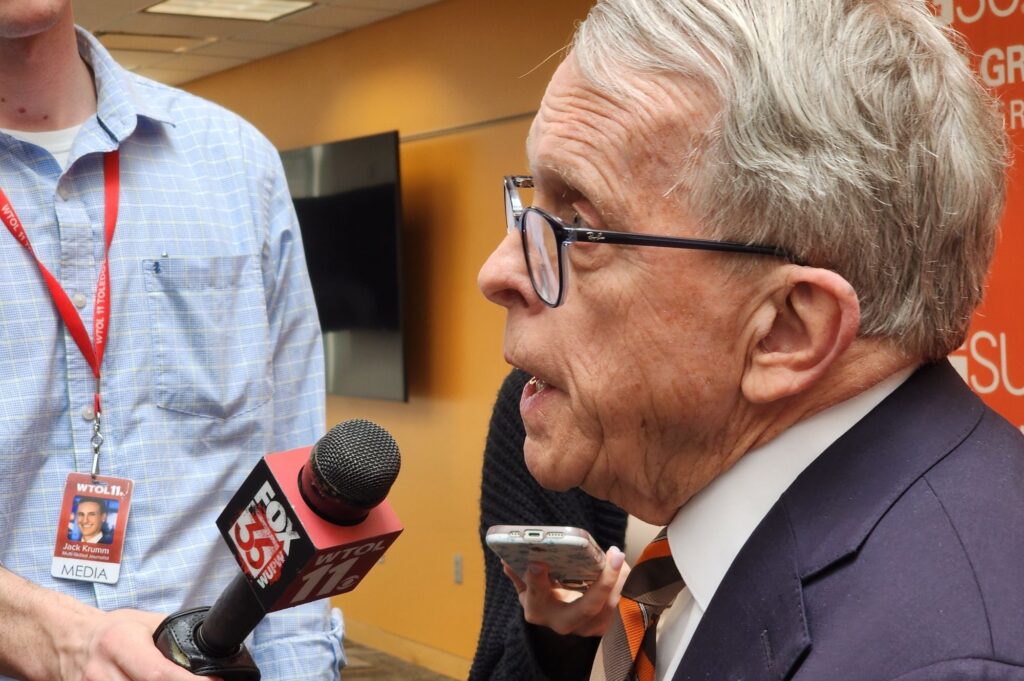
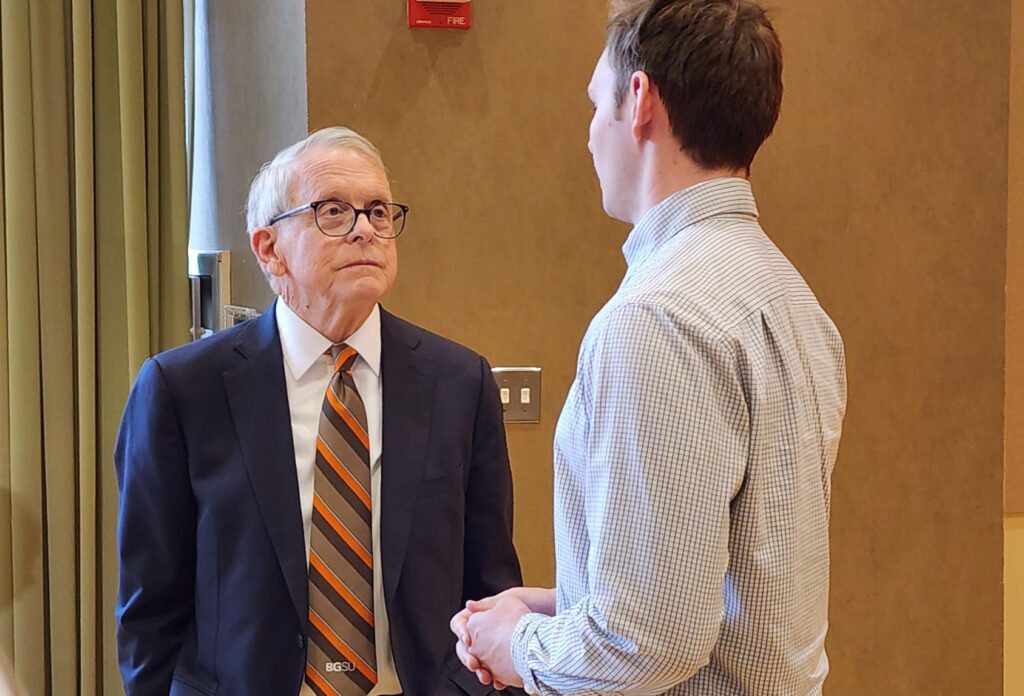
After leaving the stage, the governor spent nearly a half hour talking and posing for photographs with students. During a press gaggle following the luncheon discussion, DeWine answered a series of questions from local media on topics such as:
- Potential loss of property tax revenue for public institutions in Ohio. DeWine said that would be an “instant disaster, an “instant train wreck.” Property taxes fund vital services such as police, fire and EMS. To replace the revenue with sales tax, DeWine said Ohio’s sales tax would have to be raised to 18% to 20%. Efforts have already been made and will continue to use legislation to rein in property taxes. “We know there are people hurting in Ohio,” he said.
- The cutting of courses at public universities, such as the recently announced major programs being eliminated at BGSU. “This is something schools had to do anyway,” DeWine said, noting the need for universities to keep costs down. “This is a difficult time for higher education.”
- Republican gubernatorial candidate Vivek Ramaswamy’s suggestion that Ohio has too many public universities, some which should merge. “I think that’s a mistake,” DeWine said. “Access to education is important,” and it may make sense to share some services. But “the idea of closing a state university is not a good idea,” he said.
- Private school vouchers from the state draining funds away from public schools. “I believe parents should have choices,” DeWine said.
- Should students consider careers in public service? “We need good citizens. We need people who care about the community,” he said. “We’re a resilient people. We’ve been through tough times before.”