By JAN McLAUGHLIN
BG Independent News
The blame for Ohioans’ intense hatred of property taxes was laid squarely at the feet of state legislators Wednesday evening during a panel discussion on the property taxes.
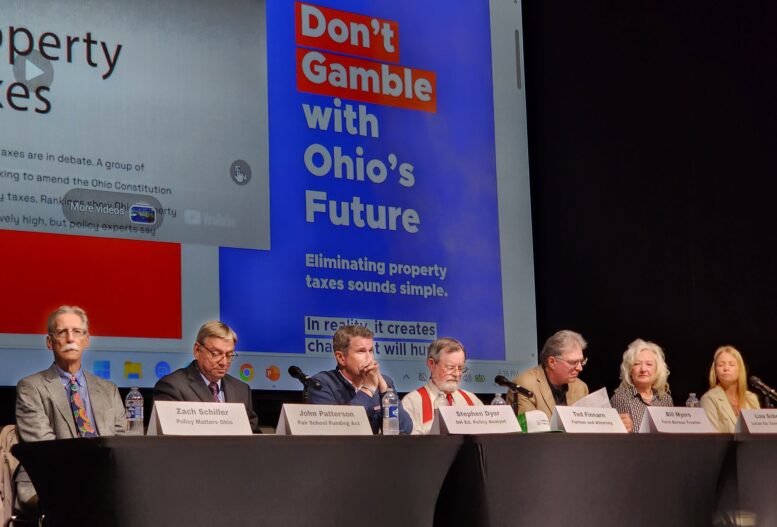
A panel of experts on tax policy, education, agriculture, county and township governments shared how state legislators have created the unbalance in funding of public services in Ohio, by continuing to cut state support for local programs, and requiring local entities to ask voters again and again to fund necessary services.
“The state legislature has absolutely screwed you,” said Stephen Dyer, a former journalist and state representative who advocates for meaningful education reform.
Petitions are being circulated around the state to get a constitutional amendment on the ballot in November to ban all property taxes in Ohio. As of earlier this month, the organizers had collected roughly half the signatures required to put the issue on the statewide ballot.
Though the panelists came from diverse backgrounds and see the tax issue from different perspectives, they all agreed a ban on property taxes would be a disaster for Ohio.
Unanswered emergency calls
Now is the time, the panelists said, for Ohio citizens to call people in their circles to warn them of the perils of the petition, and to call their legislators to warn them of their waning support.
If the amendment were to pass, said Lucas County Commissioner Lisa Sobecki, there may be no one on the other end of the line when they call for help in the future.
The state has no plan in place, if property taxes were to be abolished, to pay for necessary services that are currently funded primarily by property taxes, she said. That means on Jan. 1, 2027, thousands of first responders would lose their jobs.
Sobecki asked the audience to imagine being put on hold when calling 911 for help for a car accident, a house fire, or a heart attack.
“Let that sink in,” Sobecki said.
“The time is now” to call state legislators, she said. “Tell them to get back to work and fix this.”
Who will be affected?
Since the state has refused to adequately fund many vital services that citizens rely on, most of those public services are now funded by property taxes that entities have gotten approved by voters.
“This is harmful to all Ohioans,” said Teresa Fedor, who is vice president of the State Board of Education. “What Ohio needs is reform – not elimination” of property taxes.
“Tell everyone you know to don’t sign the petition,” Fedor said.
To raise the funding needed to support the services already provided, Ohio would need to nearly triple its sales taxes and raise its income tax from one of the lowest in the nation to one of the highest.
Over the past 20 years, the Ohio legislature has overseen the “destruction of graduated income tax,” said panelist Zach Schiller, a research director at Policy Matters Ohio. It used to be that the very wealthy 1% of Ohioans would pay a fair share of income taxes. Now the very poorest of state residents pay more than twice the percentage of income taxes as the very richest, Schiller said.
So now property taxes carry the weight of funding public services, supporting schools, police, fire, EMS, libraries, parks, plus local governmental entities of counties, municipalities and townships. Property taxes also pay for the bulk of public services for senior citizens, behavioral health, developmental disabilities, and children’s services.
“All of the services are at risk,” Schiller said.
Statewide, property taxes raise about $21.4 billion a year – far more than $14.3 billion from sales tax, and $11 billion from income tax, he said.
Schiller also pointed out that the proponents of the “ax the tax” petition haven’t told voters about the increase in electric rates that will be inevitable if property taxes were eliminated.
Schools get shorted … again
Panelist John Patterson, a former state representative known for co-authoring the bipartisan Cupp-Patterson Fair School Funding Plan, gave a little history to the funding of education in Ohio. Long ago, legislators required funding of public schools because they knew the state would benefit from its population being educated.
“We needed an educated citizenry to make this thing work,” Patterson said.
But in the last decades, the state has continued to decrease its commitment to education – so much so, that the Ohio Supreme Court has ruled four times starting in 1997 that the heavy reliance on property taxes funding schools is unconstitutional.
In 1975, approximately 40% of the state budget went to public schools. That amount is now down to 20%, Stephen Dyer said.
The state’s growing use of public taxpayer funds for private schools is worsening the problem, panelists said. Approximately 84% of Ohio children attend public schools, which receive 77% of the state funding set aside for schools. Charter schools, with 7% of the state’s children get 12% of the school funding, and voucher “subsidies” pay for 9% of the state’s children with 11% of the state’s school funding.
Dyer referred to vouchers as unconstitutional subsidies for private school tuition – benefiting more white and wealthy children in the state. Charter schools get about twice as much per student from the state as public schools, he added.
Meanwhile, private schools don’t have to meet the same standards as public schools, and pay far more in administrative costs. The bulk of schools failing state report cards are private districts, Dyer said.
“Charters still suck,” despite the amount of money being shoveled into them, he said. And still, the legislators don’t hold private schools accountable, even though they profess their fiscal responsibility, he said.
Instead, the state legislature continues to siphon money away from public schools – requiring those districts to go back to voters for support. In many cases, voters see the need and vote accordingly.
“The reason their property taxes are so high is they know it’s up to them to step up to the plate to pay,” Dyer said.
When an audience member posed a question about why people without children in schools should have to pay for schools, Dyer responded that it’s what people do for each other.
“Your education was funded by a lot of people who didn’t have kids in schools,” he said.
Farmers support reform – not abolishment
Two panelists spoke from the perspective of agricultural landowners – Ted Finnarn, who represents the Ohio Farmers Union on the Agriculture Advisory Committee to the Division of Tax Equalization, and Bill Myer, trustee for the Ohio Farm Bureau Federation.
Both talked about the Current Agricultural Use Valuation Law, which allows farmland owners to pay their real estate taxes based on the income-producing ability of the acreage and not on its market value.
Under the CAUV program, farmland and woodlots can’t be developed, Finnarn explained. If all property taxes were repealed, there would be no protection for that acreage, he said.
Myer, a fourth generation farmer, talked about the decreasing number of children wanting to take up the profession of farming.
“It’s a hard way of life,” he said.
The Farm Bureau favors property tax reform not complete removal. That would be “total chaos,” Myer said.
Finnarn noted the five bills passed by the state legislature in 2025, intended to ease the pain of property taxes. “Those bills need time to work,” he said.
Side efforts of property tax ban
The abolishment of property taxes could lead to further “brain drain” in Ohio, as businesses avoid locating in the state due to the “dismantling of public education,” Patterson said.
The biggest export in Ohio is already people – especially young people – and this will make it worse, he said.
As sales taxes are raised to make up for lost property tax, some shops won’t survive, said Sobecki. Residents in Northwest Ohio may find it more advantageous to shop in Michigan.
The ban of property taxes would also mean forever tax abatements for businesses, said Middleton Township Trustee Melissa Petrea. Tax abatements are unpopular with citizens, and the end of property taxes would mean the beginning of tax free business in Ohio.
Then there’s the loss of local control, Petrea said. Townships rely on property tax revenue more than any other form of government in Ohio. It is difficult to imagine how townships could continue to function since their services are completely funded by property taxes. That could lead to many townships being swallowed up by neighboring municipalities.
With property taxes, township leaders know where the money is going. “That money stays here,” she said. But if the state levies sales or income tax (which townships cannot) “we’d be giving that control to Columbus for them to decide what to send back,” Petrea said.
Who’s behind ‘Ax the Tax’ effort?
The group pushing for property tax abolishment in Ohio seems to be unaware that the property taxes in place for schools and public services have been voted in by citizens, Dyer said.
Last week, the group announced the results of their petition drive so far – doing so in a home replica of the Oval Office, with the leader wearing a trucker hat.
“All they know is they don’t want to pay taxes,” Dyer said.
Earlier this month, members of the Committee to Abolish Property Taxes released their signature total in a livestreamed event, after months of refusing requests to do so from journalists and group volunteers.
The group, also called Ax Ohio Tax, needs a minimum of 413,487 valid signatures from 44 of Ohio’s 88 counties by July 1 to make the November ballot. That’s 10% of the total ballots cast for governor in the last election for that office, in 2022.