By GEOFF HOWES
BG Historical Preservation Commission
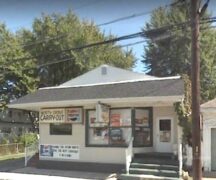
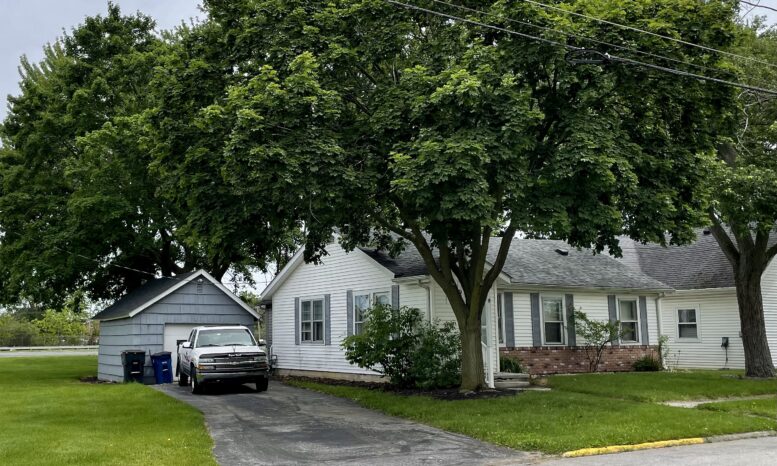
In the summer of 2025, the Bowling Green Historic Preservation Commission featured three neighborhood markets as its Historic Buildings of the Month: Dillon & Moscoe at 316 Buttonwood (June); Don’s Grocery / North Grove Carry Out at 414 North Grove (July); and Boosembark’s / Eddie’s at 443 North Enterprise (August). For June 2026, we continue this series with the former White’s Fish Market at 936 N. Summit St.
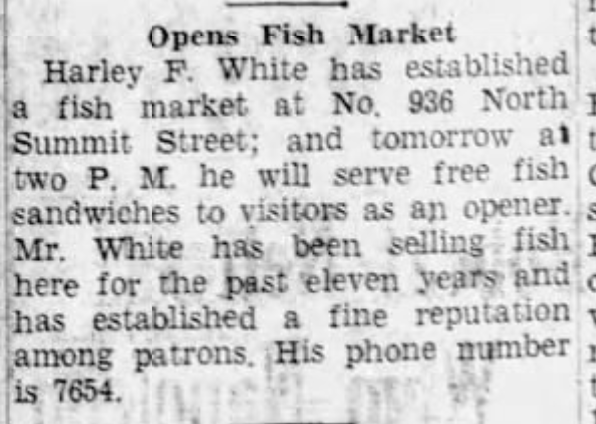
On April 23, 1940, the Sentinel-Tribune announced: “Harley F. White has established a fish market at No. 936 North Summit Street; and tomorrow at two P. M. he will serve free fish sandwiches as an opener.”
Harley White (1911-1973) had already been selling fish door-to-door for 11 years and had established “a fine reputation among patrons.”
In a 1971 interview in the same newspaper, White recalled how he accidentally got started in the business. In 1928, his father Alva (1883-1960) saw an ad in the paper offering herring at the wholesale price of eight cents a pound in Port Huron, Michigan. Alva had been laid off his railroad job and needed income, so he and 17-year-old Harley had the fish shipped by rail, processed them, and sold them for 20 cents a pound.
Alva was able to go back to work, but Harley saw a marketing opportunity and started to “huckster” fish from house to house in a Model T Ford, with the fish in the back under canvas and ice. He got “pretty fast” at cleaning the fish between stops.
In July 1939, he married Helen Nichelsen (1916-1994) in her family’s home on South College Drive. Helen had graduated from BGSU in 1938 and was teaching school in Weston. The couple moved into the house they had purchased in June 1939 from Ethel V. Avery. It still stands at 936 N. Summit St.
It is not certain when the house was built. The earliest mention found is in a classified ad in October 1913. It is not listed in the 1914 city directory, but it does appear on the 1915 Sanborn fire-insurance map. (The 1908 Sanborn map does not extend to this neighborhood.) We know that Ira and Lacreaty Sheperd lived in the house in the mid-to-late 1920s, and that George and Louella Bovie lived there in 1936.
In 1940, Harley built a small outbuilding for his fish market, which is now a garage. His main source of fish was Port Clinton. In those days, Port Clinton’s fisheries shipped refrigerated carloads of Lake Erie fish by rail to places like Chicago, New York, and Philadelphia. Harley would drive over once a week—sometimes in the middle of the night—and haul his fish back home. He sold perch and “pickerel” (walleye) along with catfish, bullhead, and sheepshead (freshwater drum).
Harley White, fondly known as “Whitey,” was filling a gap in the local market when he opened his fish store in 1940. By then, the number of fish markets in Bowling Green had dropped to zero, but during the 35 years from 1899 to 1934, there had been at least 14 fish shops downtown. Many seem to have survived only a short time. The longest-lasting were Avery’s Fish Market (1899-1907), Goit Fish Market (1904-1927), T. C. Orwig (1910-1917), and J. W. Kendall (1914-1917).
A newspaper ad for White’s store from 1943 says: “If you’re craving for a mess of strictly fresh caught fish, drive out to White’s Fish Market, 936 N. Summit. Wood County’s only Fish Market.” But that didn’t mean you couldn’t buy fish elsewhere. By the late 1930s, specialty stores like butcher shops, bakeries, and fish markets were competing with supermarkets.
Kroger and A&P were in town, and even though they were not the large, modern supermarkets that came later, they did offer a wide variety of goods in one location, including fish, or rather, seafood. In 1939, Kroger advertised boneless “tenderloins” of haddock and whiting. A 1943 A&P ad offered fresh salmon, flounder, perch, blue pike, and sheepshead. By 1947, A&P expanded to include frozen fillets of saltwater fish: haddock, pollock, and cod. This may be why White’s stressed “strictly fresh caught.”
After World War II, refrigerated trucks and home freezers were becoming common, and shipping fish from the coasts was feasible. Consumers were moving away from fish dressed to order and toward the convenience of frozen prepared fillets. And of course, one-stop shopping was quick and easy.
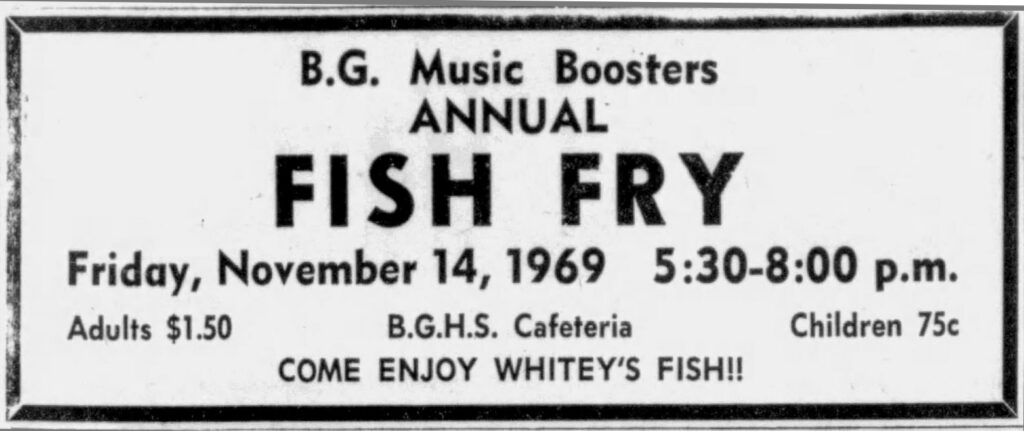
So, how did this little local shop stay in business? For one thing, the owner and his family were well known in the community. Whitey’s fish was served at fundraisers like the BG High School Music Boosters’ annual fish fry and Lenten fish fries at local churches.
Lent was White’s biggest season. An ad from the week before Easter in 1943 urges: “Due to largest demand of year, get your fish early.” And in 1953, Whitey promised “a good supply of fresh fish for Good Friday.”
White’s Fish Market also supplied fish to local restaurants, including the Main Restaurant, (in the Masonic Temple building in the 1940s), Kaufman’s on South Main Street, Everglades in Perrysburg (where Tekela is now), and Cranker’s on South Main Street (later on West Poe Road). In their advertisements, these eateries mentioned White’s by name, as a sign of fresh, local quality. The fish market stayed in business until 1971.
Unlike many of our Historic Buildings of the Month, this small, one-story house is not notable for its architecture. But it is remarkable for being the last fish market in Bowling Green, and for staying 55 years in a family that eventually grew to eight kids.
Harley and Helen’s children, Sharon, David, Douglas, Robert, Richard, Thomas, Daniel, and Harley Jr. (born on his father’s birthday), all grew up at 936 N. Summit St. Harley Sr. and his friend Phil Parsons built a rear addition for a third bedroom, but there were still three bunkbeds in the boys’ room.
Helen taught in Weston and North Baltimore before becoming a full-time homemaker. Later she worked as a baker at BGSU. She attended Trinity United Methodist Church.
Harley’s son Robert White recalls occasionally riding with his father to Port Clinton, or sometimes to Sandusky. They would put the fish in boxes in the back of the truck, cover them with ice and a tarp, and Harley would clean them when they got home. Robert also has memories of his father walking across North Enterprise Street to what was then the Heinz quarry to feed bread to the carp, who were so eager they would sometimes wriggle right out of the water.
One of Robert’s clear memories is how hard his father worked, 10 to 12 or even 14 hours a day. Customers also brought fish they had caught in to be cleaned. As a boy, Robert’s father impressed upon him how sharp the knives were—the kids were not allowed to use them. Whitey charged by the pound for cleaning, and this part of the business became more important as the commercial fish supply from Lake Erie got smaller and more costly in the 1960s.
In the 1971 interview mentioned above, Harley Sr. told how the pollution in Lake Erie along with the mercury scare meant that his fish business was practically “over and done with.” High prices “plus the restrictions on which fish can be eaten, has spelled the end of the industry.”
Whitey heard a commercial fisherman in Port Clinton tell his son to “look for a livelihood someplace else. The fishing industry is a thing of the past on the lake.” He realized then that “the handwriting was on the wall for me, too.” His health was not good, and he even had to stop fishing for fun. “So I enjoy myself now cleaning fish for the customers who catch them on the end of a fishing line or watching my boys fish. It’s still a great sport.” He admitted: “Personally, I don’t care much for fish as food. I guess I’ve handled so many that I don’t care much about them.”
About a year after he retired, Harley and Helen were heading west on vacation with their youngest son Harley Jr. and their oldest son David, his wife Barbara, and their children Shelley and Brent. On Aug. 12, 1973, near Des Moines, Iowa, their car and camper rig went off the road. While some of the car’s occupants were seriously injured, all survived except Harley Sr., who died in a hospital in Des Moines on Tuesday, Aug. 14. He was 62 years old.
Helen continued working as a baker at BGSU. Robert converted the outbuilding into a garage for his mother, though he had to add an extension in the back to fit her car—that’s how small Whitey’s market was. When Helen White died on March 6, 1994, at age 77, she was survived by her seven sons and one daughter as well as 12 grandchildren and two great-grandchildren. Harley and Helen are buried in Oak Grove Cemetery. Their grave marker says “Together Forever.”
In 1994, the Whites sold the house to Philip Barone, who sold it in 2010 to HC Summit LLC, who sold it in 2019 to Maurer Iott Elizabeth et al. It is currently a rental property.
(Written by Geoff Howes of the Bowling Green Historic Preservation Commission. With many thanks to Todd Waggoner and the Barn Bums, Gene Klotz, the Wood County District Public Library, the Sentinel-Tribune, and the Wood County Recorder’s office. Special thanks to Robert White.)
Would you like to nominate a historic building or site for recognition? You can do this through the city website at – https://www.bgohio.org/FormCenter/Planning-13/Historic-BuildingSite-Nomination-Form-83
You can learn more about the Historic Preservation Commission by attending their meetings on the fourth Tuesday of each month at 4 p.m., or by visiting their webpage at – https://www.bgohio.org/436/Historic-Preservation-Commission.