
By JAN McLAUGHLIN
and HEIDI GASSER
BG Independent News
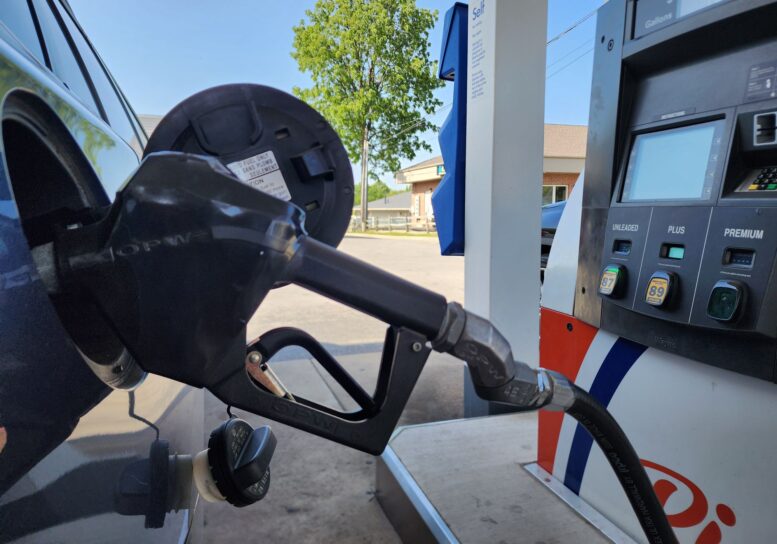
Even as gas prices inch downward, the prices at the pumps remain higher than before the U.S. began bombing Iran. Nationwide, the lingering costs averaging a dollar more per gallon than before the war are cramping the summer travels of many Americans.
But for some livelihoods – like farming, transportation and moving services – the fluctuating costs are cutting into already tight budgets.
As of today (July 1), the national average for a gallon of regular gas is $3.84, with the price in Wood County averaging $3.72, according to AAA. A month ago, regular was sitting around $4.32 a gallon, and a year ago, it was $2.95 a gallon.
Diesel peaked at $6.13 a gallon in mid-May, and today is averaging $4.94 a gallon. A year ago, diesel was selling for $3.61 a gallon, according to AAA.

Farmers getting squeezed
For Wood County farmer Kris Swartz, the gas price hikes came at an already difficult time.
“The farm economy is rather weak anyway,” Swartz said last month. “For the farming community, the most direct effect is diesel.”
But the jump in fuel prices has also led to skyrocketing costs for fertilizers and chemicals needed for crops. The prices for nitrogen, phosphates and potash have “gone up tremendously,” Swartz said.
“Unless energy prices go down, fertilizer costs won’t go down,” he said.
Corn and wheat depend on fertilizers that have jumped from $360 a ton to $550 a ton, he said. That adds up quickly for Swartz, who farms about 1,800 acres. He purchased 125 tons of nitrogen alone, costing him $25,000 more this year than last.
In recent years, profits from corn and wheat crops have already been low – and this won’t help.
At the same time that fuel and fertilizer costs have jumped, the tariffs enacted by the Trump administration have also caused other financial strain, Swartz said. Farm machinery repair parts have “been creeping up” in recent years, but the tariffs had led to “astronomical” price increases, he said.
“I’ve heard horror stories of farmers walking away from parts counters,” stunned by quoted costs.
Unless fuel prices go down more in the next few months, Swartz is expecting another hit to his budget this fall – since drying of corn crops takes a lot of energy.
“We kind of get squeezed every way,” he said.

School busing pinched
Diesel fuel prices have cost school districts more to transport students. Bowling Green City School District, with its fleet of 27 buses, purchases a load of 7,500 gallons every five weeks, according to Toby Snow, transportation director for the district.
The district had to pay $4.85 a gallon – compared to $2.25 a gallon a year ago. That came with a price tag of about $36,000.
As a precautionary measure, the district budgets about $4.50 per gallon. “We’ve had times in the past when it’s gotten out of hand,” Snow said.
But in his 10 years as transportation director, Snow has never seen diesel gas prices like this before.
“This is definitely the highest,” he said last month.
County road crews
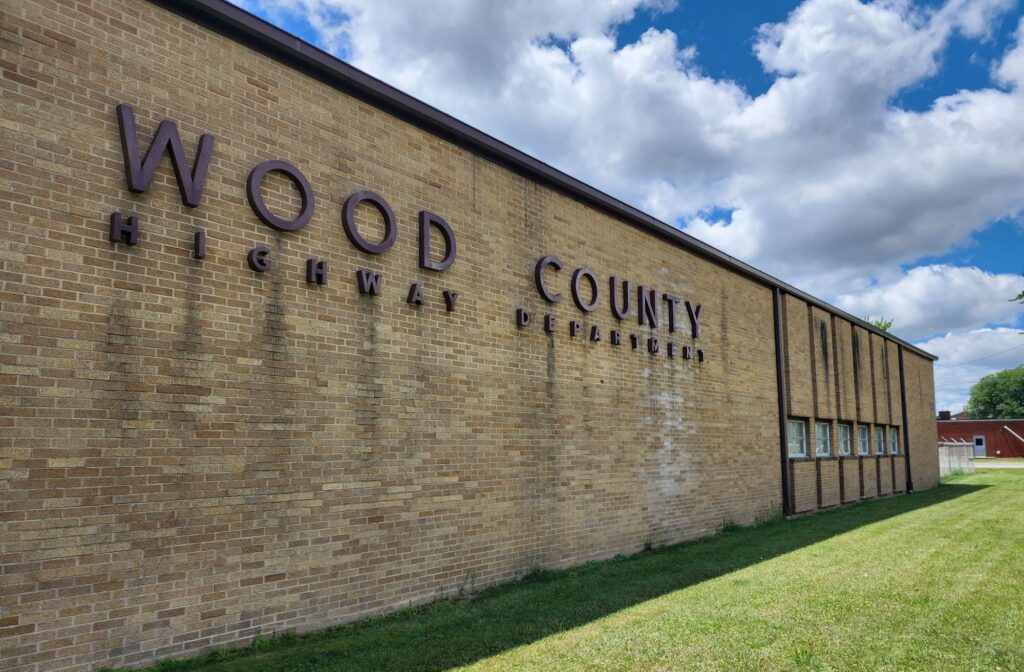
Operating as a governmental entity, the Wood County Highway Department has to keep working through high gas prices, said Jerry Houtz, superintendent of the highway garage.
“We can’t halt operations or slow things down,” Houtz said last month. This year’s projects for the highway department were scheduled last year or the year prior to that.
“Who knew what fuel prices would do,” he said.
In the summertime, road crews go through about 2,000 gallons of regular gas and 1,500 gallons of diesel a week. The highway department uses much more of the more expensive diesel fuel in the winters, taking care of snowy or icy roadways.
During rough winters, the snowplows could go through 5,000 gallons in four days, Houtz said.
While the county highway department can’t halt projects, efforts are being made to use fewer vehicles on some jobs, and organize work geographically to reduce mileage on county trucks.
“We do what we can to make wise decisions,” Houtz said. “We have to be fiscally responsible to save our taxpayers.”

Costing moving companies
The higher than usual gas prices are also cutting into businesses like the Bowling Green based Murrey’s Movers, owned and operated by Shawn Murrey for seven years.
Murrey’s company offers start to finish moving services, from packing up houses to cross-country transportation.
When interviewed in mid-May, Murrey was paying $6 a gallon for diesel.
“It’s crazy. Fuel prices got you at the pump making life decisions. Do I need to go eat tonight?” Murrey said.
“It’s jumped up $100 just to fill up the tank,” he said. “It’s taking more to go the same distance.”
Murrey also has to calculate the gas prices in the locations where his clients are moving, knowing it could cost more to refill along the journey.
“The client has to enter that cost. They have to cover the travel cost, the gas. It hurts the business too, because I have to push that cost out to the clients,” he said.
“Moving is a luxury business. Most people have their brothers, aunts, uncles, sisters, who they call over to help them out … But the average client knows it’s going to cost,” Murrey said.
Murrey said he will not be making large changes to general business operations. However, he makes it a habit to remain transparent with clients about all costs involved in the process.
“I need gas to move. I can explain, and I can educate the client on the invoice about pricing,” Murrey said.
“I am just hoping it goes back down,” he said