From BOWLING GREEN HISTORICAL PRESERVATION COMMISSION
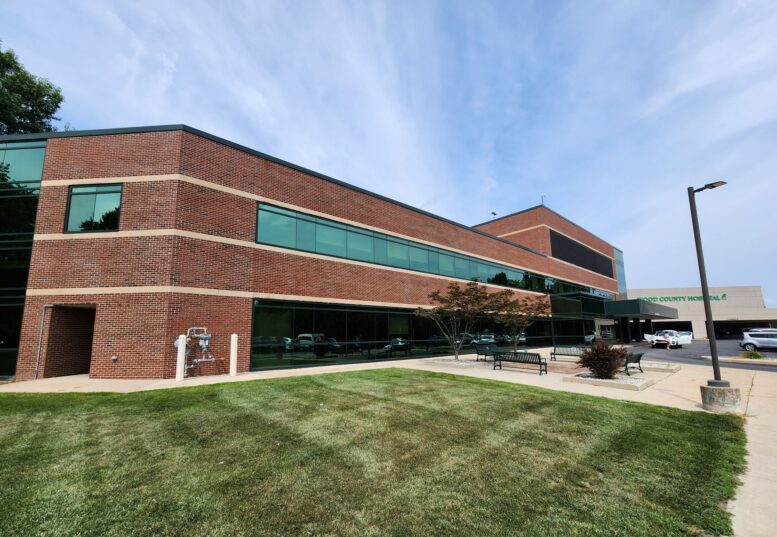
Every day, thousands of people pass the brick building of Wood County Hospital on West Wooster Street. For many, it’s where they go for an appointment, to visit a loved one, or receive care in an emergency.
Wood County Hospital exists because the people of Wood County decided it should. Long before the first patient walked through its doors, local residents, businesses, civic organizations, and volunteers united around a shared vision to build a modern hospital that would serve generations of local families.
A community builds a hospital
By the mid-1940s, Community Hospital, the small hospital that had served Bowling Green from the former Manville House on West Wooster Street since 1920, was no longer able to meet the county’s growing healthcare needs. Advances in medicine and a rapidly expanding population made it clear that Wood County needed a larger, more modern facility.
Community leaders and local physicians shared a vision of bringing modern healthcare to Bowling Green and the surrounding communities.
In the spring of 1944, community leader Alva W. Bachman was appointed chairman of the committee planning and promoting a modern hospital in Bowling Green. The following January, local businessman Fred W. Uhlman announced a landmark gift of $100,000 toward construction of the hospital. Uhlman would later contribute an additional $150,000, providing nearly one-third of the hospital’s construction cost. His extraordinary generosity inspired a countywide fundraising effort that united residents, businesses and volunteers behind a shared goal.
Residents contributed whatever they could. Businesses donated materials and services. Volunteers organized fundraising drives, bazaars, and auctions. Families made gifts both large and small, because they believed quality healthcare should be available close to home.
One of the campaign’s memorable moments came on Oct. 15, 1947, when an estimated 10,000-15,000 people gathered at Bowling Green’s City Park for an all-day hospital auction and bazaar. By the end of the day, the event had raised $30,336 for the new hospital.
The auction’s biggest attraction was a heifer donated by Emerson Ricard, a livestock dealer from Mermill. Rather than being sold just once, the animal was auctioned repeatedly throughout the day. After each winning bid, the buyer donated the heifer back so it could be sold again. By day’s end, that single heifer had generated more than $2,000 for the hospital fund – a symbol of the generosity that fueled the campaign.
The auction was just one chapter in the effort. Door-to-door fundraising campaigns spread across Wood County. Civic organizations hosted events. Businesses continued donating materials and services. Together, the community raised nearly $750,000, which is equivalent to almost $10 million today, to make the hospital a reality.
From foundation to landmark
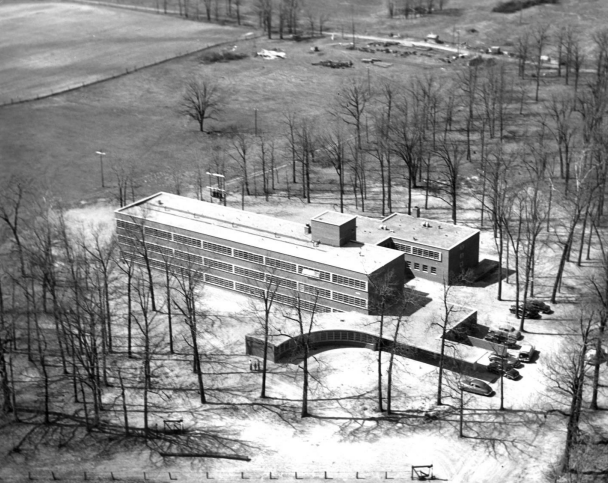
Designed by Stiehle-Wolfe Inc. of Fremont, construction began in 1949 on a 7.96-acre site along West Wooster Street.
Photographs from the time show little more than concrete footings stretching across an open field. It was difficult to know then that those foundations would become one of Bowling Green’s recognizable public buildings. It would be a place where generations of families would celebrate new beginnings, seek healing during difficult moments, and say goodbye to loved ones.
As construction progressed, local residents watched in excitement. Newspaper reporters toured the nearly completed hospital, describing its modern design, spacious patient rooms, and advanced facilities. Before opening day, the building had already become a symbol of what the community could accomplish when it worked together.
Opening day
Wood County Hospital officially opened on Aug. 14, 1951.
The original hospital welcomed patients with 65 beds, 22 bassinets, and a staff of 132 full- and part-time employees under the leadership of its first administrator, Annabelle Kinney.
A building that never stopped growing
Wood County Hospital has spent the last 75 years evolving.
It took only three years before the community had already outgrown its new hospital. A third-floor addition in 1954 increased patient capacity, beginning a pattern that would continue.
The building expanded again in 1962 with the construction of the north wing. Expansions in 1970 brought 42 new beds, expanded surgical services, coronary care, and one of the area’s earliest intensive care units. More renovations in the late 1970s and early 1980s expanded maternity services and modernized patient care.
The decades that followed brought continued growth and modernization. Renovations in the 1990s transformed admissions, the emergency department, laboratory, and rehabilitation servies. A campus expansion completed in 2010 added 100,000 square feet, new surgical suites, private patient rooms, and the Women’s Center. More recently, the addition of the Maurer Family Cancer Care Center, robotic-assisted surgery, and other technologies has helped to ensure the building continues to evolve to meet the changing healthcare needs of the people who built it.
Every generation has added something to the original structure, building on the past and growing for the future.
When Wood County Hospital first opened, penicillin had only recently become widely available. Intensive care units were new. CT scanners, MRI technology, robotic surgery, and precision cancer treatments had yet to be imagined.
The hospital adapted alongside medicine itself, evolving to meet the changing needs of the community.
More than brick and mortar
Wood County Hospital stands as a lasting reminder of what a community can accomplish when it works together around a shared purpose.
Every expansion, renovation, and improvement reflects another generation choosing to invest in the health of its neighbors.
Today, visitors see a campus that has grown beyond its original footprint. New services, modern technology, and expanded facilities have transformed the hospital over the past 75 years.
To nominate a historic building or site for recognition, visit https://www.bgohio.org/FormCenter/Planning-13/Historic-BuildingSite-Nomination-Form-83.
To learn more about the Historic Preservation Commission, attend its meetings on the fourth Tuesday of each month at 4 p.m. or visit its webpage at https://www.bgohio.org/436/Historic-Preservation-Commission.