University photographer Craig Bell’s photos will be part of a Memorial Photo Walk on campus Friday in remembrance of 9/11
By JULIE CARLE
BG Independent News
On Sept. 11, 2001, Craig Bell wore two hats—one as Bowling Green State University’s photographer and the other as a human being.
The day started for him like many days—sitting in a meeting planning the day or future photography needs for the university.
At 8:46 a.m., plans changed in an instant as word of American Airlines Flight 11 hitting the World Trade Center’s North Tower was broadcast. And 17 minutes later when United Flight 175 crashed into the South Tower, it was no longer just a fluke or a one-off.
“That’s when we knew,” Bell said. Like the whole world, everyone on campus spent much of the day tuned in to the latest coverage on televisions, trying to process what was happening.
Though Bowling Green State University was roughly 600 miles from New York City’s World Trade Center, Bell said the distance didn’t seem to lessen the shock, fear and uncertainty that swept across the university community just as it did the rest of the country.
Bell, then in his second full year as a university photographer, began documenting what was happening around him.
He went into residence halls, where students gathered in lobbies to watch the news. He heard about a candlelight vigil and followed students as they gathered at the steps of the Education Building before walking silently across campus. Later, he photographed another candlelight service at St. Thomas More University Parish.
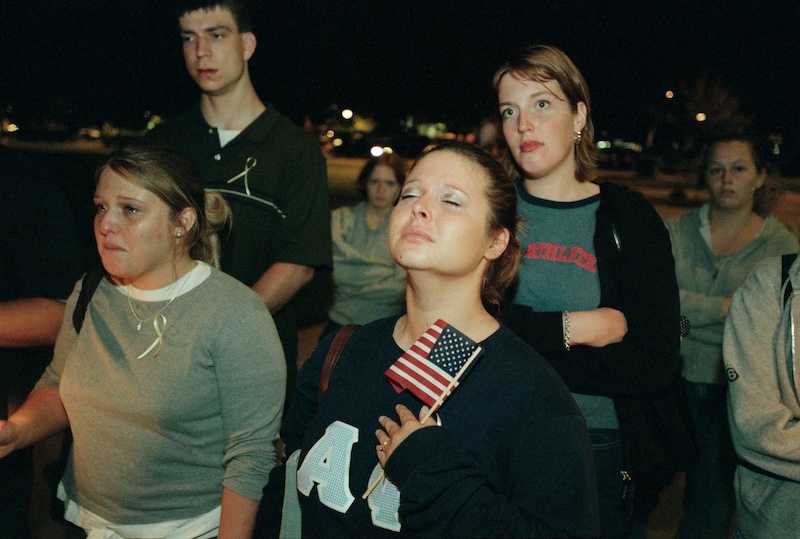
The photographs Bell made were not images of the collapsing towers or the devastation in New York. They were quieter moments—students holding candles and flags, people grieving, praying and standing together.
But because of his start as a photojournalist, Bell understood that those images mattered.
“My role as a photographer was to capture these moments,” he said. “The images not only reflected a part of our campus; they documented the shared emotions of those individuals captured in my lens.”
But Bell wasn’t simply an observer. He was experiencing the same uncertainty and grief as the people he photographed.
“I was suffering too,” he said. “I was going through the same thoughts. I was struggling with what was happening.”
Yet he also felt an obligation to document the moment for the university’s history.
“Wherever I heard something was going on, I was going to go find it and I was going to try to document it,” he said.
One of the photographs that remains particularly meaningful to him shows a young woman lying on the concrete steps, holding a candle, wearing a ribbon and surrounded by the symbols of remembrance. While others remained standing, she lay on the steps, overcome by emotion.
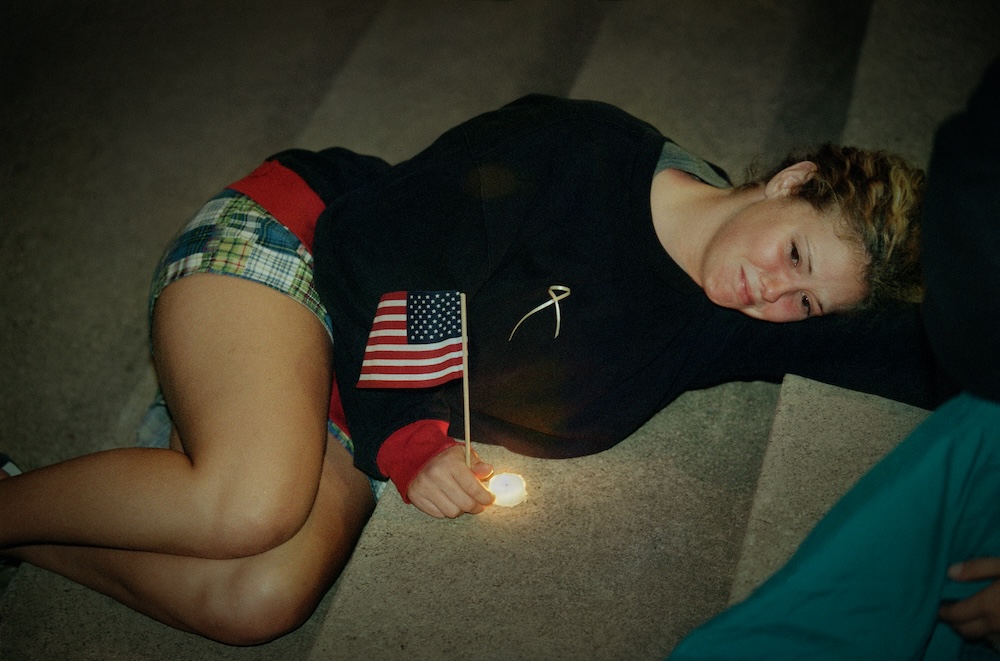
Bell remembers being struck by the image—and by the students’ determination to come together.
“I was proud of the students,” he said. “I was proud of the fact that they were just trying to come together with a unity.”
Another sequence that still affects Bell shows then-BGSU President Sidney Ribeau during a remembrance ceremony. Bell recalled watching Ribeau’s expression change as he sat with the flags and BGSU seal behind him.
To Bell, the images he captured demonstrated that 9/11 had erased distinctions between positions and titles. Everyone was affected.
“It didn’t matter if you were a student or you were the president of the university,” Bell said. “This was incredibly emotional for everyone.”
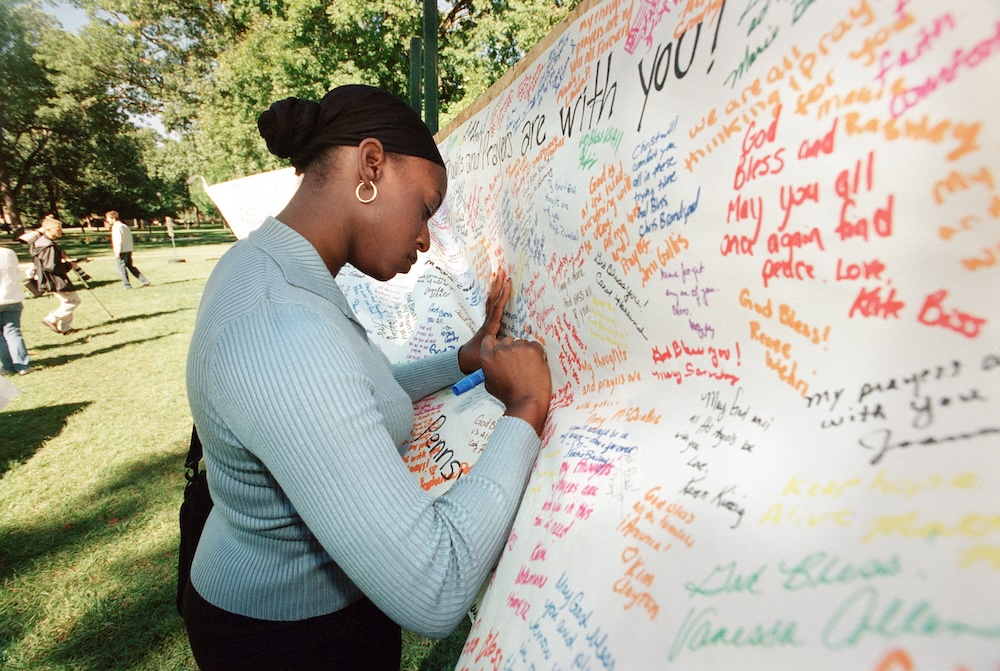
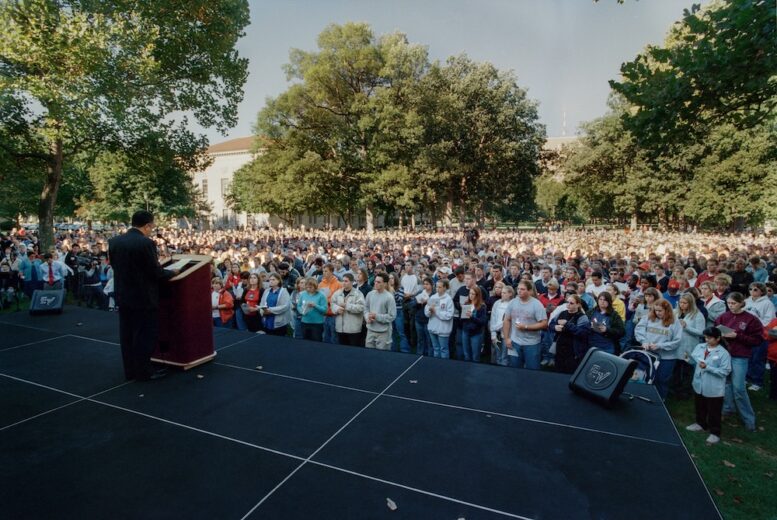
The university’s Sept. 14 Day of Remembrance became another important moment for Bell to document. A huge crowd gathered on campus. People wrote messages of remembrance, and individuals who might otherwise never have spoken to one another found themselves talking.
Bell noticed something else: compassion.
“Conversations were just more gentle,” he recalled. Students, faculty and staff were sharing the same doubts, insecurities and sense that the country was suddenly less safe.
For a university photographer accustomed to documenting celebrations—move-in days, and graduations—student life and milestones, 9/11 presented a profoundly different assignment.
“This was a tragedy, which is not what a university normally photographs for a campus community,” Bell said.
The emotions were different, too. Bell said the experience seemed to take away some of the innocence from the students who were on campus at that time.
For freshmen especially, the attack came at a moment when they were already navigating the uncertainty of beginning college, living with new roommates and entering a new chapter of their lives. Suddenly, they were also trying to understand a national tragedy and what it meant for their own safety and future.
“The 17 minutes changed our country,” Bell said, referencing a documentary of the same name. “But it changed their world.”
Twenty-five years later, as the university considered how to honor 9/11’s silver anniversary, Bell was asked to track down some of the photos from that 2001 tragedy to be used for a large-print photo display.
The request gave him the opportunity to revisit his photographs that had largely remained unseen and tucked safely away in the BGSU Archives. Some images were never scanned when they were originally made, so he worked with the library to have the photographs scanned.
Looking back through the contact sheets brought the memories rushing back.
There are images he had forgotten—including photographs from a teach-in at Olscamp Hall roughly two weeks after the attacks, where faculty, staff and students gathered to discuss terrorism and its effects. There are images of candlelight services, flags and students trying to make sense of what had happened.
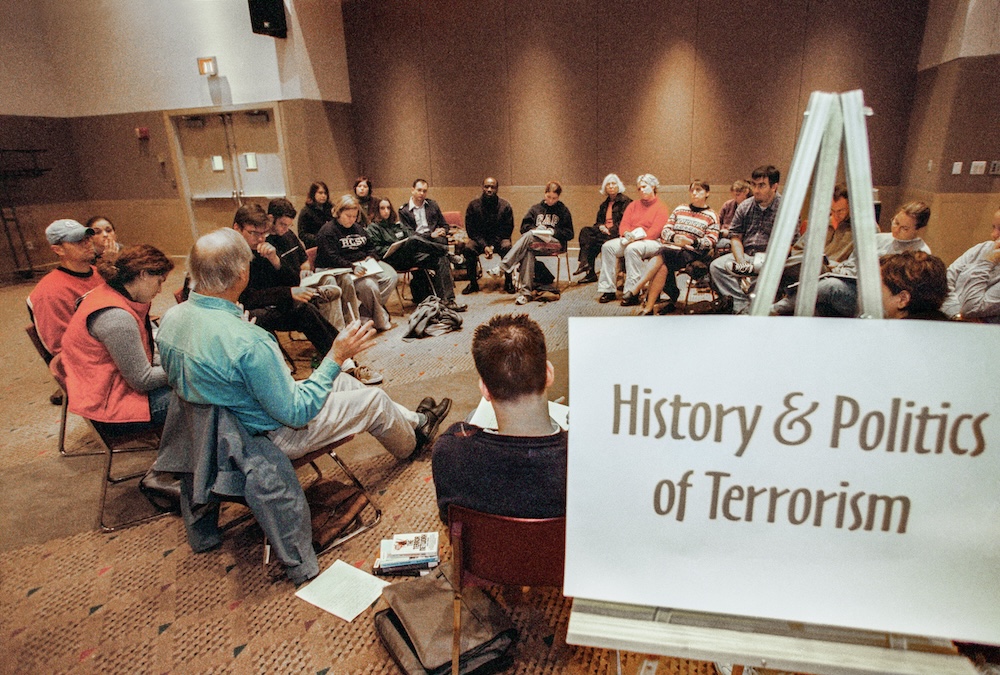
The photographs now serve as something more than a record of a historic event. They preserve a record of how 9/11 felt at BGSU.
Bell knows that today’s students experience the anniversary differently. Many were not yet born when the attacks occurred. When the university places flags in remembrance of the victims—including two BGSU alumni who died on 9/11—some students stop, kneel and understand what the flags represent. Others ask what they are for.
That, Bell believes, is why the photographs matter.
The towers were 600 miles away. The tragedy happened in New York, Washington and Pennsylvania. But on a college campus in northwest Ohio, students and colleagues were living through the same national trauma.
Bell’s photographs captured that smaller, deeply human story: the candles, the flags, the tears, the silence and the moments when strangers reached for one another.
They captured a university community trying to heal.
And they ensured that, decades later, BGSU would still have a visual record of what it meant to be there when America changed.
Twenty-five of Bell’s photographs are featured in the Memorial Photo Walk that will be set up outside of University Hall on Friday. The campus and greater Bowling Green community is invited to view the photos and experience what Sept. 11, 2001 and its aftermath looked and felt like on campus.
Additional 9/11 memorial events planned by BGSU to commemorate the 25th anniversary include:
- Field of Flags: The BGSU men’s soccer team will set up 2,975 small flags in the Bowen-Thompson Quadrangle lawn to represent the victims of the 9/11 terrorist attacks. Two large flags will represent Kathy Hawk Nicosia ’69 and William Ruth ’71, two BGSU alumni who were killed during the 9/11 terrorist attacks.
- The BGSU men’s soccer team also will host First Responders’ Night at their Friday night game against Depaul at 7 p.m. at Cochrane Field. They will hold a moment of silence to honor the 25th anniversary of 9/11.
- A 9/11 Memorial Stair Climb and Walk at the Stroh Center starts at 7 a.m. Friday with a short ceremony, followed by the stair climb at 7:30 a.m. The event is open to the public, and no registration is required. The doors open at 6:30 a.m. for pastries, coffee and community reflection on the Stroh Center Concourse. The BGSU ROTC Memorial Stair Climb, a part of the National Fallen Firefighters 9/11 Memorial Stair Climbs, is a way for the BGSU community to honor and remember the FDNY firefighters who selflessly gave their lives so that others might live on Sept. 11, 2001. Each participant pays tribute to an FDNY firefighter by climbing the equivalent of the 110 stories of the World Trade Center.
- 9/11 Day of Service & Remembrance: BGSU students will participate in meaningful service opportunities at various sites on campus and in the community that honor and remember those affected by the events of Sept. 11, 2001.