By JULIE CARLE
BG Independent News
Ohio history is important to Nancy Putnam Hollister, former Ohio governor, lieutenant governor and state representative.
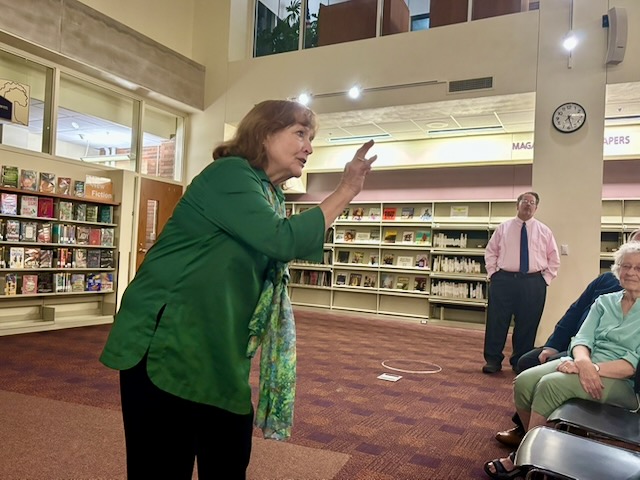
At the Wood County District Public Library on Oct. 8, Hollister, who is a member of the state America 250 Commission, connected the dots between Ohio’s history and the United States’ 250th anniversary. Her presentation was part of Wood County’s America 250 programming.
A native of Marietta, Hollister brought a personal connection to the history she discussed. Her family roots reach back to Ohio’s earliest settlement, with Brigadier General Rufus Putnam, known as the father of the Northwest Territory and founder of Marietta in 1788. Rufus was a cousin to her sixth great-grandfather Israel Putnam, who was known for his leadership in the Battle of Bunker Hill.
“Ohio played an extraordinary part in the development and the next chapter in our country’s history,” Hollister said, explaining why the state’s role deserves recognition during the America 250 celebration.
Ohio’s place in history is important because it is part of the Northwest Territory and the Northwest Ordinance, she explained. The ordinance chartered a government for the territory, provided a method for admitting new states to the Union from the territory and listed a bill of rights that guaranteed protecting religious freedom, encouraged education and forbade slavery in the territory.
“It was the first piece of the next chapter of our country when that ordinance was passed and became law,” Hollister said. Under the leadership of a group of pioneers, mostly Revolutionary War officers, the land was to be sold, laid out and developed. The state’s early history was connected to the growth of American government and the expansion of the young country.
“If our country hadn’t grown, if it hadn’t changed or moved forward, we wouldn’t be sitting here today,” she said, because the Spanish, French and English were waiting to take over.
Preserving the stories of everyday Ohioans
Hollister encouraged the audience to look beyond familiar names and dates when considering history.
America 250 activities, she said, provide an opportunity to collect the stories of ordinary people whose experiences might otherwise go unrecorded. Community meetings are being held to encourage Ohioans to share accounts of their families, upbringing, heritage and local history, with the stories to be archived for future generations.
“Every day you make a difference,” Hollister said, urging listeners to recognize the contributions of citizens in their communities, universities and state.
She praised Wood County’s participation in the statewide celebration, including local historical trails and a planned community quilt project called Threads of Democracy. She also highlighted the importance of libraries as places where people of different backgrounds can gather, learn and share experiences.
Hollister spoke warmly about the Wood County District Public Library and the role libraries play in supporting literacy, encouraging imagination and connecting communities.
“Without a library system, there is a tear at the fabric of every community,” she said.
A career shaped by public service
Hollister drew on her own political career to illustrate the importance of persistence, listening and working with people who hold different views.
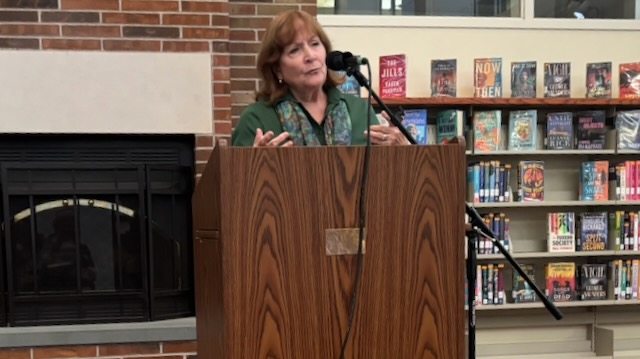
She served as mayor of Marietta, director of the governor’s Appalachian office, lieutenant governor and a member of the Ohio House of Representatives. In January 1999, she served as Ohio governor for 11 days between the administrations of George Voinovich and Bob Taft.
Her career included challenges to traditional expectations about women in public office. As a student at Kent State University, she challenged restrictions requiring women living in dormitories to observe curfews. Later, when she ran for mayor of Marietta, she recalled hearing that women should remain at home with their children rather than seek elected office.
Hollister said she won the mayoral election by emphasizing hard work, communication and a willingness to listen rather than making promises she could not guarantee.
She recalled that serving as mayor was particularly meaningful because it allowed her to interact directly with residents and respond to their concerns.
Her experiences in state government, she said, reinforced the need to understand different perspectives and find practical ways to work together.
Listening in a divided political climate
During a question-and-answer session, Hollister reflected on changes in political discourse since she entered public life during the Vietnam War era.
She expressed concern that political discussion has become increasingly personal and negative, with people often turning to sources that reinforce existing beliefs rather than engaging with opposing viewpoints.
“We don’t listen,” she said, describing what she sees as a growing obstacle to constructive public discussion.
Hollister encouraged students and other audience members to listen carefully, respect people with differing opinions and remain willing to learn from mistakes. She said disagreement does not have to prevent people from treating one another with respect.
She also urged young people entering the workforce not to become discouraged if their first jobs do not match their degrees or long-term plans. Starting somewhere, gaining experience and remaining open to new opportunities can lead to unexpected paths, she said.
As Ohio continues its America 250 observance, Hollister reminded the audience that the celebration is about more than commemorating the past.
“Ohioans have gotten a new sense of identity about who they are, not only now, but what was done in the past,” she said. “They have a renewed sense of place.”
The cooperation and partnership between communities all over the state has resulted in activities such as community picnics, untold stories, trails and train rides, she said. “You name it, we have done it.”