By JULIE CARLE
BG Independent News
Fifty years ago, R. Anthony “Tony” Marcson had a vision to create a place where kids could receive age-specific mental health services rather than adult services scaled to kids.
His idea became Children’s Resource Center, and despite his retirement in 2005 and death in 2022, his vision became the agency’s mission, said current CRC Executive Director Melanie Van Dyne.
“Over the years, CRC has continued that vision, building a full continuum of kids’ services, filling service gaps identified over the decades of changes in our societies and at the state level with rules and changes in service definitions,” Van Dyne said.

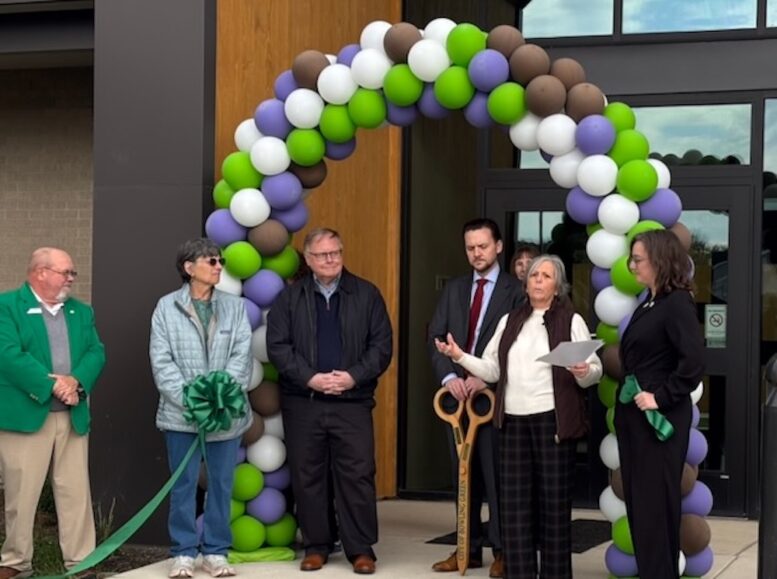
On Thursday, the Bowling Green Chamber of Commerce’s ribbon-cutting officially opened the R. Anthony Marcson Center, a $7.6 million 16-bed crisis stabilization center for youth to fill the shortage of youth crisis beds in Ohio. The center provides intensive crisis stabilization and residential behavioral health treatment for youth ages 6-17.
“The shortage of youth crisis beds has just reached a critical point,” Van Dyne said at the start of the opening ceremony. “There just aren’t enough beds, I say in Ohio, but really nationally there aren’t enough beds to serve the kids that are in need, a service gap.”
The intensive crisis stabilization center, which serves Wood County and the entire northwest Ohio region, was made possible after Gov. Mike DeWine committed $90 million of American Rescue Plan Act funds to strengthen the state’s behavioral health crisis response services.
Children’s Resource Center and the Wood County Alcohol, Drug Addiction and Mental Health Services (WCADAMHS) were awarded $6.6 million in 2023. An additional $1 million through a Youth Resiliency Fund grant and WCADAMHS matching funds, rounded out the funding for the facility.
The funds were designated to build and renovate the youth crisis services at CRC from an eight-bed crisis residential unit within CRC’s facility to a 16-bed building adjacent to CRC. The 16 beds, arranged within two residential wings, include 10 traditional crisis residential unit beds and six intensive-care beds for youth who require longer-term stabilization of up to three months.
A walk through the building affirms the space was designed with a child-centered, family-focused approach. The furniture is comfortable, yet functional —secured to prevent it being thrown in anger or frustration. There is an openness throughout that provides ample room for movement and personal space.
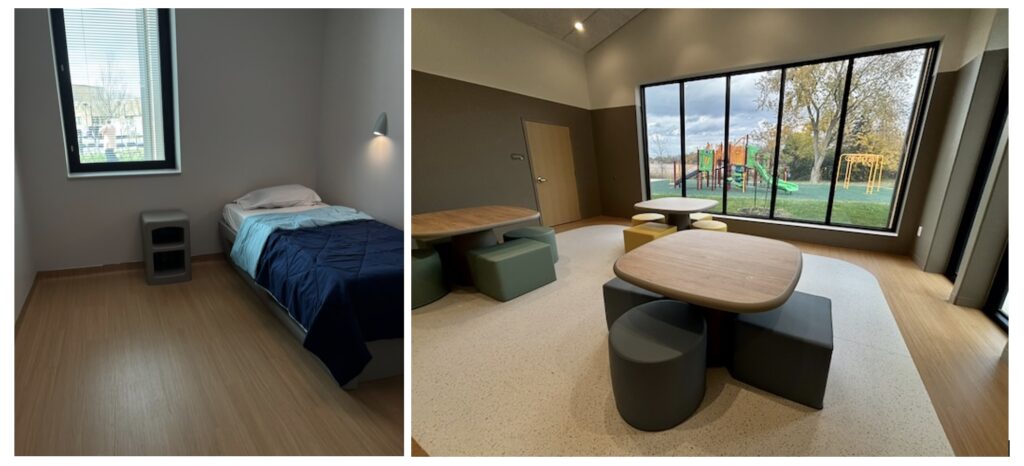
In addition to the private bedrooms, there are specialized therapy rooms for individual and group treatment, common recreation areas, including a secure outdoor courtyard and playground, sensory spaces, a full kitchen and dining hall and private family visitation spaces.
“I’m glad to see that CRC is able to build a new crisis center with more beds. It’s great to see that they’re getting the funding now to do bigger and better things, ” said Bowling Green resident Miles Nemeth, who attended because “this agency helped me out a lot when I was younger and played a pivotal role in my success in my community.
He admired the space and the layout of the building, noting it didn’t feel institutional “like many places end up feeling like for youth.”
CRC staff “really do care about the kids, and they are committed to seeing youth succeed, which is something that not every place that is meant for youth is,” Nemeth continued. “It’s hard growing up, but you are fortunate to be here to have people in this environment where you aren’t being viewed as a patient number, but as a person.”
The center will be open to provide services after the Ohio Department of Behavioral Health has come in to do the certifications “to make sure everything is up to code,” said WCADAMHS Executive Director Amanda Kern.
After the certification is complete, the kids who are still being served in the original (CRC) unit will be moved in, then the center will start the process of admitting additional youth in need.
“I am so incredibly grateful and so proud of CRC,” Kern said. “The amount of time and effort and energy that went into building the building and designing all of the details and working really hard to make sure every detail was truly what these kids deserve is such a wonderful thing.”
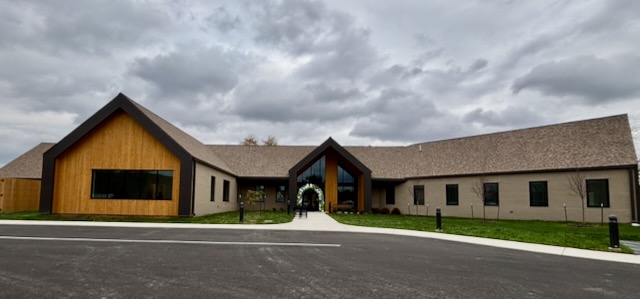
The ribbon-cutting ceremony had been postponed twice “because they were putting in so much time and care and energy and making sure it was absolutely the best it could be for our kids. I’m so thankful for that,” Kern explained.
She also praised the Ohio Department of Behavioral Health and the county for investing in and believing in the program.
“DBH has been a great partner,” making sure that everything is well furnished without having to compromise, she said.
“Because of the continued support of the county, services like this exist. We will continue providing support and funding to this building to make sure that any kid can access crisis service that needs it without being charged for services,” Kern said. “I’m really proud and very excited. I’m sure we’ll have lessons learned and there will be bumps along the way, but I’m really confident in this team. They are a great crisis team.”