
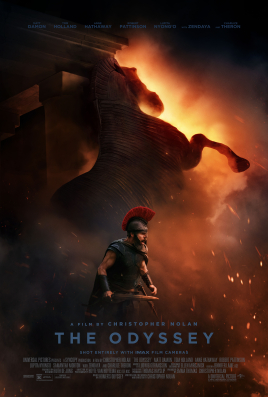
Film Review by CARROLL McCUNE
Along with The Iliad, The Odyssey is the beginning of the canon of Western literature. It’s the story of Odysseus, a Greek Bronze Age warrior-king who defeated the Trojans through trickery but spent ten years lost on the voyage home. He battled treacherous seas, a one-eyed giant, a seven-headed monster, and contended with seductive nymphs, witches, and the vengeful god Poseidon. Although he lost all his ships and crew, he survived himself thanks to the aid of the goddess of wisdom and war Athena, advice from the prophet Tiresias in the Underworld, as well as by his own wily stratagems.
Beginning in 389 CE, the Christianized Roman Emperor Theodosius I outlawed Greco/Roman pagan religion. Pagan ideas about the condition of the dead, belief in supernatural monsters, omens, a pantheon of warring deities, the practice of magic, divination, and ritual sacrifice were repressed by the early Christian church, but never completely eradicated. Pagan beliefs and values survived throughout the ages in Western art and literature, and by synthesis with Christian theology. experiencing a renaissance in modern cinema.
Although screenwriter/director Christopher Nolan studied several different translations of the 2,700-year-old, 12,109-line epic poem attributed to a Greek blind poet called Homer. he claimed to have based his screenplay on the 2017 English vernacular translation of The Odyssey by the British/American classicist Emily Wilson. Wilson, however, denied that Nolan’s adaptation reflects her progressivist/feminist interpretation of the archaic Greek text, stating that she “would be ashamed to have written any part of this script.” Commenting to AP she said, “I had the sense that Nolan was trying to pack everything in and was missing the themes essential to the poem.”
https://www.atomtickets.com/movies/the-odyssey/377232?tab=movie-details#
The themes of Homer’s Odyssey are hubris, fate, honor, and divine intervention in human affairs. The Christianized themes of Nolan’s Odyssey are transgression, guilt, vengeance, and Zeus’s Law (kindness to strangers). In an interview with Derek Thompson, Wilson described Nolan’s film as “a quite simple action hero movie about a man who feels bad about being an action hero.”
Nolan may have missed the essential themes Wilson emphasized in her translation, but he definitely picked-up on her epithet for Odysseus in the first line of the poem describing the hero as a complicated man.
Tell me about a complicated man, Muse, tell me how he wandered and was lost when he had wrecked the holy town of Troy, and where he went, and who he met, the pain he suffered on the high sea, and how he worked to save his life and bring his men back home.
Other English translations use phrases like a man for wisdom’s various arts renown, (Alexander Pope), a resourceful man (E.V. Rieu), that man skilled in all way’s contending (Robert Fitzgerald), and the man of twists and turns (Robert Fagles). All these various translations describe the nature of Odysseus’ actions whereas Wilson’s choice of the word complicated seems to describe his character or psyche.
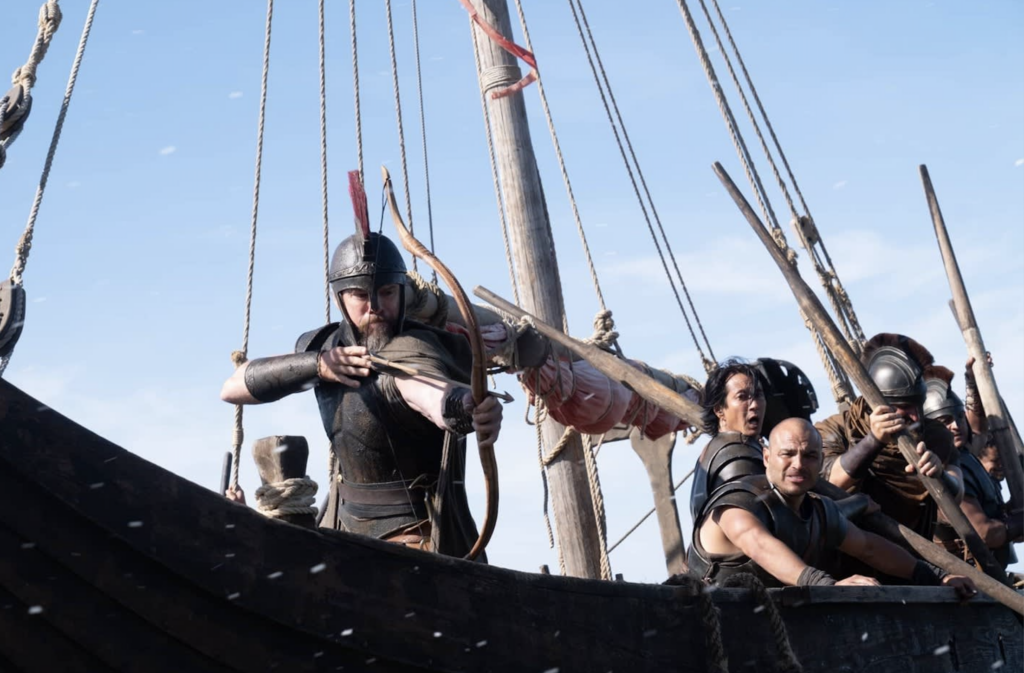
Subsequently, Nolan tapped Matt Damon for the role of Odysseus based on Damon’s ability to portray complicated men rather than on any resemblance to the mythical hero. Homer described Odysseus as a brawny, gloriously handsome, godlike warrior king in the prime of life. In preparation for the role, fifty-five-year-old Damon lost thirty pounds and grew a beard, but with his suburbanite physique, up-tipped feminine nose, and relatively short stature (5ft, 10in), he just doesn’t look the part. Neither does he speak the part, delivering his lines flatly in American colloquialisms. Also, Nolan cast Damon in a role against the actor’s on-screen character type. Damon usually embodies moral integrity. Homer’s Odysseus was an unapologetic Bronze Age warlord and raider. In the poem he brags, “I sacked the town and killed the men. We took their wives and shared their riches equally among us.”Homer’sOdysseus did not have a Christian conscience, but in order to make him complicated and more relatable Nolan gave him one.
Translator Emily Wilson explained that she chose the word complicated primarily to describe all the complicated ruses Odysseus devised to maneuver himself out of hopeless situations. Nolan, however, mistakenly took her choice of the word complicated to mean a morally conflicted, guilt-ridden, evolving hero. But the film begins with the revenge driven slaughter of the Trojans and ends with the revenge driven slaughter of the suitors. Odysseus’ morals and motivation never changed, both in the poem and the movie, despite Nolan’s addition of a complicating conscience.
He defended his choice of Damon in an interview with Richard Roeper for the Chicago Sun Times: “The character—how do you move that character to center stage and have him take you on that journey? Casting Matt Damon is a huge part of that. I mean, everything starts script-wise, but a lot of it is about, okay, who’s going to take you on this journey? Who can the audience invest in? Matt is an amazing actor, but he’s also a terrific movie star. He has that empathetic openness to an audience. We just go with him. We want to believe in him, and we want to see where he can go.”
Simply praising the actor’s talent, however, does not answer the accusation of miscasting Damon for the role. Could it be that Nolan just wanted a star-studded, box-office-proven cast and gave less consideration to believability than he purported?
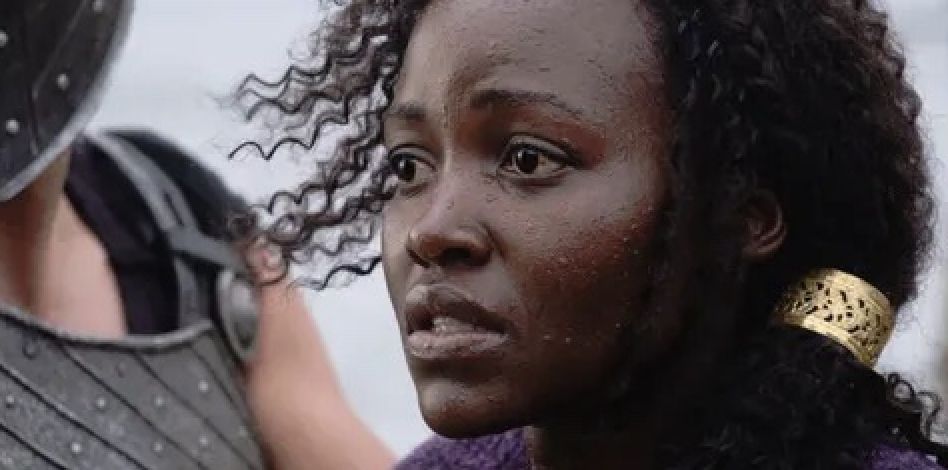
Other big-name casting choices for The Odyssey are even more controversial than Damon. Kenyan/Mexican actress Lupita Nyong’o was chosen for the dual role of the fair-haired, fair-faced, white armed Helen of Troy and her murderous sister Clytemnestra. Black British actress Zendaya played Athena, represented as a ghost of a priestess of the Temple of Athena killed during the sack of Troy. Rapper Travis Scott stood in for the blind bard Demodocus who is presumed to represent Homer himself. These casting choices prompted accusations of race-swapping for the sake of diversity.
Nolan made no reference to race in explaining his choice of a black woman to portray Helen of Troy, the most beautiful woman in the world. He said that Lupita Nyong’o was his first choice to play Helen because the role needed “strength and poise as much as beauty. And Lupita makes it look effortless. I was absolutely desperate for her to do the part.”
He minimized Zendaya’s role as Athena who is the driver of all the action in the poem; sublimating her character to a mere personification of Odysseus’ guilt over assaulting the innocent women in the Temple of Athena during the mêlée at Troy.
He justified rapperTravis Scott as the blind bard Demodocus by explaining that he wanted “to nod to the idea that this story has been handed down as oral poetry which is analogous to rap.”
Tom Holland portrayed Odysseus’ son Telemachus who in the poem equaled his father in stature and brutality, if not in cunning. Holland is 5’8” and spoke more like an American adolescent in the movie than a proud prince of ancient Ithaca. While no one objects to using modern English for a modern audience, the mundane dialogue employed in this film further detracts from its credibility. Incongruities in appearance and speech mannerisms undermined the believability of each actor’s respective role.
The director dismissed complaints about miscasting as “irrelevant” because most were leveled before the film was released in theaters on July 17, 2026. Nolan told The Telegraph, “But look, these conversations that happen before people see the film—they’re always irrelevant, because no one having them knows what the film actually is yet.” Nolan was referring to the visceral experience of a film. “I feel a real responsibility to try and get as much on screen for the audience as possible.”
Nolan feels that Hoyte Van Hoytema’s huge scale cinematography compensates for the film’s character inauthenticities.
Nolan allowed his cast to interpret their own character as they wished in order to modernize them or add psychological depth. Anne Hathaway conjured a less passive Penelope (Odysseus’ faithful, weeping wife) by adding volatility, imperiousness, and a seething hatred for the contemptible suitors. Robert Pattinson delivered an Oscar worthy performance as Antinous (the chief suitor vying for Penelope’s hand) with extreme but believable villainy.
Other cast members include James Remar as the dead prophet Tiresias, Samantha Morton as the enchantress Circe, John Bernthal as the Spartan King Menelaus, and Charlize Theron as the nymph Calypso who Nolan changed from a seductress goddess who offered him immortality into a therapist urging him to talk. Transgender actor Elliot Page played Sinon, a character from a later Roman epic not in the Greek text but central to Nolan’s interpretation of Odysseus as a guilt-ridden man. Speaking from the Underworld, Sinon’s ghost reproached Odysseus for the deception that resulted in his death and the war crimes committed at Troy.
The Odyssey has endured as a seminal work of creative literature in the Western canon precisely because of its iconic, archetypal characters. Filmmakers who adapt the story need to compel the audience to believe in the actors who portray them, just as Nolan says but fails to achieve. If an actor doesn’t speak like or remotely resemble the poem’s description of a character, then disbelief ensues and the film fails to provide catharsis. Nolan sacrificed authenticity of character in favor of long-established plot devices.
Ever since the film industry went into the action hero business, it has employed seven basic plots. As identified by journalist Christopher Booker, they are: 1) voyage and return, 2) quest for a prize, 3) overcoming a monster, 4) rags to riches or riches to rags, 5) adventure with a happy ending, 6) adventure with a tragic ending, and 7) rebirth/awakening from a spell. All of these plot devices occur in The Odyssey.
Nolan obliquely tapped into some of these plot devices before with The Dark Knight Trilogy (2005-2012), Inception (2010), Interstellar (2014), and Oppenheimer (2023), Beginning in 2024, he decided to go straight to the mother lode of pagan mythological scenarios with his own adaptation of The Odyssey. But the scriptwriter/director deviated from the themes and characters of the text so much that the movie is more a clever riff than a serious adaptation. It’s a Hollywood style fantasy film created for the purpose of entertainment and profit. But, as a filmmaker not a classicist, Nolan has every right to alter the story according to his own artistic vision. The film will fail or succeed depending on its value as entertainment.
Nolan revealed that his primary motivation in undertaking this enduring epic had more to do with his fascination with the immersive effects of the IMAX camera’s 70mm large format film than with any desire to perpetuate pagan mythology. During interviews, he focuses on how he overcame the challenges of filming with a 300-pound- camera (the IMAX had to be encased in a heavy box in order to muffle its deafening noise) and boasts about his technical achievement in depicting action and creating the first feature film shot entirely on IMAX. The problem is that only twenty-four theaters in the United States have the necessary 52 by 72 feet hemispherical screen, digital laser projector, and multi-channel sound systems needed for the full IMAX experience.
Produced by Universal Pictures and Nolan’s own Syncopy production company, the movie grossed more than $260 million in ticket sales on its opening weekend. The film runs for 173 minutes. Several episodes in the original story were omitted, and it unfolds in three parallel narratives. It is R-rated for excessive violence. Running in local theaters until August 5, 2026, it will be available to stream on Premium Video-on-Demand platforms around November 2026.
