By JULIE CARLE
BG Independent News
Members of the Bowling Green community came together Tuesday morning as neighbors, friends and colleagues in a caring community.
The Multifaith Breakfast, hosted by the Bowling Green Human Relations Commission, returned after a six-year, post-Covid hiatus with a theme of “Peace: Respecting our Differences.”
Approximately 50 people attended, representing Russian Orthodox, Church of Jesus Christ of Latter-Day Saints, Unitarian Universalists, Buddhism, Taoism, Islam, Judaism, agnostics and many with no specific declared faith, according to Jerry Anderson, master of ceremonies for the event. “That is the diversity of faith in our community, and all of those should be respected in our community.”
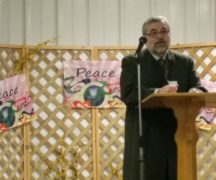
“Each of us comes from a different path of faith, philosophy, and culture. Yet, this morning reminds us that while our traditions may guide us in different ways, they often lead us with the same values,” said Bowling Green Mayor Mike Aspacher.
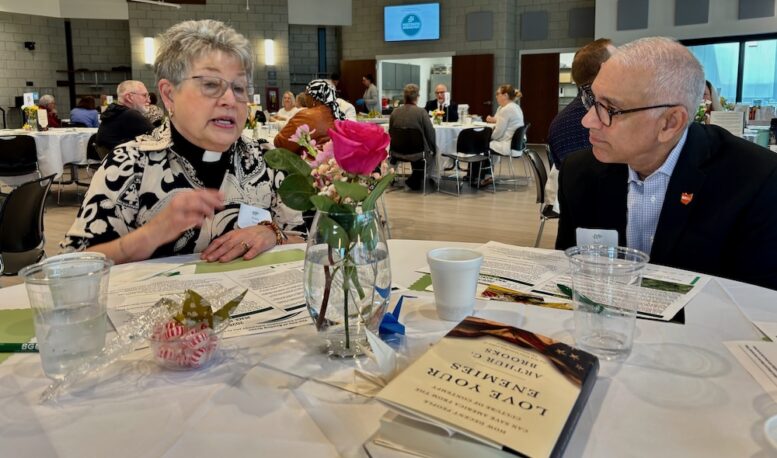
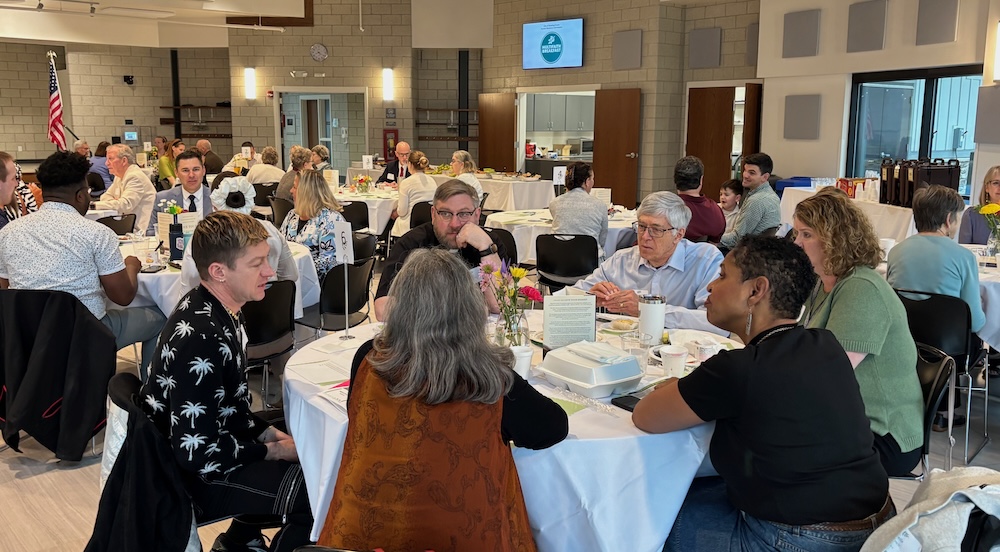
The task at hand was not to listen to a keynote speaker or a panel of experts, but to bring together voices from across faiths and perspectives in small-group conversations. They were asked to explore how understanding—instead of division—can shape a stronger community and break down barriers to dissolve the current “culture of contempt.”
“Does anyone sense the level of animosity in the current U.S. political landscape?” Anderson asked.
“Does anyone sense the level of animosity in the current U.S. political landscape?” Anderson asked.
The table discussions centered on a video and discussion based on Arthur Brooks’ book “Love Your Enemies,” which examines how contempt—not disagreement—is the true driver of today’s cultural divides. Brooks, who wrote the book in the reality of today’s breach of civility.
“There’s very clear data that 93% of Americans hate how divided we ‘ve become,” Brooks said during a short video shown of an interview on PBS. “That doesn’t mean that we agree with each other. On the contrary, we shouldn’t agree with each other because we have a competition of ideas. That’s a good thing.”
However, there are some people getting rich or famous as leaders, media and social media influencers who “are saying it’s okay to hate each other,” Brooks pointed out. “This is insane, of course. Nobody in history has ever been persuaded by insults. And it’s immoral to hate each other as well, simply because of political disagreements.
During the video, Brooks suggested the path toward “something better” requires each individual to “take a different path.”
His initial idea for the book was to provide an institutional look at better politics and better culture. He ended up writing a book that is more practical for how everyone can become a better person.
“That’s how we get it done,” he said, also admitting that it’s hard. “The hardest thing is to conquer one’s own self. It’s not changing all the society. The real challenge is saying, ‘Am I strong enough to conquer my own part?’”
As the guests prepared to discuss six topics, Anderson reminded everyone, “Remember our differences. We don’t want them to divide us.”
Table discussions provide meaningful conversations
Participants explored Brooks’ distinction between anger, a passionate emotion, and contempt, which he defines as a cold belief that others are worthless. This distinction sparked meaningful reflection throughout the room at nearly a dozen tables.
Attendees were asked to wrestle with difficult but essential ideas: the tendency to assume one’s own side is motivated by good intentions while others are not, the role of social media in deepening divisions, and the challenge of showing what Brooks calls “moral courage”—standing up for the dignity of those we disagree with, even among our own peers.
A recurring theme throughout the morning was that love is not merely a feeling but a deliberate action: choosing to will the good of others, even in disagreement. Expanding social circles, listening with curiosity, and recognizing shared values—particularly the universal concept of “goodness” across faith traditions—were identified as practical steps forward.
Lindsay-Jo Douglas, chair of the Bowling Green Human Relations Commission, closed the event by encouraging attendees to carry the spirit of the breakfast into their daily lives. The message was clear: building bridges doesn’t require agreement on everything—but it does require respect, humility, and the courage to engage.
“In today’s divisive world, when differing beliefs are often demonized, the Human Relations Commission wanted to create an environment where people could come together and unite for a common good. Instead of a keynote speaker, we chose to have facilitated table discussions, so that we could foster community collaboration. These proved to be meaningful, and I think everyone walked away with the spirit of togetherness,” she said. “I consider the event a success and look forward to next year’s breakfast.”
“This breakfast is more than a meal. It is a symbol of what our community can be at its very best. A place where differences are not barriers, but opportunities to learn from one another and build something stronger together,” Aspacher said.