By JAN McLAUGHLIN
BG Independent News
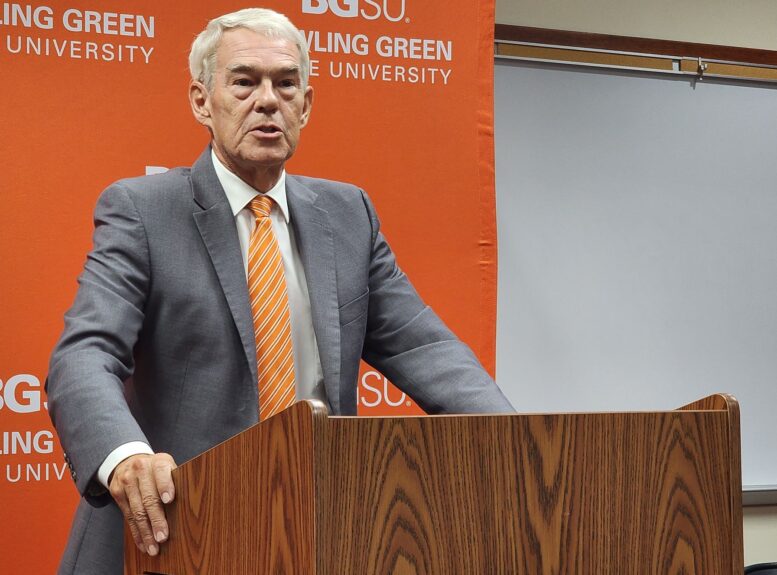
Randy Gardner has long been a believer in public broadcasting – dating back to when he answered the banks of telephones during fundraising telethons.
“I was supportive of WBGU,” he said. “I believed that my constituents in Bowling Green and Wood County cared about public TV.”
Now that he’s retired from paid public service – as a state representative, state senator, and higher education chancellor – Gardner has been asked to fill a different role. On Friday, he began a four-year unpaid term on the Broadcast Educational Media Commission.
For Gardner, it’s important that he “re-engages and supports things I’ve supported in the past.”
The Broadcast Educational Media Commission is an independent state agency dedicated to enhancing educational broadcasting and connectivity across Ohio. With over six decades of service, the agency has supported public broadcasting and promoted educational opportunities through technology and collaborative partnerships.
Now is an especially vital time for the BEMC, which provides state subsidies for public broadcasting.
The WBGU programming was at risk after federal funding cuts of $1.1 million to the Bowling Green PBS station. That federal funding made up more than 40% of the station’s budget.
The federal cuts created an unsustainable long-term financial model, and BGSU announced in January that WBGU would no longer be able to carry PBS programming after June 30, 2026.
“Federal cuts made it difficult, if not impossible, to generate a local product,” such as the programming that WBGU-TV in Bowling Green used to produce, Gardner said. “There’s less ability to have local programs and local conversations, which is disappointing.”
Some local viewers would still have been able to catch WGTE-Toledo, but many in this area would have been left with no access to public television.
But unlike some other small public television stations in Ohio, a partnership between WGTE-Toledo and WBGU rescued the smaller Bowling Green station from shutting down.
The role of the Broadcast Educational Media Commission in Ohio is to provide financial assistance and technical services to eight public television stations, 15 public radio stations, and six radio reading services. BEMC’s budget also includes operating support for The Ohio Channel and Statehouse News Bureau.
The Ohio Channel and the Statehouse News Bureau provide educational, comprehensive coverage of legislation, elections, issues, and other activities of the Ohio General Assembly, the Ohio Supreme Court, and the Executive Branch of Ohio. These productions are available to Ohio’s public radio and television stations.
Access to news about the operations of government should be available to Ohio residents, Gardner said.
“It should be accessible to the public – if the public wants it,” he said. “We must continue to respect the value of the public’s right to know.”
Gardner, who was appointed to the commission by Gov. Mike DeWine, said he hopes Ohio’s new governor has the same commitment to public broadcasting.
According to BEMC, the PBS brand is continuously voted as America’s most trusted source of public affairs information. Ohioans are familiar with their local Ohio Public Broadcast partners, including PBS television stations, public radio stations, and radio reading services for individuals with vision impairment or low vision.
The total appropriation for the agency in 2026 is $10,383,765. And the total for 2027 is $9,728,169. Nearly 99% of the total funding over the biennium comes from the state’s General Revenue Fund.
The allocation set aside for WBGU-TV for this year is $161,194, and for WBGU multi-media is $76,506.
The BEMC mission is to expand the knowledge of Ohio’s citizens by:
- Supporting and funding public television, radio, and Radio Reading Services, which ensure blind and visually impaired Ohioans have access to critical information.
- Delivering educational programming and broadcasting solutions statewide.
- Collaborating with stakeholders and advocates for technology-driven education.
The agency’s partnerships and infrastructure empower Ohio’s state government to connect with its citizens through initiatives such as live legislative sessions, public health updates, and learning opportunities.