By JAN McLAUGHLIN
BG Independent News
While data centers are promising millions in investments across the nation, some regions are feeling a drain on precious utilities and disappointing returns for tax breaks.
Some economists are citing locales where data centers have led to a brief boom to a region, only to become a bust when their tax abatements run out, according to Bowling Green native Nick Messenger, an economist and senior researcher at the Ohio River Valley Institute.
Data centers qualify for a lot of economic development incentives, Messenger said. But the returns for local governments are often lacking.
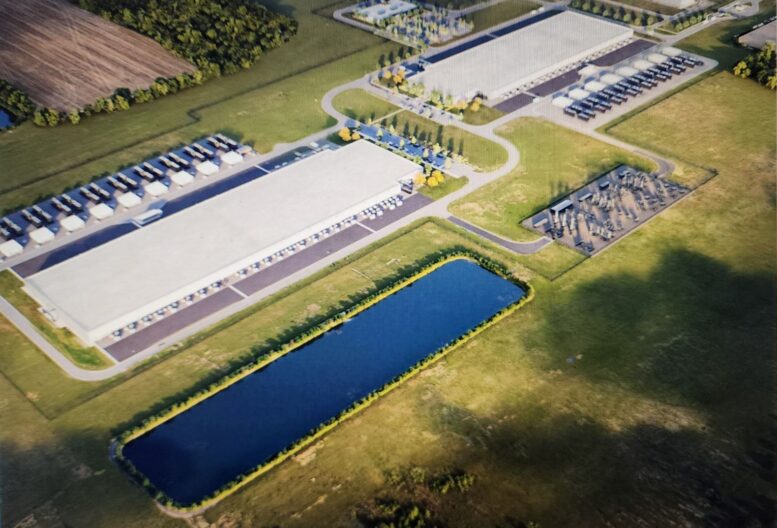
“The problem with the data centers is they don’t really create that many jobs,” he said. Once completed, the $800 million Meta data center being constructed on the 280-acre site in Middleton Township, north of Bowling Green, will employ approximately 100 workers.
The heartland of the nation – like Wood County – offers prime possibilities because of the large swaths of farm acreage potentially available for development.
And usually local officials are trying to look out for their communities, Messenger said.
“They are trying to do what’s right for the community. Not just looking for a photo op,” he said.
But according to Messenger, state leaders have been known to fall victim to “ribbon cutting syndrome.”
During Meta’s announcement earlier this year, a representative of JobsOhio said the new data center will help Ohio build a reputation as the nation’s “silicone heartland.”
Messenger and Mark Partridge, economist and Professor Emeritus at Ohio State University, have studied tax incentives in Franklin County for huge developments like data centers.
“They have been a massive giveaway with little job creation to show for it and often the company leaves or sells the site after the abatement ends,” Messenger said. “Often, data centers end up costing more in abatement per job than multiple years of worker salaries, raising questions about what the real gain is and for who.”
Power demands
The Meta acreage is close to a source of electricity, with the First Energy substation nearby on Mercer Road. And fiber-optic lines traverse the area, which could carry large amounts of information to and from the data center.
Meta is expected to be a heavy water user, requiring up to 600,000 gallons a day. The site will be served by the Northwestern Water and Sewer District, using Bowling Green water.
When Meta was searching for its site, the company said it would need up to 180 MW of electricity on peak demand days. That’s almost double what Bowling Green uses on the hottest summer days, according to Bowling Green Assistant Utilities Director Jim Odneal.
And in the last few weeks, owners of farm acreage south of Bowling Green have reported that representatives of a natural gas pipeline have been making inquiries about installing a line to the Meta site in Middleton Township.
One of the landowners said the firm working on behalf of the pipeline business, Williams Companies, has contacted descendants of the property owners to make them aware of the potential income from a pipeline.
Multiple calls from BG Independent News to Williams Companies went unreturned.
Tax abatements
As is customary with these types of large projects, Meta sought a Community Reinvestment Area agreement with the county. The county commissioners agreed in 2023 to a 75% tax abatement for 15 years for the project.
Big companies know how to get areas to compete for them, so they can “shop around” for the best deal, Messenger said.
When making the big announcement earlier this year that Meta was the company developing the data center, Dean Monske, president and CEO of Regional Growth Partnerships, said it wasn’t the tax breaks that attracted Meta to the Wood County site.
“Incentives are not what drove the decision,” Monske said.
Rather it was the availability of ample power, land, and water – “world class assets,” he said. Plus access to interstate highways and railroads provide connections to much of the U.S.
However, when requesting the tax break from the county commissioners in 2023, Chris Knezevic, an attorney representing Liames LLC, which purchased the Middleton Township acreage, said the abatements can make or break a deal.
“It’s an important factor,” Knezevic said. “It’s one piece of the puzzle. There are a lot of factors to consider.”
The developer also got a Tax Incentive Financing agreement to help with public infrastructure costs.
A roundabout was constructed on Ohio 582 to allow for smooth ingress and egress to the site for the hundreds of vehicles accessing the Meta acreage each day. The $2.8 million roundabout was funded by $1 million from the Ohio Department of Development, $250,000 from the Ohio Department of Commerce, and the rest by Meta.
During the peak of construction for the data center, more than 1,000 vehicles a day will likely be accessing the site. Once construction is completed, the data center is expected to generate minimal truck traffic.
Worth it?
What may initially seem like “manna from heaven,” to an area without much economic development, can result in a drain on local government, Messenger said.
More than 40 years of research has repeatedly shown that “small businesses create far more jobs,” he said. And those businesses use local services, like accountants, attorneys, and don’t send “dollars flowing back to the west coast.”
“We see this race to the bottom play out,” he said. “Sometimes it can be a blessing for someone else to get it.”
While Meta has cited the need for 1,000 workers to construct the site north of Bowling Green, this area doesn’t have enough to fill that demand, Messenger said. “You have to bring them in from somewhere else,” he said.
“This isn’t the worst one I’ve seen,” Messenger said of Meta’s plan in Wood County. “It’s not the most egregious example. I hope this one works out.”
The environmental impact is not as detrimental as in some locations, and Meta is proposing 100 jobs as opposed to 30-50 like some data centers.
The jobs at the site will include technicians, heating and cooling specialists, administrative support and planners – earning an average annual salary of $83,000. Meta officials said they make a concerted effort to source labor and materials locally and provide “substantial contributions” directly to the community.
But in many cases, there are no robust reporting requirements, and for some the reporting is voluntary, Messenger said.
“There’s no mechanism to go back to Meta and say, ‘Did you create 100 jobs?’”
Initially with such tax break agreements, school districts benefit.
“It’s a boon for schools early on in the deal.”
But will 100 jobs materialize, he asked. And will the project remain after the abatements run out in 15 years.
“Are these data centers going to be operating in 2040?” Messenger asked. “They tend to leave in year 14 or 15.”
“I hope I’m wrong,” he said.
Water supplied by BG
When Meta started scoping out possible locations, Bowling Green was already bulking up its water supply system for Abbott Labs, which is planning a facility on the north edge of the city.
The city’s average water usage is about 5 million gallons a day. The city’s water treatment system is approved by the EPA to effectively treat 10 million gallons a day.
The Abbott Laboratories plant planned on the north edge of Bowling Green may use up to 1 million gallons of water a day. Abbott plans to invest more than $500 million in the site and create 450 permanent jobs.
Meta is also expected to be a heavy water user, requiring up to 600,000 gallons a day. The site will be served by the Northwestern Water and Sewer District, using Bowling Green water.
So last year the Bowling Green Board of Public Utilities approved a new contract with the district. The city already supplies the district with about 860,000 gallons of water a day. The new contract would allow for the sale of an additional 600,000 gallons of water a day to the district, reaching a maximum of 1.5 million gallons a day.
The city has the capacity to treat the bigger demands for water – and has enough water from the Maumee River to supply the needs, according to BG Utilities Director Brian O’Connell.
“The plant has never run out of water,” O’Connell said. While some upriver communities have run dry in the past, the intake for the Bowling Green water system is located in a “bowl” in the river, he said.
Among the communities that rely on the Maumee River for water, Bowling Green has an allotment of 14 to 15 million gallons a day. The city has the ability to treat 10 million gallons a day, but normally treats an average of 5 million gallons of water a day.
The city’s utility division has been planning ahead for the growing water demands.
In early 2024, the Bowling Green Board of Public Utilities voted to proceed with a $4 million expansion of the membrane treatment process at the city’s water treatment plant.
“We have plenty of capacity in the plant to supply this water,” Assistant Utilities Director Jim Odneal said.
In June of 2024, Bowling Green took another step toward expanding its reservoir capacity next to its water treatment plant that draws water from the Maumee River. The Board of Public Utilities voted unanimously to purchase two acres that sit immediately north of the water treatment plant.
The new acreage could potentially double the water reservoir space at the plant. This was the second land purchase for more reservoir space. In early 2023, Bowling Green bought 36 acres to add reservoir space next to its water treatment plant.
The existing reservoir provides about 30 to 45 days of storage capacity based on the current water production.
The water treatment plant currently has a 170 million gallon raw water reservoir. The additional acreage purchased last year is expected to add storage for 100 to 150 million gallons of raw water.
The city pumps river water into the reservoir when the river has higher water quality. Efforts are made to avoid pumping when there are higher levels of pollutants in the river such as turbidity, sediment, storm events, nitrates, farm runoff, etc.
The reservoir then provides raw water to the plant for treatment. This allows the plant to use the best quality raw water for the treatment process which reduces costs and avoids potential issues.
Elsewhere…
A recent report by ProPublica cited Washington state’s tax breaks for data centers have spiraled into one of the state’s largest corporate giveaways. The breaks were intended to spur job creation in rural areas, and have cost more than $474 million in taxpayer funds since 2018, but the bulk of these benefits have accrued to Microsoft—not local communities.
In Washington, the exact number of jobs created is not a matter of public record but, according to ProPublica, an array of data center projects with a total taxpayer cost of $53.3 million would only need to collectively hire 260 people to meet the required threshold. That is an average cost of $205,000 per job or about three years salary at the median income in the state.
Forbes magazine has reported that data centers not only fail to create jobs in significant numbers, they are huge drains on local infrastructure.
As governments look to stimulate economic development, it is crucial to see the industries they are supporting for what they are—rather than what they’d like them to be, Forbes stated. Data centers do not serve as permanent and ongoing job creation engines anymore than the construction of a highway or a bridge does.
Forbes continued, reporting that subsidizing ownership of data centers, through property and sales tax breaks for example, is less defensible. The tech companies that dominate the market for these centers are among the most valuable companies in the world, with market caps that regularly dwarf the gross domestic product of the states they are asking to foot the bill. These corporations have ample resources to manage their own operational costs without public support.