By TOM GERROW
BG Independent News
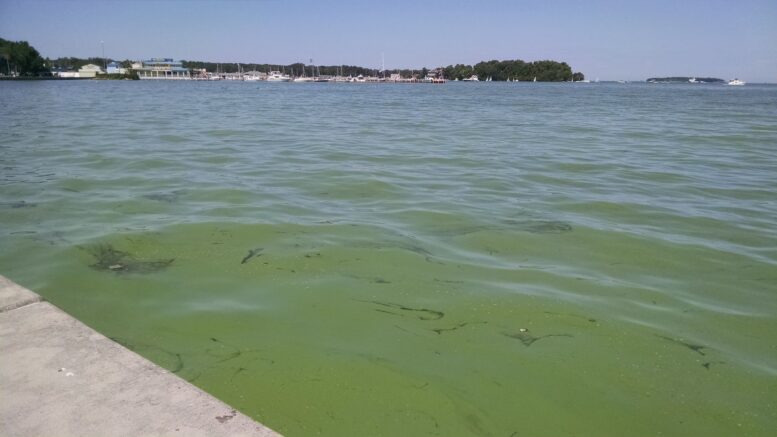
Harmful Algal Blooms, or HABs, have plagued Lake Erie for decades now. But scientists, government officials and the agricultural industry have been working to understand the nature and causes of HABs, and to reduce their severity. Ohio Sea Grant and Stone Lab co-hosted a recent conference in Toledo to bring these groups, as well as interested members of the public, together to share the latest information on HABs and related topics.
“It’s really the best way scientists can reach the public,” said George Bullerjahn, emeritus professor in the Department of Biological Sciences at Bowling Green State University and one of the hosts of the conference. “The talks are meant to inform not only other scientists – that’s a secondary thing – but primarily to reach the public and the news media.”
Thomas Bridgeman, professor of ecology and director of the University of Toledo Lake Erie Center, began the conference by describing Lake Erie as a living thing that changes over time. Much research and many mitigation efforts have focused on Erie’s watershed, but he urged the audience to also pay attention to the lake itself.
Lake Erie’s temperature has been on the rise since 1995, said Greg Gobler, a professor at Stony Brook University. And the shallowest areas – the western basin, including Maumee Bay – have warmed the fastest. This warming of the western region of Lake Erie, which also receives a high load of the nutrients that algal blooms thrive on, has lengthened the bloom season by as much as a month.
Algal blooms like it hot, Gobler said, and cyanobacteria, the blue-green algae that produce the toxins that make a bloom harmful, like it the hottest.
Microcystin, a toxin produced by cyanobacteria in HABs, is a primary concern, said Greg Dick, a professor in the Department of Earth & Environmental Sciences at the University of Michigan and director of both the Cooperative Institute for Great Lakes Research and the Great Lakes Center for Freshwaters and Human Health.
But HABs consist of many different types of cyanobacteria that can produce dozens or hundreds of other novel toxins, Dick said, and microcystin is just the tip of the iceberg.
Dr. Sarah Emery, who is the director of BGSU’s Center for Great Lakes and Watershed Studies (CGLWS) and attended the conference, said that people are most often exposed to these toxins through contaminated water and that scientists already know a lot about the health risks of microcystin, one of the most common toxins in Lake Erie.
“But new research by faculty in the BGSU Center for Great Lakes and Watershed Studies and their partners is exploring how other cyanotoxins may become airborne, and whether breathing them in could play a role in neurodegenerative diseases like ALS, Parkinson’s, or Alzheimer’s, as well as worsen respiratory conditions such as asthma or pneumonia. Much more work is needed to understand the risks of these airborne toxins for people who live near or spend time on lakes with HABs,” Emery said.
“Still, it isn’t all doom-and-gloom, as these cyanotoxins may also represent an untapped source for pharmaceuticals development,” Emery added.
According to Dr. David Kennedy, professor of medicine at the University of Toledo, work to determine the health burden of toxicity in the lake is ongoing, but it will take time and require large, long-term, and expensive future studies.
Omics — shorthand for a variety of fields of inquiry such as genomics, epigenomics, and others — and phenology, which examines the timing, intensity and duration of HABS, were also topics at the conference.
“New ‘-omics’ tools, like genomics and metabolomics, let scientists see what’s happening inside harmful algal blooms at the genetic and chemical level,” Emery said. “They can show us which algal strains are present, what toxins they can produce, and how they respond to changing conditions. Phenology is about the timing of algal blooms. When do they start, peak, and end, and how is that shifting with climate change? Together, these approaches give us both the fine-scale detail and the big-picture patterns we need to better predict, manage, and ultimately reduce the risks from HABs.”
Researchers who examine Lake Erie’s water at the microscopic level can detect the presence of the mcyE gene, which is involved in toxin production, offering insight into the possible presence of harmful algae.
“Scientists with NOAA and other agencies are able to monitor the size and movement of HABs in Lake Erie using remote sensing technology, but this can’t necessarily tell us about the relative toxicity of a given bloom,” Emery said. “Water tests for the mcyE gene, which is involved in microcystin synthesis, can serve as an early warning of toxin-producing strains and give municipal water utilities more time to prepare for potential risks, though actual toxin levels still require chemical confirmation.”
The management of agricultural nutrients and the storage and application of manure were also addressed.
Samuel Mullins, chief of the Division of Livestock Environmental Permitting at the Ohio Department of Agriculture, provided an overview of the permitting process and operating requirements for large concentrated animal feeding facilities (CAFFs), and major CAFFS (or MCAFFs, which are 10 times larger than CAFFs) in the state.
The livestock numbers to qualify as a CAFF, and thus subject to specific state regulations, vary based on the type of livestock. For example, 2,500 swine weighing 55 pounds or more would qualify as a CAFF, while 25,000 swine would qualify as an MCAFF, or 700 mature dairy cows (CAFF), versus 7,000 mature dairy cows (MCAFF).
In Ohio, there are 302 CAFFs, of which 23 are MCAFFs. All these facilities are required to have a manure management plan, and all MCAFFs must have at least one certified livestock manager who is responsible for manure management.
Mullins said the department is actively involved in overseeing the construction of CAFFs and that manure management is a significant aspect in issuing a permit to operate.
Glen Arnold, professor and field specialist at The Ohio State University, reported on new technologies and methods of applying manure to fertilize crops. Wetter rainfall patterns during the last 20 years have led to fewer days in spring and fall that are suitable for applying manure. Arnold said that using liquid manure, combined with new application technologies, opens additional windows of opportunity to apply manure.
The goal, Arnold said, was to get the right nutrient to the right place, at the right time, and in the right amount.
“I was impressed by new technologies and farming practices, such as knifing in manure or using tools such as the Rain 360 Toolbar, which can help farmers get more value from manure while reducing runoff into our waterways,” Emery said. “With wetter springs becoming more common due to climate change, it’s also harder for farmers to time planting and nutrient applications, so it was interesting to hear about farmers trying manure applications during the growing season, which may further cut down on runoff.”
HABs are an issue in many bodies of water other than Lake Erie, and this HAB research has relevance nationally and internationally.