By JAN McLAUGHLIN
BG Independent News
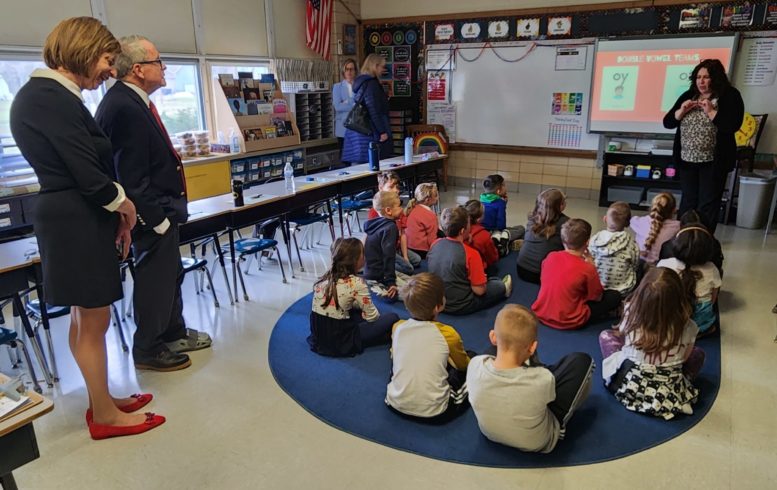
Nearly three years ago, Gov. Mike DeWine strolled through Conneaut Elementary School, stopping in classrooms to witness the magic of reading. He wanted to learn how the “Science of Reading” program had turned around literacy scores at the Bowling Green school.
Since then, DeWine’s administration has been working on bringing the Science of Reading program to all public schools in Ohio.
On Tuesday, DeWine and Ohio Department of Higher Education (ODHE) Chancellor Mike Duffey reported on an audit conducted at Ohio colleges and universities preparing teachers to use the Science of Reading program.
Of the 48 institutions evaluated, 10 received a rating of “not in alignment.” Bowling Green State University is on that list.
“Many colleges are excelling with their implementation of the Science of Reading. Not only will this improve their students’ job prospects, but it will also make future generations of children better readers,” DeWine said. “On the other hand, the audit found that there were still several institutions that had more work to do to become fully aligned.”
BGSU and the other nine institutions were found not in alignment due to using one or more “banned teaching practices.”
The education preparation programs were evaluated in two main areas:
- Best practices supporting the Science of Reading. ODHE collaborated with college and university leaders to establish 73 “audit metrics” to measure how well schools are implementing the Science of Reading.
- Any observations of banned teaching methods which are now illegal in Ohio.
To be considered “in alignment,” institutions needed to meet at least 71 out of 73 audit metrics and have zero violations for banned teaching practices.
BGSU spokesperson Colleen Rerucha responded Tuesday to the audit report.
“Bowling Green State University is proud to have met all 73 of the 73 required metrics in the state’s Science of Reading audit, achieving 100% compliance across every course currently being taught,” Rerucha said. “We are actively working with the Chancellor of the Ohio Department of Higher Education to understand the two issues of concern that were raised by the auditors in their determination of non-alignment in two graduate-level courses, which were previously scheduled for deletion and are no longer being offered.”
“The university is committed to ensuring every student who enters this noble profession is fully prepared to teach the next generation of Ohioans,” Rerucha said.
DeWine visited Conneaut Elementary in March of 2023 to learn about the dramatic upswing in reading statistics by students at the school. He was there to get a lesson on how Bowling Green City Schools have turned around the district’s reading program.
The governor was told the key had been the district’s adoption of the “Science of Reading” program, which meant a change in curriculum, intense reading intervention, and a shift in instruction. The change created measurable success for students, with far fewer having great difficulty with literacy since the program started in 2020.
The “Science of Reading” program started small, being tested out in a couple grade levels at Conneaut Elementary. But when seeing reading skills increase, school officials decided to put the program into action throughout the district.
The teachers presented DeWine with the data showing the gains in reading – at all levels.
“That’s amazing,” the governor said.
Conneaut’s three reading specialists walked DeWine through the process that makes the “Science of Reading” program so successful. Students respond well to explicit sequential instruction that builds on the lower level skills, lifting students to higher level skills.
The governor asked for tips on how the state might help more of the 630-plus school districts in the state adopt the reading program.
“As we try to roll this out through the state, what kind of advice do you have for us?” he asked.
The reading teachers were forthright, and said a good reading program requires high quality instruction and enough personnel to implement it. The reading program starts early, hitting pre-kindergarten classes through third grades.
DeWine praised the work and progress of the district.
“There’s just nothing more important. You have to be able to read to get in the door,” he said.
A couple months later, in June, the third grade English Language Arts scores for the district outpaced the state average – with Bowling Green’s passage rate at 73% compared to the state’ passage rate of 61%.
The scores surpassed the district’s previous passage rate of 62% in 2021-2022, and 57% in 2020-2021.
In 2023, Governor DeWine worked alongside the Ohio General Assembly to require schools of all levels to become aligned with the Science of Reading. State law gave Ohio colleges and universities that educate future teachers until Jan. 1, 2025, to become fully aligned.
State law also required the Ohio Department of Higher Education to lead an audit of all educator preparation programs to ensure compliance. A review panel that included ODHE and the Ohio Department of Education and Workforce (ODEW) together selected The Meadows Center for Preventing Educational Risk at the University of Texas to conduct the audits, which began on Jan. 1, 2025, and continued throughout spring semester 2025.
With the release of these audit results, institutions have one year to become fully aligned with the Science of Reading.
If any institutions do not meet this deadline, state law requires the Chancellor of Higher Education to revoke approval for their reading/literacy educator preparation programs.
“Decades of research tells us the Science of Reading gives students of all ability levels the best chance to become strong, independent readers,” DeWine said on Tuesday. “Our kids only have one chance to grow up. We have an obligation to act with great urgency to make sure every future teacher going through our college programs is learning the best way to teach reading.”
Each of the 10 institutions that received a rating of “not in alignment” at the time of the audit have since submitted a formal attestation to ODHE pledging that they are now in compliance with the law.
“This is good news. But the law also requires us to be certain that this is accurate,” DeWine said. “So we will be going back out to every one of these institutions in 2026 to verify that they have come into full alignment with the Science of Reading.”
All 10 institutions considered “not in alignment” were rated in this category for having one or more violations for banned teaching practices. They include: Bowling Green State University, Central State University, Cleveland State University, Defiance College, Ohio Christian University, Ohio Dominican University, Ohio University, The Ohio State University, University of Toledo and Wright State University.
To be considered in “partial alignment,” institutions needed to meet between 50 and 70 out of 73 audit metrics and have zero violations for banned teaching practices. Five institutions received a “partial alignment” rating – Capital University, God’s Bible School & College, Ohio Wesleyan University, Ursuline College and Western Governors University.
The 33 institutions receiving an “in alignment” rating are: Ashland University, Baldwin Wallace University, Bluffton University, Cedarville University, College of Wooster, Franciscan University of Steubenville, Franklin University, Heidelberg University, Hiram College, John Carroll University, Kent State University, Lake Erie College, Lourdes University, Malone University, Marietta College, Miami University, Mount St. Joseph University, Mount Vernon Nazarene University, Muskingum University, Ohio Northern University, Otterbein University, Shawnee State University, University of Akron, University of Cincinnati, University of Dayton, University of Findlay, University of Mount Union, University of Rio Grande, Walsh University, Wilmington College, Wittenberg University, Xavier University and Youngstown State University.