
By JULIE CARLE
BG Independent News
At a time when public conversations often turn combative, participants in a recent civil discourse workshop were asked to do something uncommon: pause.
Led by civil rights attorney and Rise Advocate Movement founder Diana Patton, the group of mostly League of Women Voters members was urged to first pause and look inward before speaking out.
Having grown up in Fostoria, Ohio, in the 1960s, ’70s and ’80s with a Black mother and white father, Patton drew on her personal story and the teachings of Martin Luther King Jr. to make a case for handling difficult conversations in a polarized world.
The premise is that effective advocacy begins with managing one’s own internal responses.
“In order for you to be effective in anything … who is the common denominator? You,” Patton told the audience, prompting them to repeat after her, “I am my full-time job.”
She focused on managing emotional triggers, understanding stress responses and choosing compassion over reaction, especially when conversations grow tense.
Throughout the workshop, Patton emphasized that anger and frustration — while understandable — are unsustainable tools for long-term social change. Instead, she encouraged participants to cultivate what she described as a posture of love, compassion and emotional discipline when engaging across differences.
A central portion of the session focused on understanding physiological stress responses commonly known as fight, flight, fawn or freeze. Patton explained that when individuals are triggered, they are “offline” and unable to engage productively. She encouraged attendees to pause and allow the body’s chemical stress response — which she said typically lasts about 90 seconds — to subside before responding in tense situations.
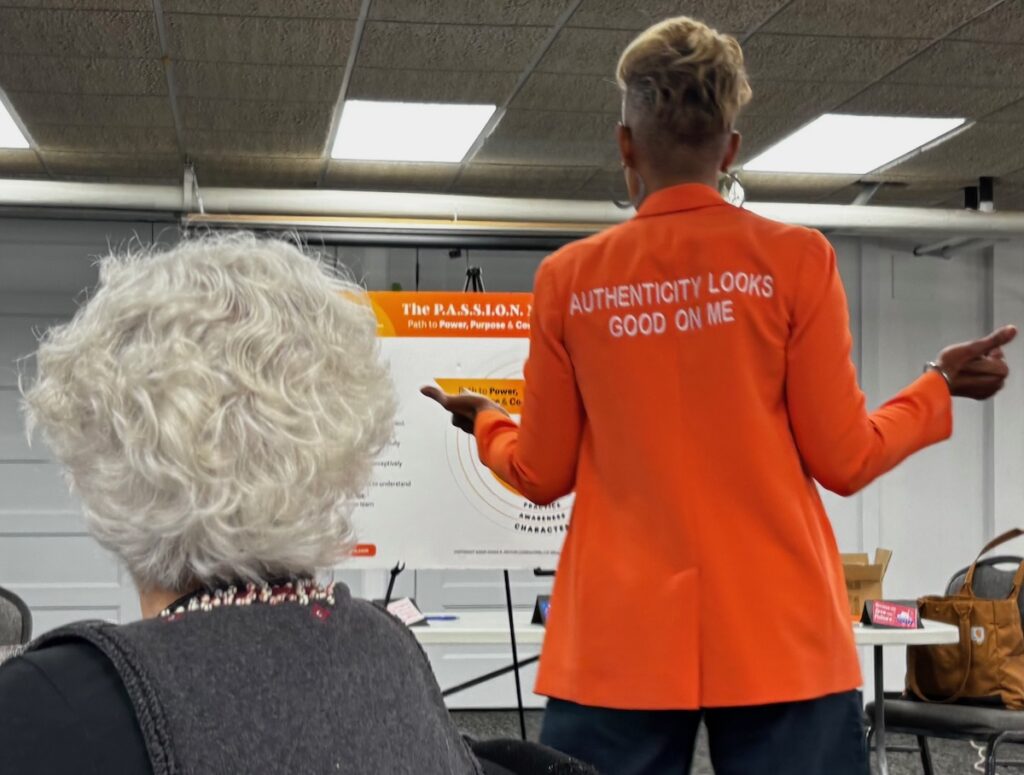
Being able to assess your reactions to others’ comments “is a good thing,” Patton said. “Is this really critical at this moment to respond or go on social media and speak my truth at this point? Can I do it in love?”
If not, she gave them permission to halt the conversation and explain the need for some space before continuing.
“I’m not in the best position to be able to say something right now. Would you mind if we table this conversation until tomorrow?” she suggested.
Participants also took part in an “I am, but I am not” exercise designed to help them identify and challenge stereotypes they have experienced or internalized. Patton said confronting these assumptions is necessary for authentic connection.
For example, Shar Katzner, president of the Bowling Green League of Women Voters and organizer of the workshop, shared, “I am an introvert, but I’m not a doormat.”
Michele McFarlane from the Toledo -Lucas County League of Women Voters contributed, “I’m opinionated, but I am open to other people’s opinions.”
“We have to debunk the labels that keep us boxed in,” Patton said. The responses showed that the prompt successfully encouraged vulnerability and self-reflection.
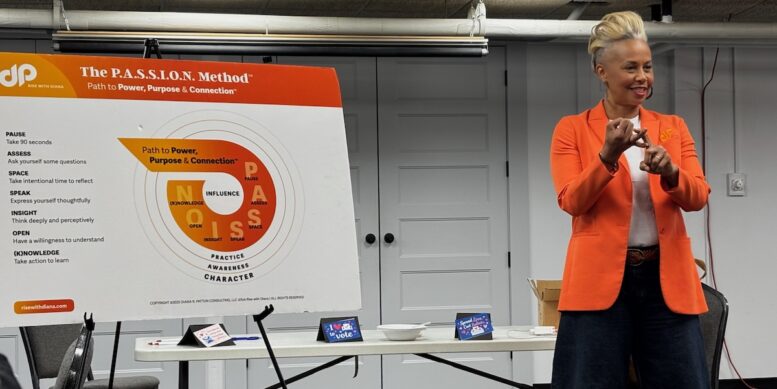
To provide a practical roadmap, Patton introduced her “PASSION” framework — Pause, Assess, Space, Speak, Insight, Open and kNowledge—“The ‘K’ is silent,” she pointed out.
The step-by-step method helps to maintain composure while navigating difficult conversations without being consumed by negative emotions. The framework encourages individuals to create emotional space before speaking and to seek understanding rather than immediate rebuttal.
Maintaining a high energy level through practices such as gratitude, awareness and forgiveness is essential for being an effective “light” that can drive out darkness,” she said, quoting King’s speech: “Darkness cannot drive out darkness. Only light can do that. Hate cannot drive out hate. Only love can do that.”
Fighting hate with more hate is counterproductive, she added.
Patton wove her personal story throughout the presentation, speaking candidly about surviving an abusive childhood and channeling early anger into a career in fair housing law and diversity, equity and inclusion training.
Her message repeatedly returned to personal responsibility as the foundation of broader social impact.
“Courage requires you to go in a fire and not be consumed by it,” Patton said.
The workshop reflected a growing emphasis in advocacy spaces on internal work — including emotional regulation and self-awareness — as a precursor to effective public engagement. Patton encouraged attendees to practice gratitude, forgiveness and mindfulness as daily habits that support constructive dialogue.
As the session concluded, participants were urged to apply the tools not only in public debates but also in workplaces, relationships and community settings, where Patton said meaningful change often begins.