By JAN McLAUGHLIN
BG Independent News
After years of fighting a fee for rooftop solar systems in Bowling Green, Joe DeMare said by using AI to analyze the municipal code, he found a solution to his ongoing battle.
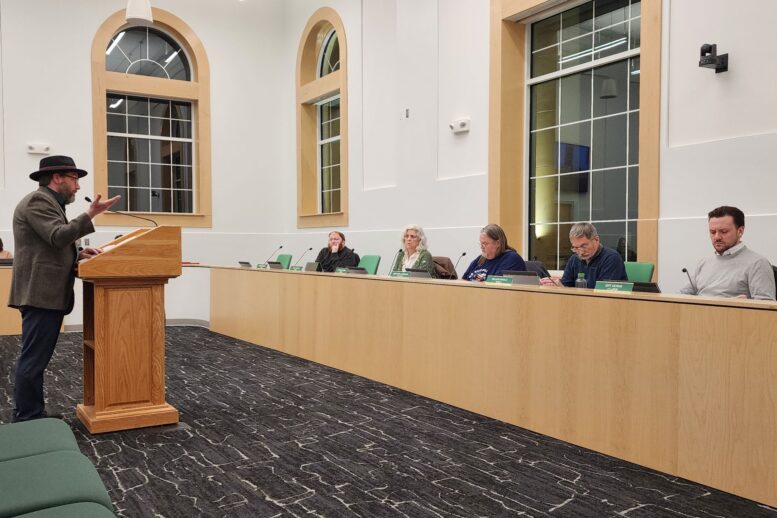
On Monday, DeMare presented an ordinance to City Council that he had created for them to adopt. It came with an emergency clause in case the council wanted to pass it that evening.
Council declined to act on his ordinance.
DeMare said that despite being told for years that the city’s Board of Public Utilities has the ultimate authority on electric fees, he discovered wording that actually gave City Council that ability to override the board.
While the city charter gives the utilities board the power to set fees for all city utilities, it also states that regulations set by the board “shall not be repugnant” to ordinances of the city, DeMare told council.
“You have not just an ability, but a responsibility to represent the community,” he said.
And according to DeMare, nobody in Bowling Green supports the rooftop solar fees. He noted that when he ran for mayor in 2023, he learned from residents that they are all opposed to the fee.
“Pretty much nobody who lives in BG wants there to be a penalty,” said DeMare, who garnered 26% of the vote in the race for mayor. “They all agreed with me.”
DeMare tried to take a poll of those in the audience on Monday evening, and was cautioned by council President Mark Hollenbaugh that DeMare could hold his own public forum, but during the council meeting his time should be spent addressing council.
DeMare continued to ask for a show of hands from those in the council chambers on a second question.
“So you’re going to ignore me then,” Hollenbaugh said.
“Just for a second or two,” DeMare responded.
The rooftop solar issue became a flashpoint in 2021 when the Board of Public Utilities began charging a fee for homeowners with rooftop solar that tied into the grid. City officials called it a reasonable “fee” while rooftop solar users said it was an unfair “penalty.”
Brian O’Connell, director of the city’s public utilities and infrastructure, has explained that the fee is necessary to make sure other electric customers in the city aren’t paying for those who choose to install rooftop solar panels.
Solar customers pay a monthly facilities charge based on their system size. The electric rates in the city are based on customers buying their energy from the city. A smaller portion of the rates is based on fixed electric system costs for such items as meters, poles, wire, transformers, switches and linemen – items needed for all homes including those with rooftop solar, O’Connell has said.
“Those fixed costs don’t change just because someone decides to put rooftop solar on their home,” he said.
Without that fee being charged to homes with their own solar power, “the other customers are subsidizing their energy sales,” O’Connell said.
With the current fee of $4 per kilowatt hour, the average rooftop solar residence pays anywhere from $12 to $20 for the monthly fee. Despite those fees, O’Connell said two more homes in the city have added rooftop solar in the last three years.
“We’re here to provide power in a fair way – not try to make it burdensome,” he said.
O’Connell said last year it would take a cost of service analysis to convince him that changes are needed in the solar policy.
DeMare said Monday that the city’s solar fees have cost the city money – in fighting a lawsuit from the owners of a residential rooftop system and by stunting the addition of new rooftop solar systems in Bowling Green. He noted the city’s recent adoption of a Climate Action and Resiliency Improvement Plan, which encourages renewable energy in the community. And he mentioned state legislation penalizing wind and solar energy.
“That makes this even more vital,” DeMare said.
“If you wanted, you could pass this tonight,” he said to council. “That’s kind of up to you.”
Hollenbaugh read portions of the city charter, giving the Board of Public Utilities the authority to “fix all rates and charges” for electric, water and sewer.
“For the city to pass an ordinance that goes against the city charter would not be something I desire to do,” Hollenbaugh said.
But DeMare said it is the responsibility of elected City Council members to overrule appointed Board of Public Utilities members when necessary.
“Those people need to have some oversight,” DeMare said of the board. “The question is – why do you exist,” if council isn’t willing to rein in the utilities board. “They badly need some discipline.”
Council member Jeff Dennis pointed out to DeMare that it’s been the BG Board of Public Utilities that has led the way for Bowling Green to be a pioneer with the first wind turbines, the largest municipal solar field, and a portfolio of 40% renewable energy sources.
“The BPU has been largely responsible for that,” Dennis said.
But DeMare said that in recent years, the board has “retreated from that leadership role” in green energy.
DeMare has said the city “blew it” more than a decade ago when it invested in coal power, then erred again five years ago when it decided to “penalize” rooftop solar systems – tarnishing the “green” image of Bowling Green.
DeMare said the current policy is keeping residents from installing solar. He predicted the city would experience a “wave” of new solar panels if the fee is dropped.
He also acknowledged that he hadn’t discussed his proposed ordinance with City Attorney Hunter Brown.