
By ROBIN GERROW
BG Independent News
When Bowling Green State University student Stone Foltz died from alcohol poisoning in 2021 in a hazing incident, it put the subject in a spotlight. But it was far from the first time the practice had been an issue at the university.
“We need to have conversations about hazing,” said Rebecca Mancuso, associate professor of history at BGSU. “It’s difficult, in any case, to talk about hazing, but it’s especially difficult to talk about when it’s a problem at home. And it is a problem at home.”
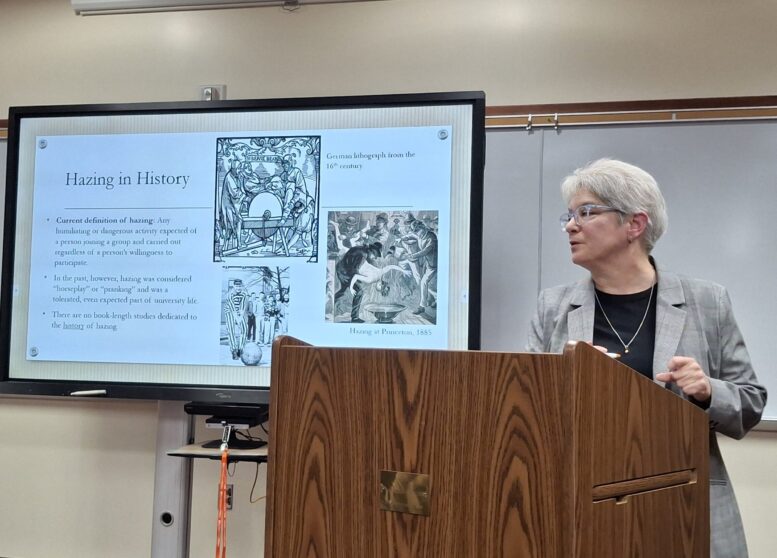
Mancuso’s research, “‘How Many Times Can You Learn That Lesson?’ A History of Hazing at Bowling Green State University, 1920-2000,” was a presentation by the university’s Institute for the Study of Culture & Society at the Wood County District Public Library on Thursday.
The study, which began with a class project in the late 2010s, involved examining written records and conducting oral interviews with former students.
“I was bowled over by the number of documents and photos that were in the records at the Center for Archival Collections,” Mancuso said. “Hundreds and hundreds of documents on hazing going back all the way to the early 1920s. I’m not trying to show Bowling Green as worse than any other university because it isn’t. It’s very typical. We see the same patterns and trends here that we see throughout the country.”
Her work started with examining the limited history of hazing. While there has been research on modern hazing, she said it has been largely prescriptive in asking what and why students are doing it, and how to end it.
“I’m finding very little history,” she said. “What I’m finding is in sections of books, little pieces that I have to put together. That’s been a challenge, but it is a longstanding part of university life. As long as there have been educational institutions, there’s been hazing. The ancients talk about it.”
She found that many of the hazing practices and terms used now came from the Middle Ages.
“Hazing’s been going on for thousands of years, but the 20th century is really significant because in the 20th century we see some major changes in hazing practice,” Mancuso explained. “For thousands of years, hazing was newcomer hazing, or freshman hazing. It was the hazing of all the freshmen who would come into an institution, all at once, all together. Every single freshman would be hazed. Freshman hazing would exist at BGSU, as in many other places, until about 1950. It was very public, very carnival-esque. Students bragged about it, talked about it, the whole town knew that it was going on.”
Records show this type of hazing was condoned by the administration, with rules and tasks assigned to freshmen published in the newspaper. Students who failed to comply and participate were ostracized and humiliated.
Those activities saw a steep decline during World War II, when BGSU became a naval training base, with older, more serious students. Mancuso said it changed the culture of the university considerably and freshman hazing began to die out.
She found that freshman hazing would decline in the mid-20th century and be replaced by “social hazing,” generally taking place in student organizations such as fraternities and sororities, honor societies and sports teams. Many of these student organizations were started locally at BGSU in the 1920s, before national organizations were present on campus.
“Those groups had rush initiations,” she said. “They existed at the same time as freshman hazing. Freshmen hazing is going to lose favor in part because it has more cost than benefit, but students see real benefit to joining these organizations.
“If you’re going to be a member of the group, you have to prove your loyalty, your commitment,” she continued. “That you’re going to keep the group’s secret. You put the group’s welfare before your own. And sometimes you see that in hazing practices. When new members are coming in, the existing members really want to make sure that they can vet their membership.”
It was an incident of sexual assault of a young woman at a fraternity in 1981 which motivated the administration to institute early policies regarding hazing.
“By the early 90s under Ed Whipple, the vice president of student affairs, takes control of hazing decisions away from the Interfraternity Council and other groups, and he creates better policies and better processes surrounding hazing,” she said.
“Administrators, they’re struggling with this,” Mancuso said. “So, they start to come up with some policies, and these policies to our eye look terrible, but they’re trying to understand. As far as where we are with hazing now, I believe that universities like BGSU do care about the student body. They’re really working to try to prevent hazing and educate students on hazing. Our education this year on hazing was better than it has been before.”
