By JAN McLAUGHLIN
BG Independent News
From her motorized wheelchair, Debbie Thompson offers a perspective on Bowling Green crosswalks likely missed by most pedestrians. On Monday evening, she presented a City Council committee with a list of intersections with non-compliant ADA sidewalk ramps.
As part of two “walk audits” across the city, 63 crosswalks at intersections were studied by Thompson and others on the BG SONG Transportation and Mobility Action Team.
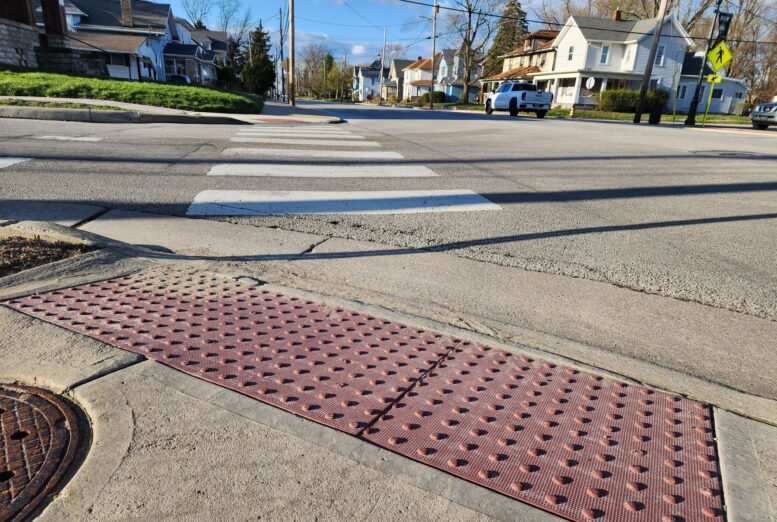
The ramps installed at several intersection curb cuts are not compliant with the Americans with Disabilities Act, according to Thompson. The ramps need to be facing the crosswalk, but Thompson presented a list of several ramps along Main Street that are angled into the lanes of traffic instead.
Thompson told the Bowling Green City Council’s Transportation and Safety Committee on Monday of an incident where a person with a disability had to be helped back to the curb after the ramp directed them into the street rather than the crosswalk.
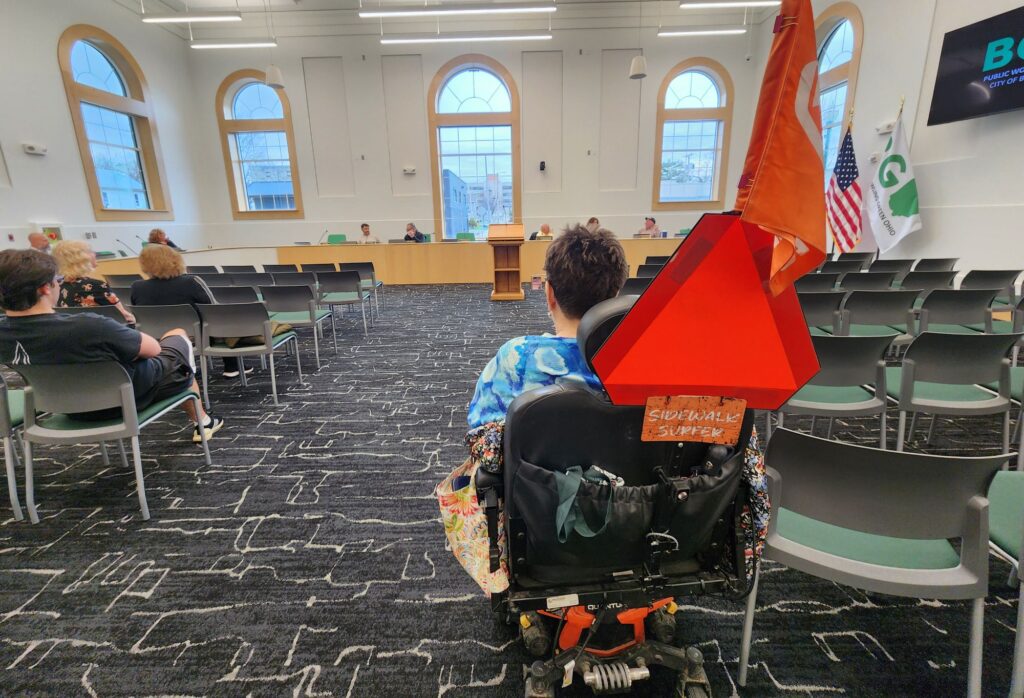
“This is something I’m very passionate about,” she said. “We need to be more compliant with some of the ramps. Many of them don’t meet ADA requirements.”
The list of problem ramps has been given to BG Public Works Director Mick Murray, said Thompson, who has been a squeaky wheel on ADA issues. After the meeting, Thompson said the city and Murray have “absolutely” been responsive when she has pointed out ADA concerns.
City Council member Jeff Dennis, who chairs the Transportation and Safety Committee, said the city will work to address these ramp concerns. “This would be a good time for those conversations,” he said.
And council member Bill Herald thanked Thompson for her efforts to make them aware of issues. “We appreciate your eyes, and all your work,” he said.
The Americans with Disabilities Act requires that state and local governments ensure people with disabilities have access to the pedestrian routes in the public right of way. An important part of this requirement is the obligation whenever streets, roadways, or highways are altered to provide curb ramps where street level pedestrian walkways cross curbs. This requirement is intended to ensure the accessibility and usability of the pedestrian walkway for people with disabilities.
Common issues found in communities:
- Slopes exceeding ADA limits
- Missing or improperly placed detectable warnings
- Ramps not aligned with crosswalks
- Uneven transitions or lips at street level
- Excessive cross slope (side tilt)
Even small deviations from ADA standards can make ramps:
- Difficult or unsafe for wheelchair users
- Hazardous for people with mobility or vision impairments
- Barriers for parents with strollers and older adults
Local opportunity:
- Walk audits have already identified areas of concern
- Data exists to help prioritize improvements
- Addressing issues proactively reduces safety risks, future repair costs, and potential ADA complaints or legal action
Recommended next steps:
- Conduct a citywide curb ramp compliance review
- Use a standard ADA checklist for evaluation
- Prioritize high-traffic and high-risk intersections
- Incorporate ADA compliance into all future sidewalk projects
Also at the transportation and safety meeting, committee members discussed future plans for Poe Road and Main Street. Dennis noted that a “more holistic approach” may be desired for Poe Road from Mercer Road to Mitchell Road. Dennis also said he will be talking with city administration and council President Mark Hollenbaugh about engaging the public on options being considered for bicycle accommodations on Main Street.
Herald, who agreed to serve again on the city’s Sidewalk Commission, suggested that the city needs to further investigate different avenues for street repair funding. “We need additional and creative funding,” he said.