By TOM GERROW
BG Independent News
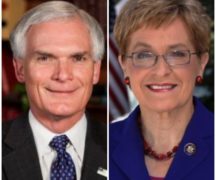
Many people might be familiar with a modern variant of the Golden Rule: he who has the gold, makes the rules. But when it comes to international trade policy, that golden rule is squarely in the cross hairs of Rep. Marcy Kaptur, D-Ohio, and Rep. Debbie Dingell, D-Mich.
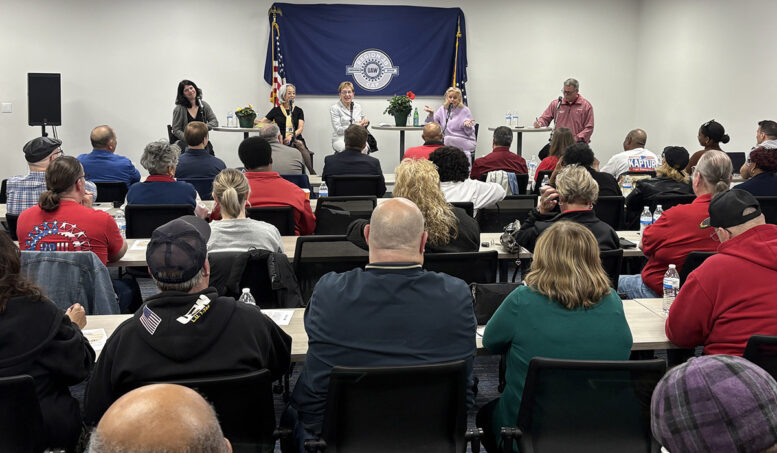
In a town hall meeting to discuss trade policy and tariffs, Kaptur and Dingell were joined by American University economist Thea Lea, UAW Region 2B Director Dave Green, and Melinda St. Louis, Global Trade Watch director at Public Citizen, a nonprofit consumer advocacy organization. The event, part of a 10-city town hall tour, was held at the UAW Region 2B office in Toledo.

St. Louis, who acted as the moderator for the discussion, told the many union members and others in attendance that the free trade policies enacted over the past few decades have hurt workers in the United States, and particularly union workers.
“Unfortunately, we know that both the free trade agreements of the past, like NAFTA, and the chaotic and corrupt trade policies of today are not leading us down the right path,” said St. Louis. “And what’s clear, and this probably won’t be a surprise to folks in Toledo, is that these trade deals led to a race to the bottom.”
The result, St. Louis said, is 325,000 fewer manufacturing jobs in 2025 than there were before NAFTA started, with manufacturing jobs in Ohio falling by more than 30%. While productivity has increased by 7%, real earnings for Ohio manufacturing workers, after accounting for inflation, have gone down 3.5%.
“So even though we’re working harder, we’re making less,” St. Louis said. “If we’re serious about revitalizing U.S. manufacturing and creating and supporting good-paying union jobs, we need big, bold ideas for a trade policy that actually centers workers.”
Seeking trade policies that put the interests of labor first
Economist Thea Lea, who has worked on trade policy since the 1990s including in leadership positions at the AFL-CIO, saw how the interests of labor took a back seat to corporate interests during the NAFTA trade negotiations.
“Unfortunately, at the top level of the parties, where the big money is, that’s where the problems have been,” Lea said. “We can see that those politicians took the side of the corporations and the billionaires.”
“They designed trade policy to weaken the bargaining power of labor, to undermine our democratic ability to protect workers’ rights, consumer safety, and the environment,” Lea said. “That was the point. It wasn’t an unfortunate outcome.”
“Donald Trump, the outsourcing billionaire, has never been a friend to workers or to unions,” she added. “And his new tariff policies have not delivered.”
Lea noted that since NAFTA, U.S. trade policy has simply been an enabler for outsourcing.
“The good news is that Donald Trump has broken the free trade consensus, the elite free trade consensus,” Lea said. “He took a sledgehammer to it. So now it’s our job to rebuild something better.”
Lea said that means turning current trade policy upside down. Instead of having concerns about labor and the environment come last, after all the other negotiations on intellectual property, investment, financial services, and the like are settled, labor and the environment should be the first thing on the negotiating agenda.
Better enforcement of the rules of origin is also important, Lea said, because it’s one of the reasons that the U.S.-Mexico-Canada agreement that renegotiated NAFTA doesn’t work. Currently, it leaves the back door wide open for products from other parts of the world to come through Mexico without paying their fair share of tariffs or living up to labor and environmental standards.
“So we can fix that,” Lea said. “We can close those loopholes.”
Asked whether trade enforcement could be strengthened so that labor violations abroad don’t undercut union jobs, Lea reported there was some good news and that the labor chapters in trade agreements had gotten progressively stronger and more usable.
“One of my jobs at the U.S. Department of Labor was to enforce the labor chapters in our trade agreements,” she said. “So I’m very familiar with when it works and when it doesn’t work.”
One effective rapid response enforcement mechanism she used targeted a specific facility for violations.
“It was surgical,” Lea said. “The key thing about that was that you were able to bring a trade sanction against a single factory. And that was really effective because some of the other trade tools we have, you had to put a tariff on the whole country.”
“But we need to have more courage to be able to use those provisions more effectively,” Lea said. “And the one place where we don’t have good provisions is with respect to China.”
Lea said the forced labor import ban is one of the most powerful trade tools available, but one of the most underused. It prohibits imported goods made in whole or in part with forced labor. “Trying to force the corporations to take responsibility for their entire supply chain is one of the most important things we can do,” she said. “We’re starting to make a little bit of progress, but there’s a lot of work to be done.”
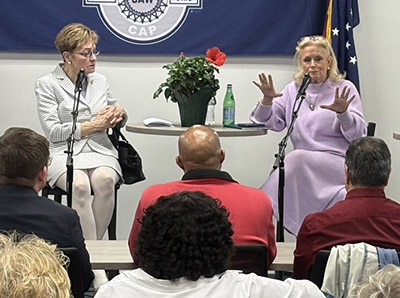
Noting that the current tariff regime is ineffective, chaotic, and corrupt, Dingell says she is not against tariffs if they are used properly. “They’re a tool we’ve got to use. Right now, one of our biggest threats is China. And when we are competing with China, which manipulates its currency, subsidizes products, uses slave labor, we need to level the playing field.”
Dingell also noted the playing field isn’t level with Mexico due to their hostility toward organized labor, and lack of workplace safety and environmental standards.
Solidarity with workers in other countries
“One of the things I learned at the AFL-CIO, in the Labor Department, at the Economic Policy Institute, is that labor solidarity is what makes the world go round,” Lea said. “That workers in other countries are not our enemies. They are our brothers and sisters. And when they’re mistreated, we face unfair competition.”
Green noted that freedom of association and the ability to organize is crucial to the labor movement’s success, both in the United States and beyond.
“Our density is our destiny,” Green said. “We need more union members in this country if we’re going to fight these companies and get what we deserve back.”
Building relationships with unions in other countries is also a priority, and Green has had recent conversations with French unions. Green also said that organizing work is taking place in Mexico. But he noted it’s difficult when some of the workers fear for their lives if they were to form a union.
To help illustrate how difficult organizing in Mexico can be, Kaptur talked about a tour she took with her mother of a factory that had been relocated from the United States to Mexico. After the tour, her mother asked if Kaptur had noticed anything. Kaptur remembered that none of the workers, many of whom were women, said anything. Her mother said, “Did you look at their faces? They were not free to say anything.”
On a more positive note, Kaptur recounted a meeting in Washington some years ago with labor leader Richard Trumka, a former secretary-general of the AFL-CIO. Trumka had taken a car apart to figure out where every part came from. If it came from Germany, he invited the labor leaders from Germany. If it came from somewhere in Mexico, he tried to find somebody who could form a union in Mexico.
“It was like a United Nations of labor,” Kaptur said. “And I’ve never forgotten that meeting because I thought that’s the road forward. The unions of the world, they have to get together.”
“I think labor has to think about finance because there are a lot of people that would put their money in your bank if they were given the chance,” Kaptur said. “We’ve got to think of new institutions to do this. When I was first elected, there were 27,000 credit unions in the country. There are now 2,300. The concentration of money in this country is a sacrilege. And we have to fight back with financial institutions of our own.”
Representation and accountability
Kaptur, who emphasized her labor background, said change is going to require electing more people from the labor movement to Congress. “We need people who come from labor to be inside the Congress of the United States,” she said. “We need to look harder for people to run for office, because what’s happening is we get a lot of people who come more from the finance world, or they’ve represented big companies.”
“So I’m just telling you that we as working people and representatives of working people have to elect more of our own,” Kaptur said.
Kaptur said that some elected officials find trade policy inconvenient because of their donors, so they want to take a backseat. “But we have to tell them, no, you have to stand up now,” she said. “We need to have this broad conversation and a proactive, pro-worker trade policy.”
“You need to hold the people that you are electing to office accountable,” Dingell said, noting the need to motivate more union members to participate and speak out. “People aren’t turning out anymore. But you got to get out there. You can’t get tired.”