From BGSU PLANETARIUM
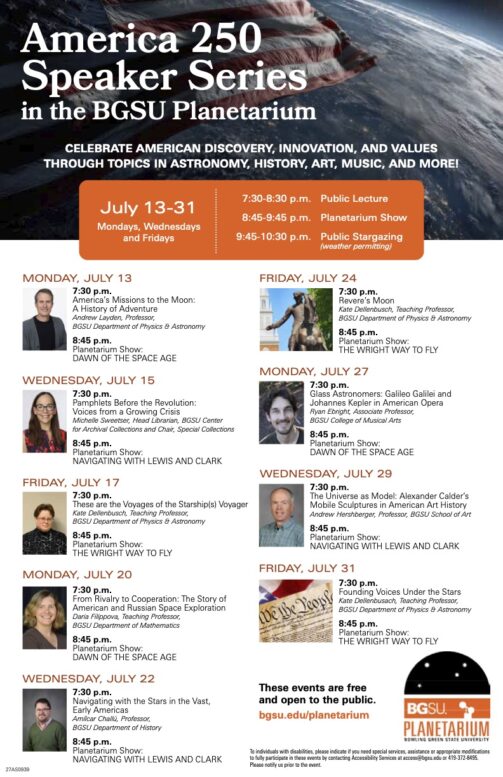
The BGSU Planetarium invites the community to celebrate American discovery, innovation, and values through topics in astronomy, history, art, music, and more in a special nine-part series of talks.
The America 250 in the Planetarium series will take place on Mondays, Wednesdays, and Fridays starting at 7:30 p.m. July 13 – 31. All of the America 250 in the Planetarium programs are free and open to the public.
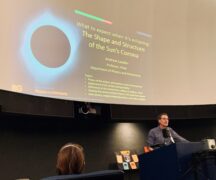
The first program in the series, “America’s Missions to the Moon: A History of Adventure,” will be presented July 13 at 7:30 p.m. by Andrew Layden, professor, BGSU Department of Physics & Astronomy.
From the unmanned lunar probes of the early 1960s, through the Apollo missions to the Artemis missions of today, Layden will trace the development of America’s lunar discovery and the spacecraft that made it possible. There will be ample opportunity for questions and discussion to place these events into the context of the politics and technology of these decades of American history. The talk will be followed by the planetarium show “Dawn of the Space Age” at 8:45 p.m.
The second program in the series, “Pamphlets Before the Revolution: Voices from a Growing Crisis,” will be presented July 15 by Michelle Sweetser, head librarian, BGSU Center for Archival Collections, and Special Collections chair.
Long before the social media barbs and trolling of today, men engaged in debate through the publication of pamphlets. Learn more about the 18th-century “pamphlet wars” between British and American thinkers who argued in print about taxation, British administrative and governing policies, and colonial rights. View several original pamphlets, published between 1765 and 1774, along with selections of other colonial and early American material held by the BGSU Center for Archival Collections. The presentation will be followed by the planetarium show “Navigating with Lewis & Clark” at 8:45 p.m.
The third talk in the series, “These are the Voyages of the Starship(s) Voyager,” will be presented on July 17 by Kate Dellenbusch, teaching professor, BGSU Department of Physics & Astronomy.
The twin NASA Voyager 1 and 2 spacecraft launched in 1977 and together made a Grand Tour of the gas giants of our solar system, providing breathtaking images of those worlds along the way. At more than 13 billion miles from Earth, the Voyagers are the most distant manmade objects, and in 2012, Voyager 1 became the first spacecraft to enter into interstellar space. Voyager 2 followed this historic milestone in 2018. After nearly 49 years in space, most of their systems have been turned off, but as they venture ever farther from the Sun, they continue to send data back to Earth and teach us about the environment where the solar wind interacts with interstellar material. How do we know they have now entered into interstellar space? How long can they continue to function and return useful scientific data as their power dwindles, and what might the future hold as these robotic emissaries of humanity continue into the cosmos? The talk will be followed by the planetarium show “The Wright Way to Fly” at 8:45 p.m.
The fourth talk on July 20, “From Rivalry to Cooperation: The Story of American and Russian Space Exploration,” will be presented by Daria Filippova, teaching professor, BGSU Department of Mathematics.
Since the 1950s, and arguably even earlier, the Soviet Union and the United States have invested enormous effort and resources in the exploration of space. Initially, this endeavor was driven by intense competition, leading to milestones such as the launch of the first artificial satellite, the first animals in space, the first human orbital flight, and ultimately the first human landing on the Moon. Over time, however, cooperation between the two nations proved increasingly productive. From the historic Apollo–Soyuz mission in 1975 to the development and operation of the International Space Station, collaboration became an important part of humanity’s journey beyond Earth.
Since childhood, Filippova has been fascinated by space exploration and has visited numerous museums, launch sites, training facilities, and other locations connected to the American and Russian space programs. In this presentation, she will share the history of this remarkable transition from rivalry to partnership, drawing on both historical events and personal experiences. The talk will be followed by the planetarium show “Dawn of the Space Age” at 8:45 p.m.
Amilcar Challú, professor, BGSU Department of History, will present “Navigating with the Stars in the Vast Early Americas” on July 22 for the fifth talk in the series.
His talk explores native and European astronomical knowledge, both scientific, technical and popular in the Americas around the time of the American Revolution. The talk will be followed by the planetarium show, “Navigating with Lewis & Clark” at 8:45 p.m.
On July 24, the sixth talk of the series will be “Revere’s Moon,” presented by Dellenbusch.
Americans grow up hearing about the midnight ride of Paul Revere, often through Longfellow’s famous poem “Paul Revere’s Ride.” This telling of the story takes many liberties with the historic events of April 18-19, 1775, but it paints a memorable picture of the daring journeys made by Revere and several other riders who set out to warn their fellow colonists of the movements of British forces. Longfellow makes several uses of Moon imagery in his poem. What role did the position and phase of the Moon really play on that momentous night? The talk will be followed by the planetarium show “The Wright Way to Fly” at 8:45 p.m.
The seventh talk in the series, “Glass Astronomers: Galileo Galilei and Johannes Kepler in American Opera,” will be presented on July 27 by Ryan Ebright, associate professor, BGSU College of Musical Arts.
The American composer Philip Glass is perhaps most famous for his bicentennial opera “Einstein on the Beach,” a groundbreaking collaboration with avant-garde director Robert Wilson that was loosely inspired by the life and ideas of physicist Albert Einstein. Among Glass’s more than two dozen subsequent operas, scientists are recurring subjects, including two 17th-Century astronomers whose work revolutionized humanity’s understanding of the universe. In this multimedia presentation, attendees will learn how space and those who study it are dramatized musically in Glass’s operas Galileo Galilei (2002) and Kepler (2009). The talk will be followed by the planetarium show “Dawn of the Space Age” at 8:45 p.m.
On July 29, the eighth talk in the series, “The Universe as Model: Alexander Calder’s Mobile Sculptures in American Art History,” will be presented by Andrew Hershberger, professor, BGSU School of Art.
Starting in the early 1930s and continuing throughout his life, the American artist Alexander Calder (1898-1976) created a remarkable body of sculptures that he called “mobiles.” Unlike most, if not all, earlier sculptures in art history, Calder’s mobiles actually moved and often rotated on a variety of axes. Perhaps the innovative and mechanical aspects of these mobile sculptures caused the French artist Fernand Léger (1881-1955) to describe them as “100 percent American.” Calder himself proclaimed of the mobiles that the “underlying sense of form in my work has been the system of the Universe.” With those words, Calder shared the inspiration he received from the way planets revolve around stars, and the way moons revolve around planets, etc.
Connecting to the theme of innovation in this America 250 lecture series, Calder has often been hailed as the inventor of moving sculptures. Thus, Calder’s mobiles fit the theme of American discovery and innovation while also connecting to the discipline of astronomy. The talk will be followed by the planetarium show “Navigating with Lewis & Clark” at 8:45 p.m.
In the ninth and final program of America 250 in the Planetarium, “Founding Voices Under the Stars” will be presented by Dellenbusch. Attendees will experience the reading of seminal American documents such as the Declaration of Independence and Bill of Rights under the night sky of the day they were signed. This program will also feature live fife and drum music performed by the Fort Meigs Field Music, featuring John Thompson on fife and Isaac Rapai on drum. The program will be followed by the planetarium show “The Wright Way to Fly” at 8:45 p.m.
For more information, visit the planetarium website at bgsu.edu /planetarium.