
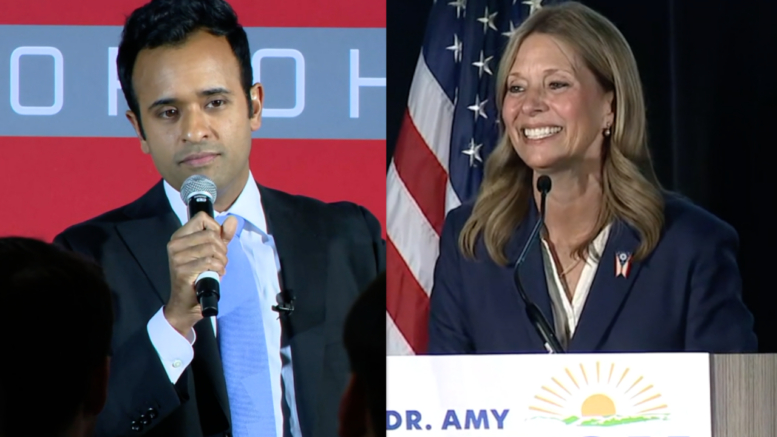
Acton calls for conditional moratorium while Ramaswamy says he wants free electricity for those near data centers
BY MEGAN HENRY
Ohio’s two candidates for governor have conflicting ideas of what they would like to see happen to future data centers, which have become a political lightning rod in this year’s November election.
Ohio’s next governor will appoint the five members of the Public Utilities Commission, which sets utility rates and set the parameters for data centers opening in cities across the state.
Ohio Democratic candidate for governor Dr. Amy Acton announced on July 27 she supports a conditional moratorium on data centers “if requirements on costs, union labor, transparency, environmental standards, community benefit agreements, and development are not met,” she said in a statement.
Innovation Ohio, a progressive policy advocacy organization, said Acton has a strong data center proposal.
“Requiring data centers to really pay their own money in terms of electricity, electricity in terms of really protecting the environment, protecting water, making sure workers are getting a fair shake out of these fields, that to us is really leveling the playing field and ensuring that going forward,” said Innovation Ohio President Michael McGovern.
Ohio Republican candidate for governor Vivek Ramaswamy announced his three-fold data center plan on Aug. 6.
“If a data center is built in your community, then (1) you will no longer have to pay for your home’s electricity, (2) you will pay lower property taxes, and (3) the data center will be required to abide by all air and water quality standards without exception, and we will take the necessary steps to protect Ohio’s fertile farmland,” he said in a post on X.
“If any one of these three conditions is not met, the data center won’t be built. Period,” Ramaswamy said in his statement.
McGovern called Ramaswamy’s idea for data centers to pay for citizen’s electric bills “utter nonsense.”
“We see Vivek Ramaswamy’s plan that’s just like absolute nonsense in coming up with these wild ideas that don’t make any sense and aren’t based in any actual policy research, and instead are sort of just these silly promises,” McGovern said.
Ramaswamy’s plan does not specify how many miles away from a data center someone must be living to get their electricity for free.
“There’s no detail, there’s no substance,” McGovern said.
Ramaswamy said last year it’s a “good thing” AI data centers moving to Ohio.
“I want the sectors of the future to come here, but that will make a level of demand on our electric grid of a kind that we have not seen in the history of our state … right at a time when we’ve also cut off and reduced the supply of base load power generation, shutting down coal plants that, on my watch, would have remained open,” Ramaswamy said in a video posted to X in March 2025.
Ramaswamy has a financial stake in data centers by having financial positions in the chips that power AI to the companies that run the data centers, according to a report released earlier this year from Innovation Ohio.
“He has rolled out a plan that is unserious and does not really tackle this vital issue for Ohioans, and he is personally getting richer off of data centers,” McGovern said.
“He’s making money here, and all of a sudden that’s a political problem, so he’s walking that back.”
Ohio has more than 200 data centers, the sixth-highest state in the country, according to Pew Research Center. Most of the data centers are in central Ohio. Cincinnati has 26 and Cleveland has 22, according to the Data Center Map.
Ohioans are seeing increased electric bills. The average Ohio residential utility bills are projected to be about $800 for the summer — a 17% increase compared to last summer, according to a report by Third Way.
Lawmakers at the Ohio Statehouse have yet to pass any data center legislation.
Conserve Ohio, the grassroots organization behind a proposed constitutional amendment to ban new data centers, is collecting signatures to make the 2027 ballot.