By JAN McLAUGHLIN
BG Independent News
After serving on daring missions to take out Osama bin Laden in Pakistan and rescue an American doctor held hostage in Afghanistan, Edward C. Byers Jr. returned home Saturday evening on a new mission.
The Medal of Honor recipient, who grew up in Grand Rapids and graduated from Otsego High School in 1997, came home to talk about patriotism.
Many in the auditorium knew Byers from a lifetime ago. They remembered him as the daredevil boy who had no fear jumping off buildings or tying his leg to a cinderblock and throwing it into his pond. He was the kid who wore camouflage to school.
High school buddies mentioned the “urban legends” surrounding Byers – the kid who would hide in ditches as cars drove by or climb to the roof of the high school with a paintball gun when rival teams were scheduled to arrive.
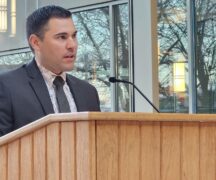
“I was definitely a weird kid – that’s for sure,” Byers said during his visit to Otsego High School on Saturday evening, arranged by the Historical Society of Grand Rapids as part of its commemoration of America’s 250th celebration.
“I wasn’t the greatest Boy Scout in the world,” he acknowledged, noting that he dropped out of scouting a couple times.
But even back then, Byers knew he wanted to lead a purposeful life.
“I wanted to serve something greater than myself,” he said.
For Byers that meant joining the Navy in 1998 – a decision that would lead to many meaningful roles in U.S. military missions.
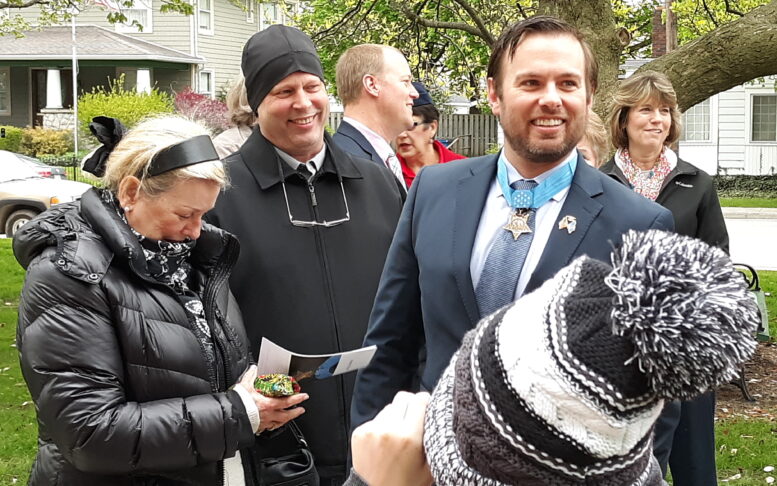
As U.S. Navy Master Chief Special Warfare Operator Byers, he was awarded the Medal of Honor in 2016 by President Barack Obama for actions in Afghanistan during Operation Enduring Freedom.
Byers earned the honor during a night in December 2012, when his unit rescued Dr. Dilip Joseph from the Taliban deep in the remote mountains of eastern Afghanistan.
After walking four hours in the freezing night to reach the Taliban camp, Byers was the second SEAL through the door of a tiny, one-room building where Joseph was held hostage. Byers killed two armed Taliban fighters before identifying Joseph and shielding him from harm. As bullets flew across the room, Byers leaped on top of the doctor, using his own body armor to shield the captive as his fellow SEALs exchanged gunfire with Taliban fighters.
As Byers protected Joseph, he spotted a Taliban guard wielding an AK-47 just inches away. He continued to shield Joseph with his body as he grabbed the gunman by the throat, pinning him to a wall long enough for another SEAL to shoot him dead.
His good friend Petty Officer 1st Class Nicolas Checque was shot after being the first man through the door during the rescue. Once outside, Byers, a medic, turned his attention to Checque, spending the 40-minute flight back to Bagram Airfield trying to resuscitate his friend. Checque was declared dead at the American base.
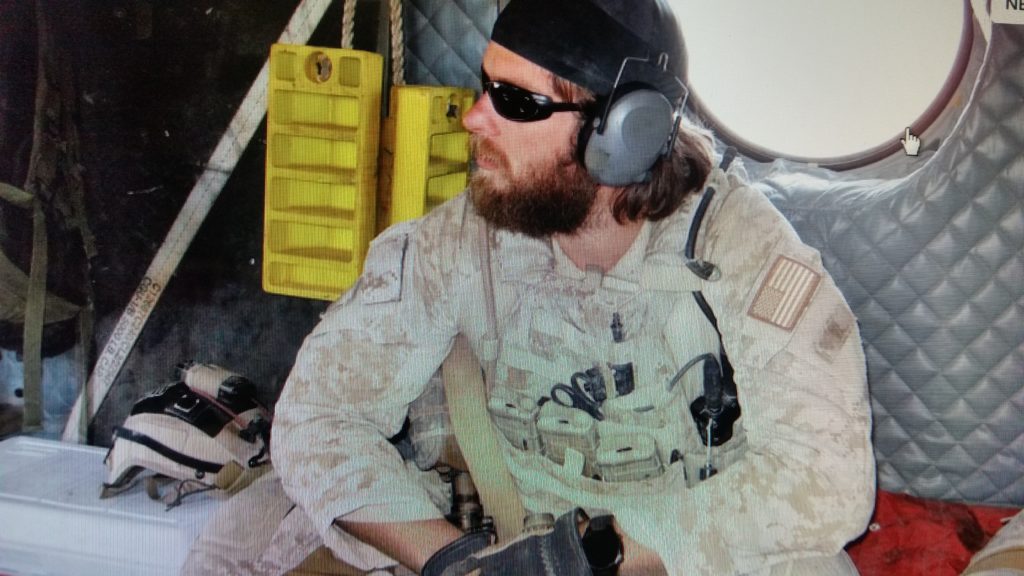
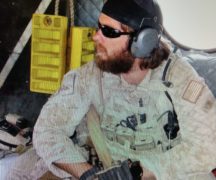
Throughout his military career, Byers served 11 overseas deployments with nine combat tours that would take him from home 280 to 300 days a year.
When selected for SEAL training, Byers sustained the grueling physical and mental drills that break down the vast majority of trainees.
“They treated everyone alike – just like shit,” Byers said of the drills.
The training was intended to beat down the trainees until they realized they are nothing without the men to their left and right, he said.
Nearly 90% of the sailors in SEAL training can’t complete it, Byers said. And of those who earn SEAL status most can’t make the cut for the “big leagues” – such as pinnacle of SEAL Team Six.
There were times when Byers questioned himself. “I didn’t know if I could go on any longer.”
But he found strength in his stubbornness, and told himself, “I’m not giving anybody who thought I couldn’t do it the satisfaction.”
Being part of SEAL Team Six was the pinnacle for Byers, and meant “operating at the edge of chaos.” It meant “research and development” and the willingness to accept challenges like jumping out of a plane with a dog or an ATV.
In 2011, Byers recalled the lead up to the raid for Osama bin Laden, the mastermind behind the 9/11 attacks on the U.S. Uncertain of his fate, Byers left a letter for his wife on his desk just in case he didn’t return from the mission.
“I played a very, very small role in that mission,” he said, explaining he was in one of the helicopters landing by the compound.
“It was the proudest day of my life. Taking out the most wanted man in the world,” he said. “That’s why we were SEALs.”
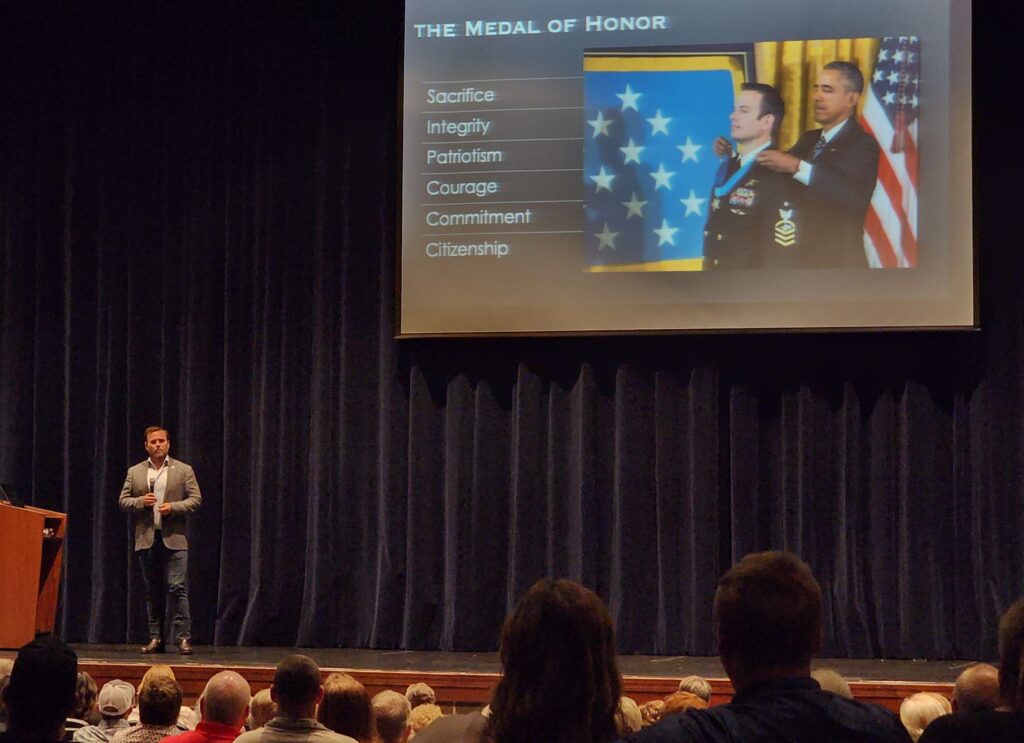
But it was the mission a year later that earned Byers the Medal of Honor for sacrifice, integrity, patriotism, courage, commitment and citizenship.
And it was that operation that led to an unwanted career change for Byers, who learned he was no longer allowed to serve. He compared it to being named MVP, then never permitted to play again.
“All I wanted to do in life was be a SEAL,” he said, confronting questions about his future. “Why have I used all 12 of my lives? And what do I do next?”
He retired from the military six years ago, and still struggles at times with returning to civilian life.
“We’re known for kicking down doors and shooting people in the face,” he said. But as a SEAL, he was also trained to adapt. “We are chameleons, blending into the environment.”
He has made adjustments so he can still serve – just in a different way.
“I went from being the tip of the spear” to being someone in the background, he said. “I can still help protect and do things for the boys overseas.”
Byers also struggles with the loss of his teammate Nic Checque in the Afghan raid.
“If he wouldn’t have been in front of me that night, it would have been me,” he said.
The physician rescued in the mission has reached out to the SEAL team, but Byers has no desire to communicate with him. Dr. Joseph had been to Afghanistan 10 times with a non-profit organization to train health care workers operating clinics deep in the war zone.
“The audacity of the guy,” putting his rescuers at risk, Byers said. “I don’t want anything to do with him.”
Since retiring, Byers has earned his MBA in finance, works in the private sector, and does consulting.
And he shares his story, his belief in America and his concerns about its future.
“There’s been a significant decline in the concept of patriotism, citizenship and sacrifice,” with a smaller share of the population being willing to serve, he said.
Many in the audience expressed their awe of Byers, and asked how to best serve their nation.
“Be the best damn citizen you can possibly be,” Byers said.