
By JULIE CARLE
BG Independent News
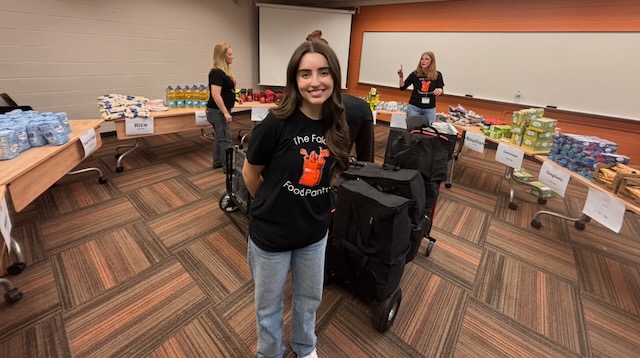
For Bowling Green State University student Anna Dawley, an honors project was an opportunity to do more than conduct research or write another academic paper. She wanted to create something that would make a difference in the lives of people in her community.
That goal became the Northwest Ohio Latinx Migrant Workers Food Access Initiative, a grant-funded project in partnership with La Conexión that brings culturally relevant food bags and Spanish-language resource information to migrant workers and their families across northwest Ohio.
Dawley of Perrysburg is an ambitious Honors College student and triple major in political science, English and Spanish. As an intern with BGSU’s Falcon Food Pantry, she has seen the harsh reality of food insecurity and wanted her senior year honors project to be more than just a paper.
“Typically, honors projects are very research-focused, but I’ve done so many research papers and different writing things with my majors that I really wanted to do something a little bit different,” she said. “I wanted to make sure that I could see an impact. I wanted it to be something with the community.”
Together with the Falcon Food Pantry and La Conexión, the local nonprofit that serves the Latinx and immigrant community, Dawley focused her project on addressing food insecurity among the region’s Latinx migrant population.
Working at the food pantry affirmed how important community is at BGSU and beyond, she said. “I wanted to do something that wasn’t just scholarship but scholarship that helps people,” Dawley said, describing the kind of impact she wanted her honors project to have.
She submitted a grant proposal to the John Henry Eldred Jr. Foundation, which awarded the project $7,500 to purchase food and support the project’s distribution efforts. Dawley also received a $450 grant through BGSU’s Center for Undergraduate Research and Scholarship program, which she used toward purchasing the insulated bags.
Rather than simply assembling conventional food donations, Dawley and her Falcon Food Pantry colleagues worked to ensure the bags contained ingredients familiar to the people receiving them.
Listening to the community
Developing the food list required input from multiple sources, including migrant workers, clients of La Conexión and BGSU faculty.
Dr. Amy Robinson, Spanish professor and one of Dawley’s project advisers, interviewed people with connections to the migrant worker community to learn which foods they wanted. Lucia Myers, executive director at La Conexión, also asked the nonprofit’s clients about their preferences. Dawley supplemented that feedback with her own research before compiling the final list.
The resulting bags included staples and ingredients such as rice, beans, flour, tortillas, masa, fideo, diced tomatoes, vegetable oil, bouillon, cumin, oregano and mole. Other items included coffee, oatmeal, hot chocolate and soup packets.
The Falcon Food Pantry team did all the shopping at the Bowling Green Walmart, which traditionally stocks the variety of foods Dawley identified for the project.
“They were very helpful at Walmart. They were so kind. They helped us check out, opened multiple registers and had a bunch of people helping us get our carts out to the car. And they gave us gift cards too to come back and shop more,” she said.
The foods purchased and distributed answered the Latinx community’s requests and provided food assistance that reflected their preferences and cooking traditions.
Local food pantries do a great job of providing essential services, but they may not always have culturally specific ingredients or information available in Spanish.
Bringing assistance directly to families
The project also considered the practical barriers that can prevent people from accessing traditional food assistance.
Dawley’s research found that transportation challenges and eligibility requirements can make it difficult for some migrant workers to obtain food from a pantry. Distributing bags through community organizations and sites serving migrant workers offered a way to bring resources closer to the families who needed them.
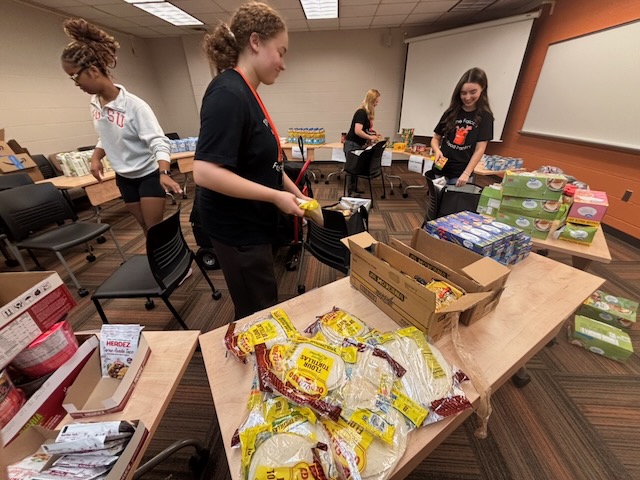
The first 100 bags were packed at the Falcon Food Pantry on campus and delivered via La Conexión in June directly to farms where families lived.
Recently, Dawley and a group that included four peers and Dr. Shannon Orr, director of the Falcon Food Pantry, spent an afternoon filling the remaining 50 insulated bags for the project’s final delivery.
As part of the project, Dawley helped develop a bilingual resource handout listing available food and community services. She also worked on a separate handout for food pantries across northwest Ohio explaining the need for culturally specific foods and ways pantries could better serve the Latinx migrant community.
The combination of immediate food assistance and educational outreach reflects a broader goal: not only helping families access food now, but also encouraging local organizations to make their services more inclusive in the long term.
Research with a real-world impact
For Simon Morgan-Russell, dean of BGSU’s Honors College, the project demonstrates the value of connecting academic research with community needs.
Dawley researched food insecurity among Northwest Ohio’s Latinx migrant workers, examined existing resources and identified barriers to accessing assistance before developing the initiative.
“I appreciated that the project combined research with a practical effort to address the problem it examined,” Morgan-Russell said.
The work also reflected Dawley’s desire to use her education beyond the university. Working with the Falcon Food Pantry helped her see the importance of community support at BGSU, and she wanted her honors project to reflect that same spirit.
She will take the experience with her after graduating in May as she hopes to attend law school to become an attorney, possibly pursuing intellectual property or immigration law. The project aligned with the university’s institutional identity, “A public university for the public good.” Dawley turned an idea into action, proving student research can lead to important and meaningful community support.