By JULIE CARLE
BG Independent News
Robin Wall Kimmerer was born a botanist. Her childhood lessons were learned in the woods and meadows of upstate New York.
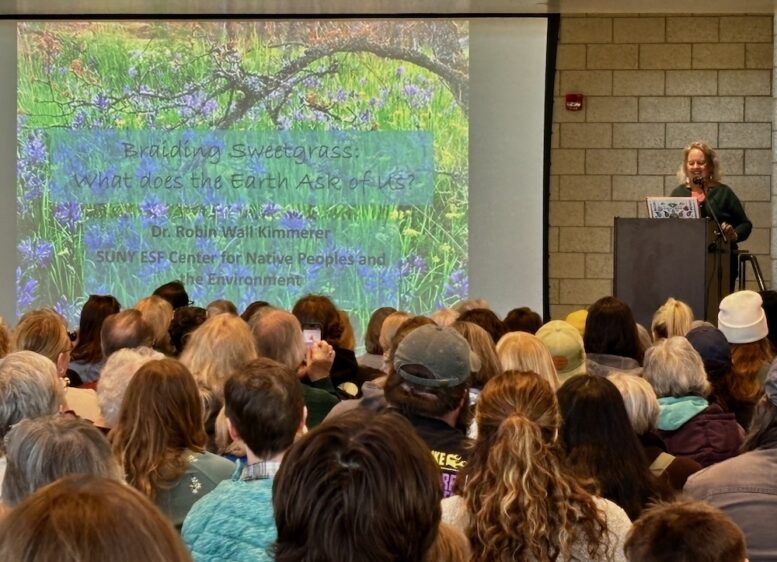
The scientist, author, member of the Citizen Potawatomi Nation, and 2025-26 BGSU “In the Round” keynote speaker told two standing-room-only crowds, “I grew up in the Indigenous paradigm where plants and the forest and the meadows around me were my relatives, my family.”
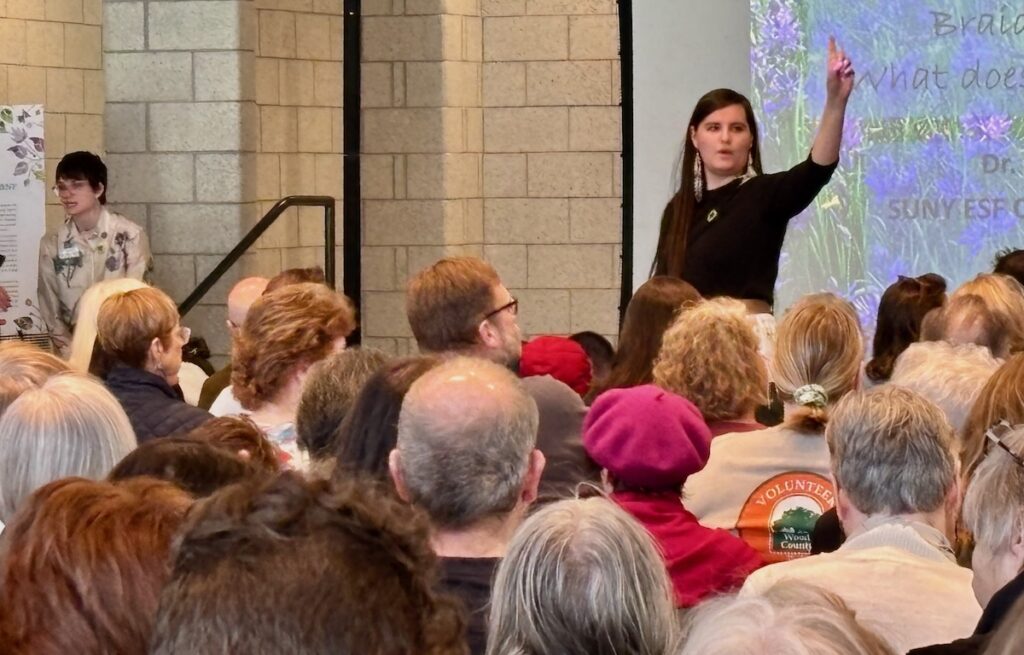
She spoke Friday night to more than 850 people who packed Kobacker Hall in the Moore Musical Arts Center, and a standing-room-only crowd of approximately 250 people Saturday morning at the Veteran’s Memorial Building in Bowling Green City Park. The events were a partnership between BGSU, Wood County District Public Library and Wood County Park District.
In talks that wove together science, Indigenous knowledge, and moral philosophy, Kimmerer challenged audiences to rethink humanity’s relationship with the natural world—not as one of ownership, but of responsibility.
As with everything she does, Kimmerer began not with data, but with gratitude.
“When our feet hit the ground in the morning, we should be asking what can we give, not what can we take,” she said. “Gratitude is like the doorway to reciprocity, which is why it’s so important in this equation of what does the earth ask of us.”
In keeping with Potawatomi tradition, she invited the audience to reflect on the gifts of the day—air, water, birdsong, and community—and to consider a reciprocal question: “How can we live so that the Earth is grateful for us?”
In her native language, Kimmerer talked about “Nagaan ge bezhig emkwaan,” the Indigenous treaty known as “The Dish with One Spoon.” She called it “the oldest international sustainability policy on the planet.”
“In this agreement with our neighbors, we agree that Mother Earth fills the same dish with everything that we need. And our two nations, despite our differences, agree that we will keep that bowl clean and full, because when it’s empty, everyone will suffer,” she explained. “There’s not a big spoon for some and a little spoon for others.”
For both audiences, she described sustainability as “an issue of justice as much as ecology.”
She contrasted this worldview with dominant Western systems, which often frame land as property, capital, or “natural resources.” Such language, she argued, reflects a deeper mindset of extraction—one that has led to climate crisis and biodiversity loss. That is where gratitude fits in, she said as she outlined a framework of giving back through science, restoration, art, policy and ethical living.
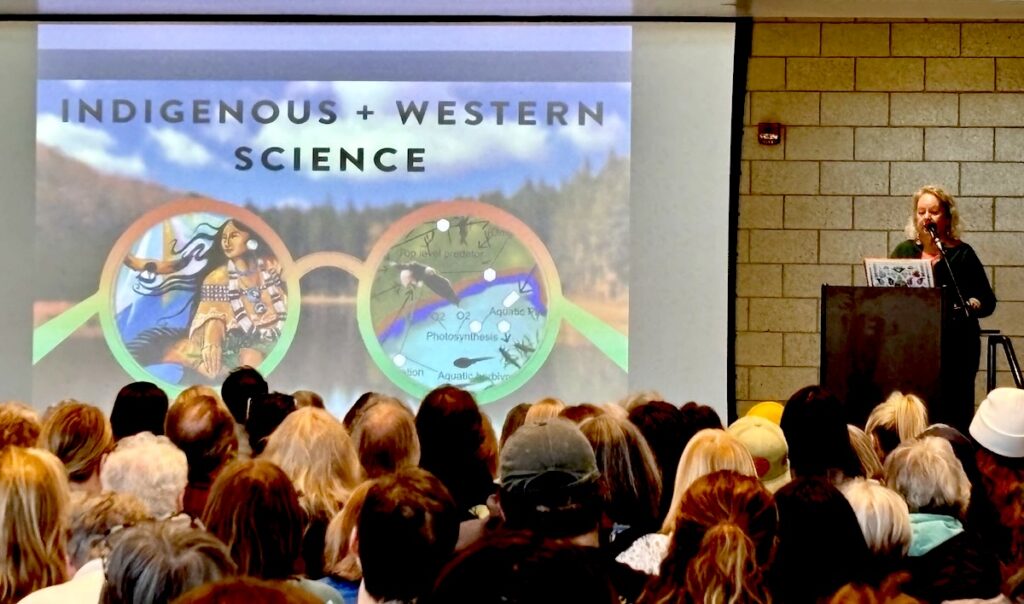
Kimmerer introduced the concept of “two-eyed seeing,” which integrates Indigenous and Western ways of knowing to achieve a more holistic understanding. While Western science emphasizes measurement and analysis, Indigenous knowledge also values emotional and spiritual understanding. Together, she argued, they offer a more complete path forward. “We need knowledge diversity,” she said, likening it to biodiversity as a driver of resilience and adaptation.
She also highlighted language as a powerful tool shaping human behavior. In English, non-human beings are often referred to as “it,” reducing them to objects. In Potawatomi, however, plants and animals are addressed with the same grammatical respect as humans. She proposed a simple linguistic shift—using the pronoun “ki” for living beings—to foster a sense of kinship. “These are the pronouns of the revolution,” she said, suggesting that even small changes in speech can transform perception.
Her call to action extended into ethics through the concept of the “Honorable Harvest,” a set of principles guiding how humans take from the Earth. These include never taking the first or last resource, asking permission, minimizing harm, sharing what is taken, and always giving something back. Applied broadly, she suggested, these principles could reshape consumption patterns and environmental policy.
Despite the gravity of the environmental crises, which is addressed in a United Nations report, and is evident just by reading the newspaper or looking out the window, Kimmerer’s message was ultimately one of possibility. She pointed to Indigenous-managed lands, which harbor a significant portion of the world’s remaining biodiversity, as evidence that sustainable relationships with nature are not only possible but already in practice.
Closing on a hopeful note, she introduced a grassroots movement with a simple mantra: “Plant, baby, plant.” Encouraging restoration, reforestation, and care for native ecosystems, the initiative invites individuals to take tangible steps toward healing the Earth.
For Kimmerer, the path forward is not just technological or political—it is cultural. “What if we changed ourselves?” she asked. “What if we chose to behave as if the land is our family, not a warehouse?”
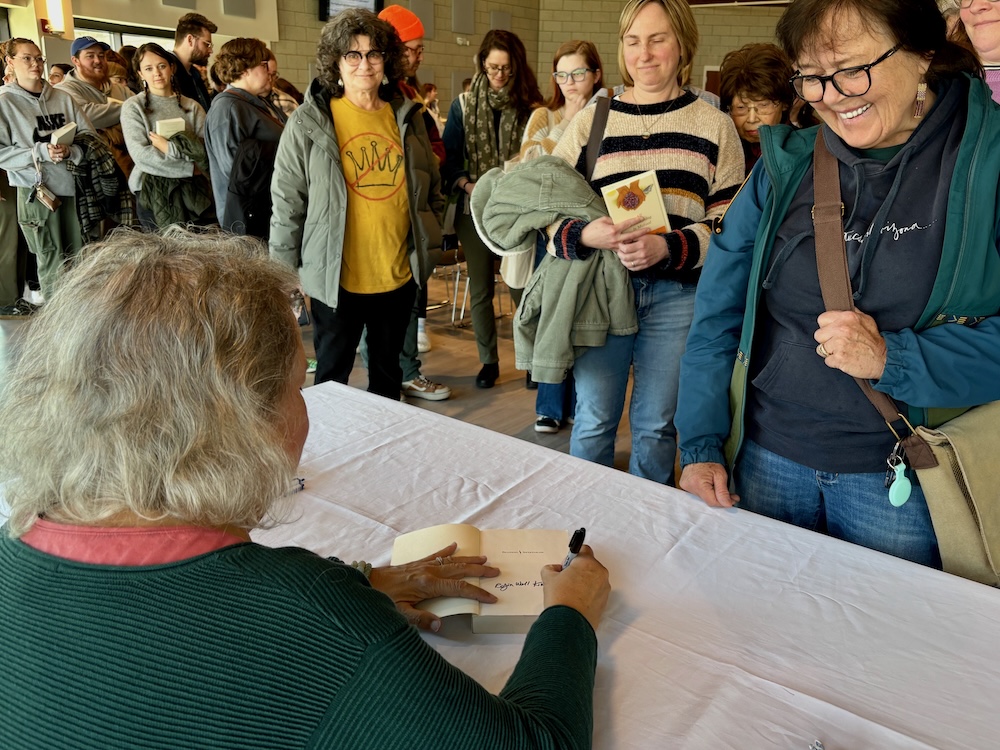
For an author’s talk in Bowling Green to attract a thousand people is a sign that Kimmerer’s message struck a chord in the community, said Jenn Stucker, a BGSU graphic design professor and one of the organizers for the university’s “In the Round Series” that started in 2022.
“I think just getting reconnected to the everyday and the things that people are taking for granted is a big part of the appeal,” Stucker said. “What she said is not necessarily new, but it feels so profound and necessary.”
Stucker was also pleased with the attendance. “I think the visibility of so many people coming is important. They can see how many other people care, so they don’t feel like they are the only ones that care about this issue.”