By JOHN M. KING
BG Independent News
Wood County has been called an agricultural powerhouse; it is the fifth-largest producer in Ohio, with more than 260,000 acres of farmland in production. Corn and soybeans reign supreme, and not just in Wood County, but throughout Ohio.
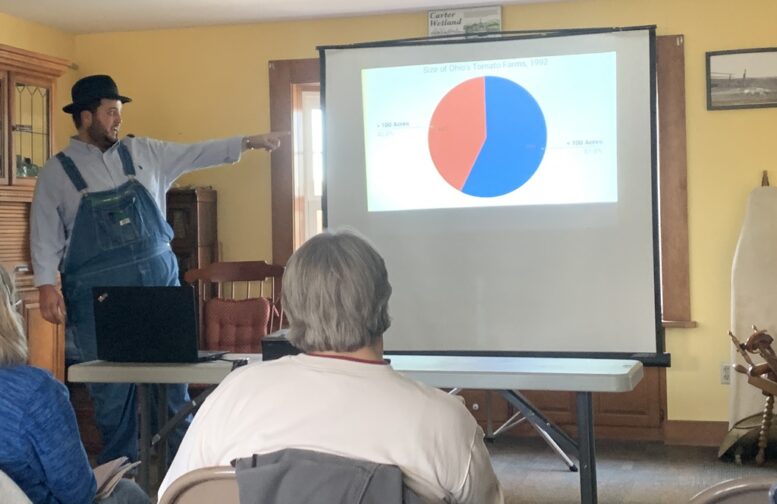
Together, these crops bring in nearly $8 billion statewide a year, according to historic agricultural specialist Chase Fleece, leading a cultural program on Wood County’s specialty crops at Carter Historic Farms on Nov. 23.
For Fleece, who has worked at Carter Historic Farm since 2023, the history of crop production in the county paints a vivid picture of diversity over the last 100 years. While corn production has always been a staple, soybean production in Wood County only began in 1930.
At the time, specialty crops like cucumbers, sugar beets, and tomatoes were common in Wood County fields. When soybeans were first planted in the county at about 2,000 acres, sugar beets accounted for about 15,000 acres.
The federal government supports commodity crops like corn and soybeans through subsidies and insurance, but not specialty crops, which has led many farmers to move away from crops like these.
The story of tomatoes in Wood County is much more complex.
Fleece said that due to the Black Swamp soil, tomato production was so fruitful that H.J. Heinz opened a major ketchup factory in 1914 on Enterprise Street in Bowling Green. It remained in operation until 1975. In fact, tomato production became such a major part of the local culture that Bowling Green even had a tomato festival in 1938 and 1939, with a parade and banners that read “Tomato Land Welcomes You.”
In 1939, Jane Kramp was crowned Queen of Tomato Land and was given an all-expenses trip to the Heinz facilities in Pittsburgh, Pennsylvania. Kramp was chosen due to her “robust health, beautiful face, attractiveness of bodily form, radiant personality, graceful poise, serene charm and talent; those inherent qualities of the Wood County tomato, which make it the leader of all tomatoes produced.”
Tomato production in Wood County peaked in 1940 with 4,669 acres. At the time, the success of the crop was due to the availability of migrant workers from Mexico to hand-pick the tomatoes.
An immigration “crackdown” by the federal government greatly reduced the availability of laborers during World War II, in which German and Italian prisoners of war from Camp Perry were used to pick the crop, Fleece said.
In 1978, the Farm Labor Organizing Committee (FLOC) led by Baldemar Velasquez in Toledo, staged a national boycott of Campbell’s soup and Wood County tomatoes. The boycott alleged that Campbell’s was not paying farmers enough for it to be sustainable, and FLOC pressured Campbell’s to pay more for their product.
Campbell’s, in turn, in 1979, told farmers that to “eliminate the farm labor threat,” they would only buy tomatoes picked by mechanical harvesters. In 1986, FLOC and Campbell’s came to a collective bargaining agreement, but by this time, many local farmers who could not afford mechanized harvesters stopped tomato production altogether.
While specialty crops have mostly disappeared from commercial farms in Wood County, they are still grown at Carter Historic Farm, a Wood County Parks educational working farm from a 1930s Depression era perspective. Beets, onions, popcorn, tomatoes, and squash are among the specialty crops you will find at Carter Historic Farm.
“One of the things we are looking into doing is expanding into these historically specialty crops,” Fleece said. This includes growing sugar beets and having a program on making sugar for a “more holistic approach” to “give people an idea of what it looked like in the 1930s.”
Fleece’s next cultural program will be on the history of ice harvesting in the U.S. on Dec. 12 at 1:30 p.m. in the Carter Historic Farm farrowing house. The event is free, and reservations can be made on the Wood County Park District website.