
By JULIE CARLE
BG Independent News
What began as a decade of optimism in the 1920s quickly unraveled into one of the darkest economic crises in modern history.
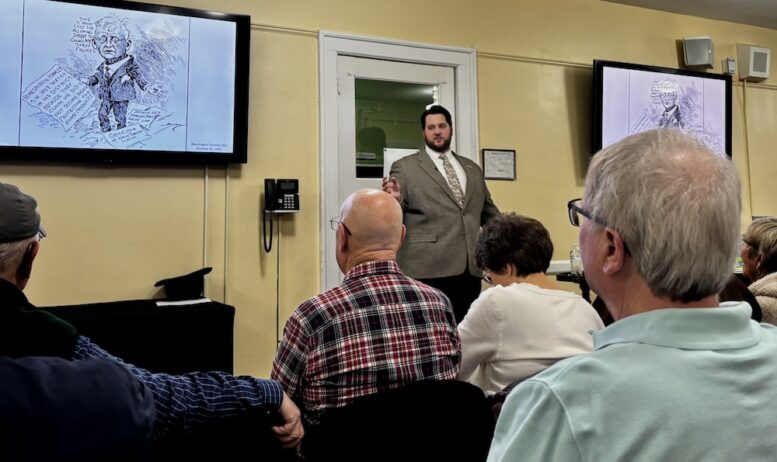
Chase Fleece, historic agricultural specialist for the Wood County Park District, traced the origins of the Great Depression during a recent talk at the Wood County Museum for The Great Depression Lecture Series.
Fleece challenged the popular myth that a single event—the Wall Street Crash of 1929—caused the collapse. Instead, he painted a far more complex picture: a fragile system strained by inequality, risky financial practices, weak regulation, and misguided policy decisions at home and abroad.
When Herbert Hoover assumed the presidency in March 1929, he inherited what appeared to be a thriving economy, what is often referred to as “The Roaring ’20s,” the bolstered economy of Calvin Coolidge’s presidency.
Guided by a belief in “rugged individualism,” which relies more on self-reliance through hard work of the American people, Hoover favored limited government intervention and trusted businesses and individuals to stabilize the economy through voluntary cooperation. He expected businesses and corporations to “willingly out of their own pockets make sure wages are mantained and unemployment is kept low,” Fleece said.
The government’s role was to foster cooperation—not with a heavy hand, but as a judge, to make sure that things were moving equitably throughout the country.
Hoover believed that government intervention would undermine the American character and that it would foster dependency among American people if the federal government subsidizes them.
“That is what is going to propel the nation forward,” Fleece said about Hoover’s mindset. “But he also understands there are issues, especially in the countryside. Farmers are strapped because rising debts and bankruptcies.”
Yet as cracks widened, Hoover’s rugged individualism philosophy was tested—and ultimately criticized, Fleece said.
“The stock market crash, while dramatic, was only a symptom of deeper structural issues,” he explained. Wealth was concentrated among a small elite, leaving most Americans with limited purchasing power.
At the time, only 10% of households or 2% of the individuals were invested in the stock market, Fleece said, contrasted to today when 60% of Americans have direct holdings in the stock market through pensions or 401Ks.
“The only people who are affected by the stock market crash are the top 2% of Americans,” he said. “For many in the countryside, they weren’t invested, so they thought, ‘What’s the difference? We’ve been in an agricultural depression since 1919,’” Fleece said.
Industries like construction and automobile manufacturing dominated the economy, creating vulnerability when demand fell.
At the same time, widespread speculation inflated stock prices far beyond their real value, setting the stage for collapse.
Bank failures soon followed. As panic spread, thousands of banks closed between 1929 and 1933, wiping out savings and crippling credit. The Federal Reserve, rather than stabilizing the system, allowed the money supply to shrink and raised interest rates—decisions that deepened the crisis.
The lack of economic diversification in the United States, the maldistribution of wealth, and the volatile credit structure plagued cities and country alike with debt and consumer purchasing power. These factors and “the mistakes of the Federal Reserve Board responding to the crisis,” also led to a decline in international trade and international debt structure.
Government policy also played a pivotal role. The Smoot-Hawley Tariff Act, intended to protect American businesses, instead triggered retaliatory tariffs worldwide, Fleece said. International trade collapsed by roughly two-thirds, devastating farmers and accelerating unemployment.
Globally, the crisis was interconnected. A fragile post–World War I debt system tied the United States to Europe. When the American economy faltered, the entire structure collapsed, plunging countries like Germany into economic chaos—conditions that would later contribute to the rise of extremism.
Hoover’s response—focused on local relief, limited federal aid, and business cooperation—proved insufficient in the face of mass unemployment and poverty. Public frustration grew, symbolized by “Hoovervilles,” makeshift shantytowns housing the homeless. His reputation suffered further after the violent dispersal of the Bonus Army, when thousands of veterans demanding early payment of promised bonuses were forcibly removed by U.S. troops.
By 1932, unemployment had soared to 25%, and confidence in Hoover had collapsed. Yet historians continue to debate his legacy. While widely criticized for inaction, some argue that his late efforts—public works spending, financial support programs, and housing relief—laid groundwork later expanded by Franklin D. Roosevelt.
Hoover’s policies and presidency became “the ire and the blame of many of the conditions that afflicted Americans during these earliest years,” Fleece said. “He didn’t quite grasp what the everyday Americans were experiencing.”
He would be remembered for his ineffective leadership and his response to the Bonus Army, “a protest of about 17,000 to 43,000 World War I veterans, their families and the supporters who planned to march on Washington, D.C., to demand Congress enact an early bonus payment,” Fleece said. “It led to the final nail in his aspirations to win the election in 1932.”
