By JULIE CARLE
BG Independent News
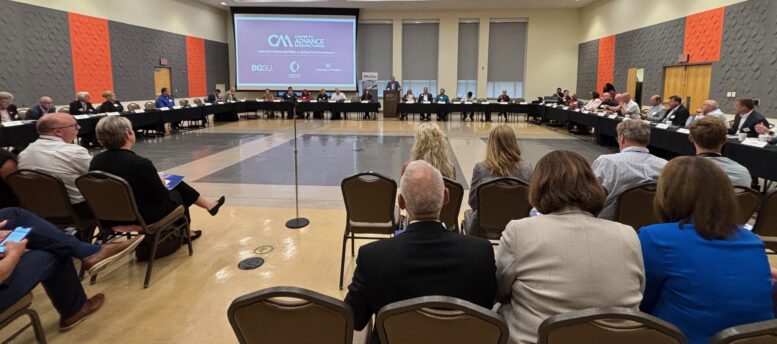
Representatives from manufacturing, higher education, economic development, and state and federal government recently shared concerns and possible solutions to some of the manufacturing sector’s most critical workforce challenges.
The conversation centered on the difficulty in attracting and retaining talent, the negative public perception of manufacturing jobs, and the need for student exposure to today’s modern manufacturing environments.
The roundtable was led by the Center to Advance Manufacturing, a partnership that is anchored by Bowling Green State University, the University of Findlay and Owens Community College.
“What are the most pressing workforce challenges that you’re seeing, and what’s making it difficult to overcome?” asked Kassie Cooper, projects manager at the center. “We want to hear what’s working and where the pain points are from our manufacturers.”
Despite it being a gathering of several dozen stakeholders, there was little hesitation when it came to the manufacturing workforce—“a hot topic in a lot of rooms around manufacturing,” Cooper said.
The image of manufacturing
Today’s manufacturing is a very different industry than it was even 20 and 30 years ago. The industry used to be considered dark, dirty and scary. Today, it is very technical and advanced.
But public perception hasn’t necessarily changed.
“How do you make manufacturing sexy? How do you make Ohio sexy?” asked Bill Steel, of Bard Manufacturing.
“There’s a lot of talent around here, but not everybody wants to stay here. They want to go to New York to be in investment banking or private wealth management. I don’t know how to get people to stay (in Ohio),” he said, summarizing the dual challenge of improving the industry’s image and retaining young talent within the state.
Several participants talked about exposing students, as young as elementary school aged, to the new world of manufacturing that includes technology, robotics, and automation.
In some districts, teachers are given continuing education credits to explore local manufacturing plants to open their students’ eyes to the industry and the modern facilities that are prevalent today. Schools are invited into the plants to see how the industry has changed.
One positive aspect that is changing somewhat is the financial benefits of some manufacturing jobs. With welders being in demand, U.S. Rep. Bob Latta said he was at a career center welding shop and asked two of the 16-year-old students why they were interested in welding. “Without missing a beat, what they said was the money.”
The welding instructor told Latta the students would likely make $65,000 a year after graduating from high school and as much as $100,000 within three years. “This is what we need to share with parents, teachers and kids,” he said.
Another participant suggested the need to help youth see themselves as welders, HVAC technicians and in similar trade positions.
“It’s OK to be a truck driver, a forklift operator,” said Charles Bills, president and CEO of Ohio Logistics. “Getting education teachers out to see that has made a big difference for us.”
The nature of automation
Automation in the industry offers an opportunity for efficiency, but it also creates a challenge that eliminates entry-level positions.
Participants also discussed the dual nature of automation as both an opportunity for efficiency and a challenge that eliminates entry-level positions.
A significant portion of the dialogue focused on the instability created by federal immigration policies and the potential economic impact of losing a large segment of the legal immigrant workforce.
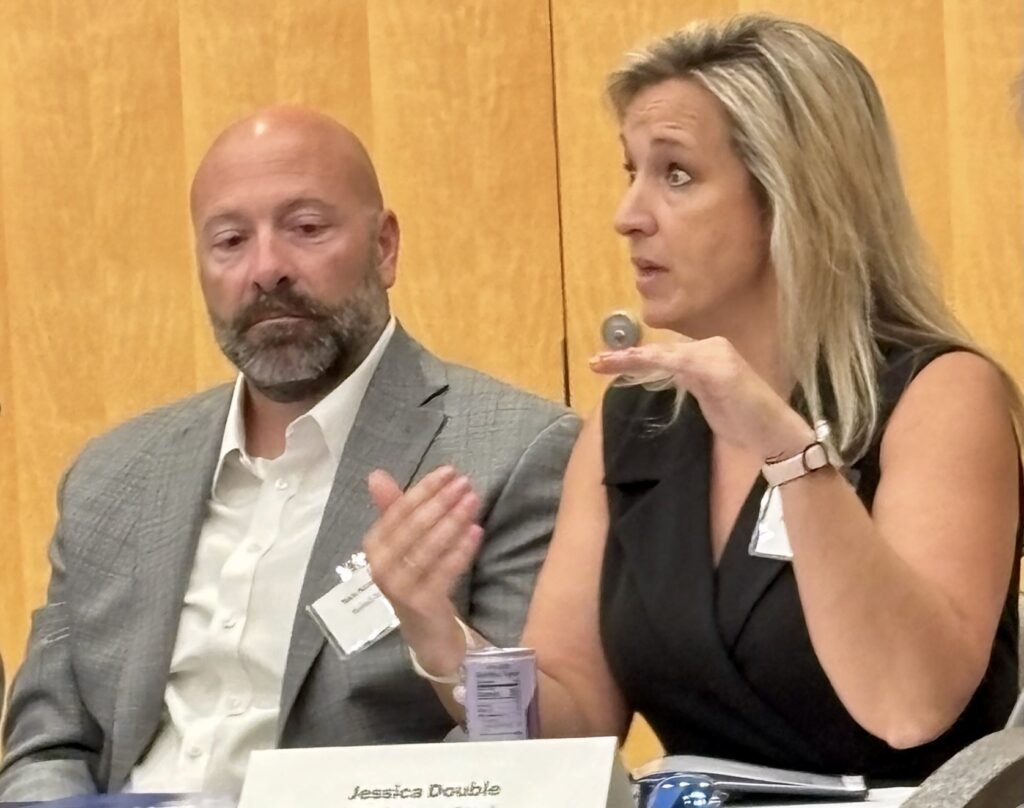
Lawmakers and representatives need to be aware of how northwest Ohio is being affected and will continue to be affected by the reduction of the immigrant population, said an area company representative, whose workforce is 50% legal immigrants. He said because those immigrants “are quickly becoming illegal,” the financial impact could be a loss of $900,000 in state taxes and close to $500,000 in local taxes from his company.
“I just want our representatives to understand that this is going to be a significant impact in Ohio, especially for the local city,” he said. “We don’t necessarily face a skilled position absence, but we do struggle with the hourly workforce.”
Throughout the meeting, there was a strong emphasis on the need for increased collaboration, better communication of available resources, and a unified regional approach to solving these complex issues.
They also called for a shift in the mindset among competing companies to address the shared crisis of talent shortages.
The center’s work is different for each company that they work with, whether it’s small, mid-size, or large manufacturers. “We might be upskilling their current workforce, navigating the Ohio Tech Credit process from start to finish, or identifying opportunities to partner with our educational institution,” Cooper said.
“Manufacturing remains a cornerstone of our region’s economy, but it faces real challenges, from talent shortages, work participation barriers and rapid technology changes,” she said. “We are here to elevate the voices of manufacturers, share insights that can help inform legislative decision-making, and maybe also uncover some challenges to make others aware.”
“These conversations help us strengthen collaboration and move northwest Ohio’s manufacturing sector forward,” said BGSU President Rodney Rogers. “A lot of exciting things are going on, whether it is AI (artificial intelligence), the use of technology or new industries. At the end of the day it is about making sure we have a workforce that is adaptable, and that has created problem solvers who know how to work with technology, especially in this (manufacturing) space.”