
From BOWLING GREEN CITY SCHOOLS
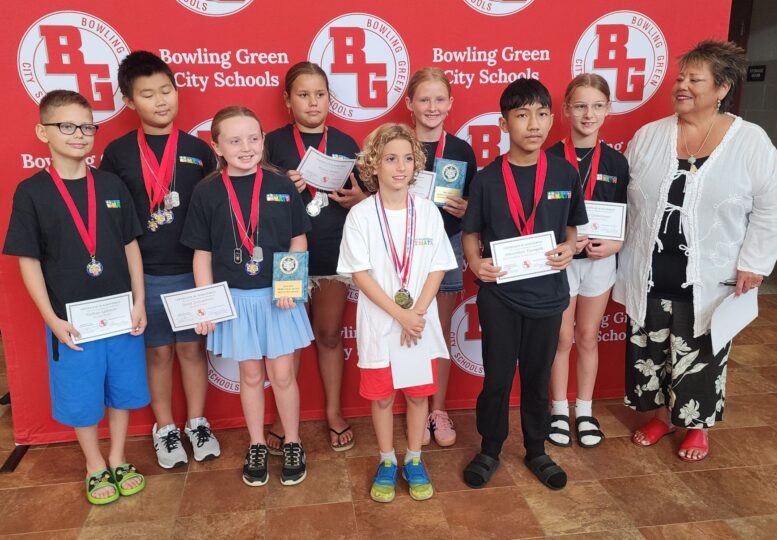
Each year, one of the most challenging assignments in PACE is the Perennial Math competition, according to Laura Weaver, Bowling Green City Schools coordinator for gifted services and the gifted intervention specialist for third through fifth grades.
To prepare for the competition tests, students complete weekly practice quizzes from previous competitions, a variety of other math challenges, such as the Daily Number Study, which takes a number and breaks it down with prime factorization, multiples, and the order of operations to be able to quickly solve advanced logic problems on the test. They also do a program called “MASHUP MATH,” where students have to cognitively decipher the value of objects using the order of operations to find the hidden value of a number.
Perennial Math is a competition program which offers accelerated logic math problems to students with all math skills and abilities. Students participate for team points and individual points by taking one test each month, which is comprised of six questions. The three teams are “Rookie,” grades 3 and 4; “Intermediate,” grades 5 and 6; and “Advanced,” grades 7 and 8.
Students cannot compete on a team that is more than two grade levels higher than their current grade, which usually eliminates some of the advanced mathletes in 3rd and 4th grades. According to Weaver, these mathletes are capable of advanced courses in middle school and high school math.
Bowling Green City Schools has participated in this competition since 2013, and PACE students have won team plaques and gold medals with perfect scores every year since. In 2025, there were 2,403 students competing internationally, with 145 teams participating in grades 3 – 8.
Each student receives a certificate of participation and each team awards the gold medal to its top competitor. Medals are awarded based on the highest score out of the four tests of the season. A perfect score is 24 points. Gold medalists receive a t-shirt and a gold medal for having the top score on the team and in their grade level for that team. Students who receive dog tags are in the top 10% of students participating in that competition level at their grade level.
For the team plaques in 2025, the Rookie team needed a score of 183. The BGCS team had a score of 230, which was the highest score out of all teams participating. Internationally, nine students had a perfect score of 24, and four of those are gold medalist students from BGCS. They were:
- Declan Koontz, 3rd grade
- Jessa Donaldson, 4th grade
- Nathan LaWarre, 4th grade
- Ryann Dennis, 4th grade
For a team plaque, the Intermediate team needed a score of 170. The BGCS team had a score of 187. Internationally, 10 students had perfect scores. Of those students, five gold medalists were from BGCS, and they were:
- Jonathan Thangdik
- Aiden Xu
- Mazie Perkins
- Quinn Camera
- Ruby Underwood
The “Advanced” team is the most difficult for most students because it challenges the logics of math at an accelerated 7th and 8th grade level. BG had a smaller team than in past years, which limited a higher team score of 135 for a plaque. However, the team of six students scored 126 points. Internationally, there were two students who had perfect scores, and those two students were from BGCS. They were:
- Jonathan Thangdik
- Quinn Camera