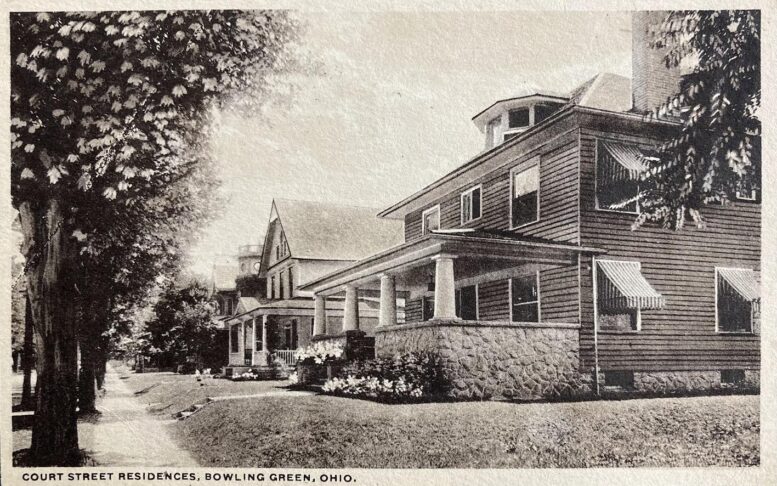
The Historic Building of the Month in Bowling Green is the home at 216 East Court Street. Not far from Bowling Green’s downtown Main Street Historic District, standing taller than any of the surrounding structures, is the Wood County Courthouse. Just across the street from the courthouse are four residential homes, including 216 East Court Street. From the front lawn of this handsome, green-painted house, one can imagine watching couples young and in love venture into the courthouse to obtain a marriage license, teenagers picking up their first vehicle titles, and lawyers and clients hurrying to make their court appearances.
Historically, 216 East Court Street has borne witness to several moments of significance for the county that took place on the courthouse lawn just across the street. The house has seen two presidents campaign on the courthouse steps: William Howard Taft in 1912, and Ronald Reagan, on behalf of George H.W. Bush, in 1988. 216 East Court Street also viewed two Ku Klux Klan rallies in the 1990s. For as much history as this property has beheld from its vantage point, it also holds a great deal within its walls.
The home, called the “Nearing House” by many in Bowling Green, is named after its first owner, Wood County Judge Charles Rockwood Nearing. The parcel it stands on had originally been owned by another prominent citizen, Alfred Thurstin, a landowner and farmer in Wood County whose dealings in real estate stretch back to the city’s earliest days, in the 1830s. In 1904, Charles Nearing’s father, the attorney Guy C. Nearing, purchased the property and built a house on it at 220 East Court Street.
Guy C. Nearing was born in Plain Township, Wood County, to Stella and Neptune Nearing, and was grandson to early settlers of Perrysburg who had a role in building the county’s first log courthouse, when Perrysburg was the county seat. He enlisted in the 6th Ohio Volunteer Infantry in 1861 and saw combat at the battles of Shiloh, Stone River (where he was wounded and held as a prisoner of war for five months), Chickamauga, and Missionary Ridge, and was honorably discharged in 1864.
Upon returning to civilian life, Nearing married Emma V. Rockwood in 1865. He worked as a teacher, a farmer, and finally a lawyer, being admitted to the bar in 1876. His 40-year career in Bowling Green saw him serve as director of and investor in the First National Bank, as a member and president of City Council, as city solicitor and, by 1891, as probate judge. In 1904 he had a house built at 220 East Court Street. Emma died in 1907 and in 1908 Guy married Lola Carney. Guy Nearing died in his home in 1919, after a long battle with anemia. His funeral was held at his home, and he is buried in Oak Grove Cemetery in Bowling Green.
Guy Nearing’s son, Charles Rockwood Nearing, was born in 1868. Charles would follow in his father’s footsteps in his choice of career. Before he enrolled at Ohio Normal University (now Ohio Northern), Charles worked as a rig builder in Wood County during the oil boom of the early 1880s. He then took a job with Willsey Oar Factory in Jerry City, where he met a future Wood County common pleas judge, E.G. McClelland, and the future county sheriff Floyd Heald. Both men influenced his decision to study law. When his father was elected probate court judge in the mid-1880s, Charles assisted him in his office.
He enrolled in university in 1887 but was stricken with typhoid in 1888. His treatment included a drug that was believed to have caused paralysis in his legs, but this may have been what we know today as Guillain-Barre syndrome, a complication of typhoid. That Charles used a wheelchair for the remainder of his life did not prevent him from pursuing his law career. He held several judgeships, including justice of the peace for Center Township from 1895-1909, probate judge from 1910 to 1917, and justice of the peace again until 1943.
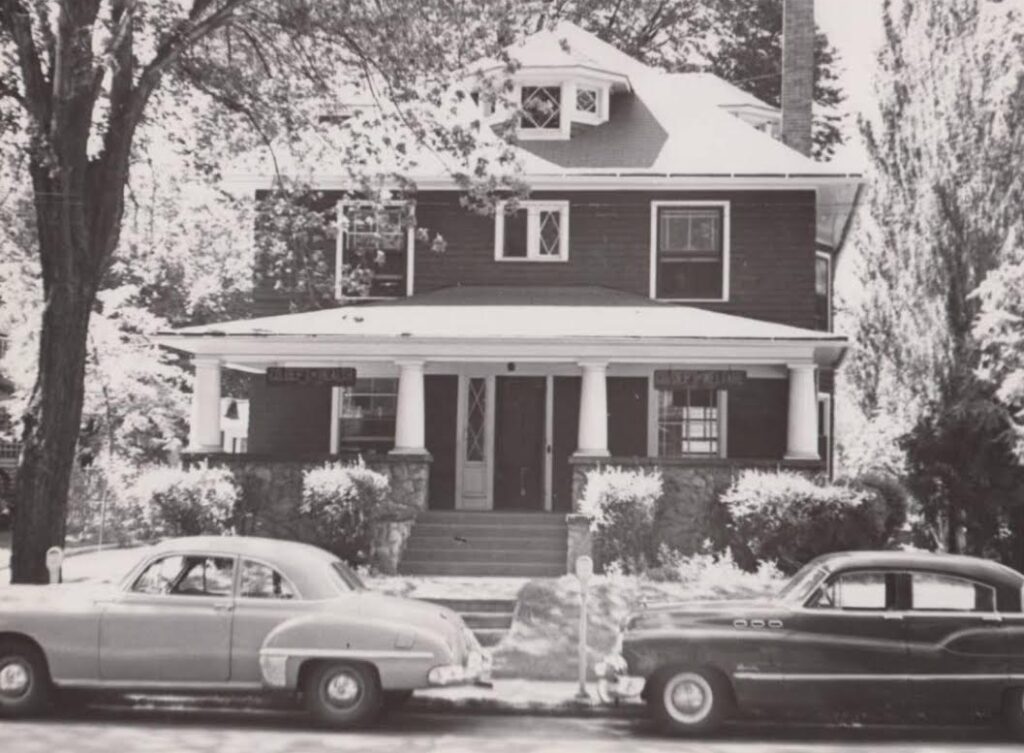
By 1913, he was living with his wife Harriet in the newly built house at 216 East Court Street, next to his father’s home. The house was conveniently located across from the Wood County Courthouse, which enabled Nearing to use rooms in his home as a judge’s chamber and jury recess area. As justice of the peace, Nearing performed many marriages in front of the fireplace in the home’s parlor. Between 1920 and 1942, Bowling Green was considered a “marriage mill” town because it was possible to get married here without much red tape or waiting. With 454 ceremonies performed, Nearing married more couples than anyone else in Bowling Green. (See the HPC’s historical sign at the southeast corner of East Court and North Prospect streets, “Court Street Connections.”)
Charles and Harriet Nearing had two sons, Guy and Earl, who survived to adulthood; another son, Stephen, died as a baby. The Nearings both passed away in 1943. They are buried in Oak Grove Cemetery.
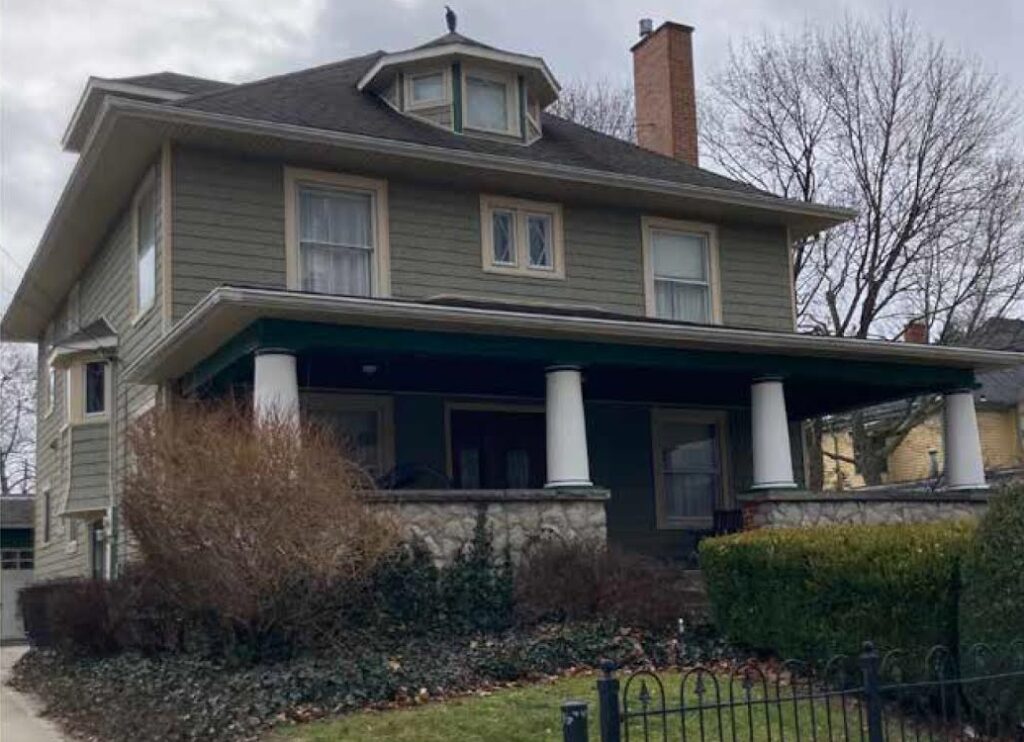
If you walk down East Court Street, 216 stands out as aesthetically distinct from the surrounding houses, with its hipped roof, three hexagonal dormers, prominent overhangs, and precise symmetry. It is less elaborate than the Queen Anne Victorian at 228 East Court Street (1892; Historic Building of the Month for October 2023), but more ornate than Guy Nearing’s Folk Victorian house at 220 (1904).
The three-bedroom house fits within the time frame and artistic movement of the Craftsman style as one of many Craftsman bungalows which pepper Bowling Green’s residential streets. However, its hipped—not gabled—roof and dormers, and its two and half floors—not one and a half—distinguish it from the majority of Craftsman bungalows.
216 E. Court Street is set apart by its long, covered porch connecting it to the outdoors, its modest symmetrical facade, and its four round, tapered white columns, which pull attention straight to the wide front door. The single sidelight to the door’s left is a departure from the house’s general symmetry.
These features, as signature elements of a Craftsman bungalow, fit within the Arts and Crafts movement, which rose to popularity at the turn of the 20th century. Influenced by the Art Nouveau movement that preceded it, and by the English designer William Morris, the Arts and Crafts movement was an informal aesthetic that put emphasis on natural materials, and on making functional features into pieces of eye-catching beauty as well. The simplicity and informality of this aesthetic also made it an affordable option for building or buying a home.
After the passing of the Nearings in 1943, the home was owned by William and Margaret Grant until 1949, when it was purchased by the Wood County Commissioners to be used as a courthouse annex and to house the health department. When the new County Office Building was opened in 1976, the commissioners no longer needed the Nearing House, which reverted to a private residence when purchased by Lois Jean Yarnell. She would live there through her time serving as the director of Parking Services and Traffic at Bowling Green State University, before she passed away in 1994. Steven and Leslie McConkey owned the home from 1994 until 1999, when Nancy Lenhart took ownership.
Owners of the Court Street house have been known to decorate the home with flair. Judge Charles Nearing and his wife placed animal heads and skin rugs around the ornately decorated fireplace. The late Dr. Francis Lenhart, longtime Defiance County Coroner and a Civil War buff, installed the cannon still visible on the front porch. Current resident Nancy Lenhart was such a fan of the 1950 film “Harvey,” which told the story of a man whose best friend was an invisible rabbit, that she bought a giant stuffed white rabbit for $2,000. When the Lenharts moved into the Court Street house, the rabbit took up his perch in the upstairs bedroom where he remains, to the delight of BG residents.
(This Building of the Month submission is the result of a collaborative effort by students in BGSU’s Local History seminar taught by Dr. Rebecca Mancuso in Fall 2025. Students Rory Burmeister, Phil Dickinson, Alex Eckhart, Noah Fitch, Morgan Goodchild, Sarah Hopson, Garrett Lewis, Connor Madden, Shelley McClure, Lochlyn Ramsey, Dylan Rice, Roberto Rios, Abbey Laird, Sabrina Sprague, and Cole Stoots worked together to research this historic home and its inhabitants. Dr. Mancuso and Historic Preservation Commission member Geoff Howes edited the article.)
Would you like to nominate a historic building or site for recognition? You can do this through the City website at – https://www.bgohio.org/FormCenter/Planning-13/Historic-BuildingSite-Nomination-Form-83
You can learn more about the Historic Preservation Commission by attending the group’s meetings, on the fourth Tuesday of each month at 4 p.m., or by visiting the webpage at https://www.bgohio.org/436/Historic-Preservation-Commission.