
By TOM GERROW
BG Independent News
The elements that power the economy of Northwest Ohio – financing, industry, institutions and partnerships, infrastructure, and especially human capital – were on the minds of attendees at this year’s State of the Region conference at BGSU.
The event, the 24th State of the Region, was focused on Shaping Ohio’s Next Generation of Talent and brought together business leaders, university faculty and students to network and explore the value of and need for industry-university partnerships.
“Universities that are connected, that are thinking about the programs for tomorrow, that are thinking about how to support students to help them be successful are attracting talent,” said BGSU President Rodney Rogers in his opening remarks, setting the theme for the event. “What we are working on is making sure that every student is a creative problem solver who knows how to use technology, to enhance that technology, to be of great value to employers, to lead companies, to create companies, to be partners. That is our goal, and that should be every university’s goal.”
Addressing members of the business community, Rogers said, “We want to continue to be an important partner to every one of you. We’ve got amazing faculty and we have amazing students who want to work on real world issues and challenges.”
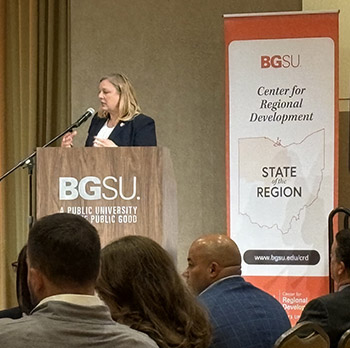
Nichole Fifer, director of the BGSU Center for Regional Development, dove into the economic numbers of the 32 counties based on a variety of data sources, including NERDE (National Economic Resilience Data Explorer).
Ohio saw growth in GDP of about 1.9%, which was a little lower than last year’s 2.8% and a bit behind the nation, which saw closer to 2.8% GDP growth.
“Where we can see better outcomes is when we look at our industry sector strength,” Fifer said. “So we see in terms of GRP growth, manufacturing, transportation and warehousing, and technical and professional services – three of our major industries – over the past five years we’re seeing between 20 and 30 percent growth in all of those areas.
Fifer reported the region has seen a slight rise in unemployment but is in a relatively steady state when it comes to the labor force. The unemployment rate for the region is only slightly higher than the national average. Some counties, however, are experiencing significantly higher unemployment rates of 5.25 or higher. Labor force participation rates were hovering around 62%, but this varied significantly from county to county.
“We have some counties that have what we would consider incredibly good labor force participation rates,” Fifer said. “So we have 72% in Delaware County, for instance. On the other hand, we have some that are much lower. We have 51% in Marion County. So we have about a 20-point distribution range in our region.”
Fifer emphasized that the prime age (25-55 years old) labor force employment rate was very good at 81%.
NERDE uses data in five “buckets” of economic development capacity – human capital, financial, infrastructure, industry, and institutions & partnerships – that help determine a resiliency score. Overall, the region scores a 0.6 out of a maximum score of 1. Fifer identified financial capacity as where the region is weakest, while infrastructure and industry are among the region’s strengths.
“Access to capital is a problem that we talk about consistently in Northwest Ohio,” Fifer said. “A place where we do very well is infrastructure. We’ve got water, we’ve got land, we’ve got rail, we’ve got highways, we’ve got ports. We have all the things that make us very attractive. So what does that tell us? We should have a stable job economy. We should see companies doing well. And we do.”
According to Fifer, the region’s human capital metric is experiencing a bit of a demographic squeeze, with lower numbers of young people and more retirees when compared with the rest of the nation. Five-year population growth is projected at just 0.44%. Also of concern is that regional average earnings are about $72,000, about 12% lower than the national average. On the plus side, the cost-of-living index for the region is about 6% below the national average.
“The summary is that we have a lot of jobs, maybe not with the highest wages,” Fifer said. “We have a very attractive region in a lot of ways, but we have a population crunch.”
“We have a whole lot of talent that we’re bringing here,” Fifer said. “How do we keep them here? And how do we make sure that we attract those job opportunities so that they have someplace to work and to share their talent here?”
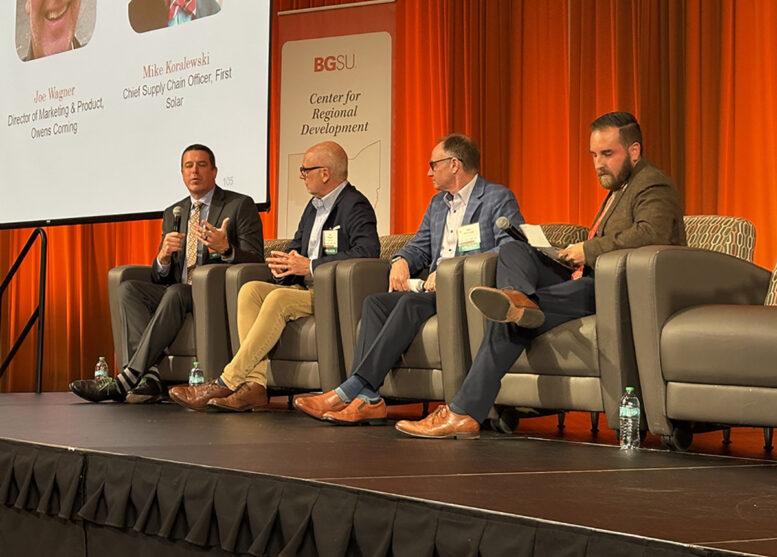
The conference featured an Industry Partner Panel to discuss how industry can coordinate and partner with BGSU and other universities to help build the future workforce.
“I do view the university as part of the supply chain,” said Mike Koralewski, chief supply chain officer at First Solar. “And when I think about how we measure quality, throughput, reliability, and continuous improvement in our suppliers, I measure the university the same way.”
Koralewski noted that advisory boards should not be generic in focus, but very specific, driven to help industry co-develop the curriculum and highlight what industry really needs.
“When you do that, you get this nice virtual integration, not vertical integration, but virtual integration of the supply chain moving forward,” Koralewski said.
Panelist Joe Wager is the director of marketing & product at Owens Corning, but he also serves on the marketing advisory board for the Marketing Department in the College of Business at BGSU.
“The talent that is coming into Owens Corning, especially from BGSU, is the talent that sticks,” said Wager. “We’ll have employees, colleagues from different schools of higher pedigree, you could say, they don’t stick. And I don’t know what the magic is, but the ROI on someone that has graduated from BGSU, and comes to Owens Corning, is there. They invest in our company, they mentor other young people that come into the company, and they make it a pleasant place and a place that everyone wants to work and see some headway going forward in their careers.”
Jeremy Normington-Slay, another panelist and president and CEO of Firelands Regional Health, said, “We kind of abide by a philosophy, and I think you’ve probably heard the saying, if you want to go fast, you go alone. If you want to go far, you go together. And at Firelands Regional Health System, you can’t walk down a hallway without bumping into a BGSU grad.”
The conference also featured a keynote address from Dr. Dieudonne Baribustsa on the Purdue Improved Crop Storage innovation program, and a BGSU partnership spotlight with regional community vitality projects.
BGSU students also participated in a panel discussion of how internships, co-ops and working-based learning experiences at BGSU helped them prepare for and land employment in their career fields.
A stream of the full conference is available for viewing on YouTube: https://www.youtube.com/live/47Zm2XboXNo
