By JAN McLAUGHLIN
BG Independent News
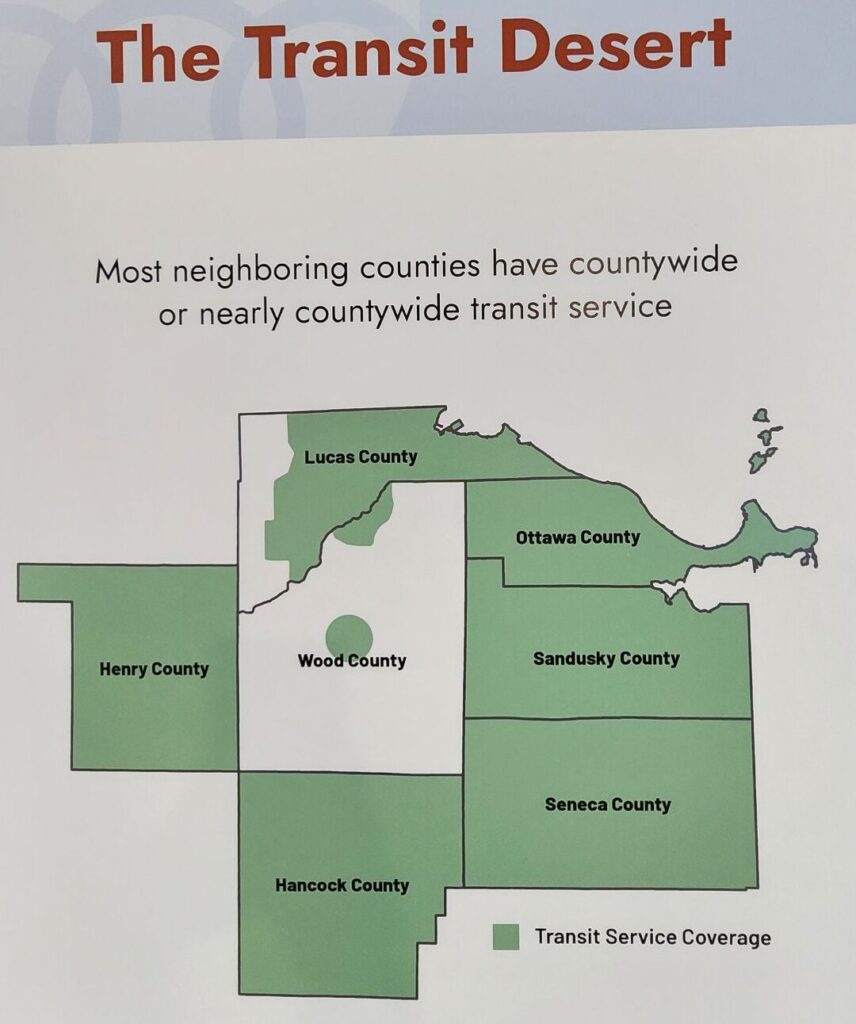
The county that was once in the center of the swamp is now known as a transit desert.
A map shows countywide transportation systems in Henry, Hancock, Seneca, Sandusky, Ottawa and much of Lucas counties. But in Wood County, small shaded areas signify limited transit systems in Bowling Green and Perrysburg – leaving the wide open areas with no regular rides.
To remedy that deficiency, the Wood County Workforce Mobility Study has been working on how best to provide transportation to the rest of Wood County.
With 620 square miles, Wood County has a lot of space to cover with few options available to people needing public transportation to get to their jobs. That causes problems for employees who don’t own a vehicle and face daily hardships getting to their jobs. And it creates problems for employers, who have a less reliable workforce and a smaller pool of prospects to select from.
Efforts in the past to devise a county-wide public transportation system in Wood County have stalled out due to the vast geographic area and the expected expense. Some transit programs exist to get local residents to medical appointments – but none offer transportation to workplaces.
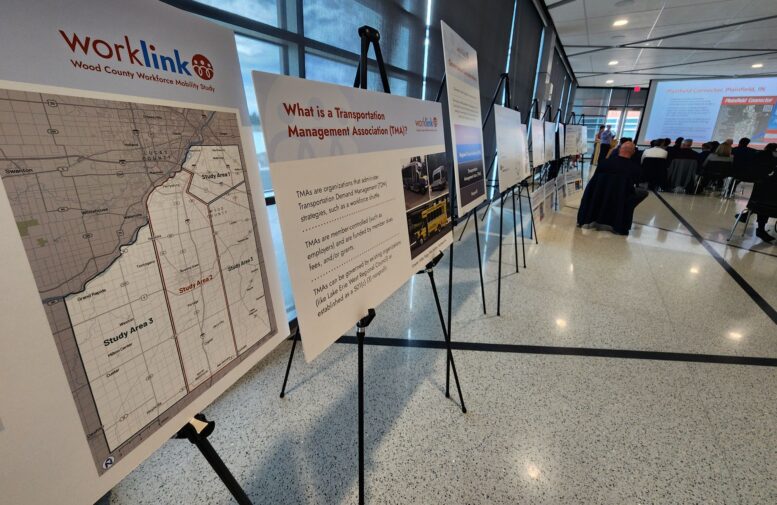
So a Wood County Workforce Mobility Study – branded as Worklink – has been searching for solutions. The project is aimed at addressing transportation challenges by developing a medium- and long-term mobility strategy to better meet the needs of the regional employers and improve access to their workforce. This needs assessment evaluated workforce mobility needs and transit service gaps.
Partnering in the study are the Ohio Department of Transportation, Lake Erie West Region, TARTA, and the Great Lakes Community Action Partnership.
During a meeting updating the study’s progress, B.J. Fischer, of Strategy by Fischer, reported that 26 employers in the area were interviewed about their needs. Half said access to transportation is an issue for their employees. And all said the lack of transportation limits their access to talent.
“There’s not a business in this area that doesn’t want to attract more or higher quality employees,” Fischer said.
The study is developing medium- and long-term strategies to connect employers with talent and help workers access jobs. By assessing mobility needs, identifying service gaps and analyzing regional travel patterns, WorkLink will shape solutions that expand access to both jobs and employees.
Supported by the Ohio Workforce Mobility Program, WorkLink emphasizes innovation and collaboration among governments, transit agencies, employers and community partners to design flexible, workforce-focused transit solutions.
WorkLink’s final report on Wood County workforce mobility feasibility will be available in May. Project and regional partners are expected to use this report to inform discussions on workforce transit service formation, governance models and funding options.
Many Ohio counties have countywide transportation usually with a combination of fixed routes and demand-response service. Sixty of the 88 counties have countywide transit, 14 have city models, and 14 have no public transportation. Wood County receives the second lowest transportation allocation among Ohio counties.
The goals of the Worklink program include:
- Enhance workforce mobility.
- Establish multimodal connection points.
- Encourage regional collaboration.
- Support economic growth.
Long gone are the days when most workers lived within walking distance of the businesses where they made their livings.
Lack of transportation affects employee attendance and retention, said Heather Mallette, director of human services at Envelope Mart.
“I’ve seen how the lack of transportation has impacted retention, has impacted recruitment, has impacted a person’s quality of life,” Mallette said.
“The misconception is they don’t want to work,” she said. “That is not the case. It’s they’re not able to get to work in a timely manner.”
Unreliable transportation – like a car on its last legs – affects both the employee and employer.
“It can be catastrophic. It can mean losing their job,” said Kali Swaya, transit planning project manager with TARTA.
The work ethic in this region remains strong, Fischer said.
“It’s unbelievable what people are doing to get to work that they shouldn’t have to,” he said. “This is not about work ethic. We have people climbing over obstacles to get to work that they shouldn’t have to.”
On Wednesday, Fischer talked about one plant manager who picks up workers from their homes if they lack transportation.
“People are unbelievably resilient and resourceful,” he said.
The study is working with companies to build connection points that are accessible to people in certain areas, where links to transportation can be offered.
“The same solution is not going to work everywhere,” especially in all the rural areas of Wood County, Swaya said. It won’t be like running a bus line up and down the road in Toledo, she said.
Following is some data collected by the study.
Nearly 50,000 jobs in Wood County are filled by workers who live outside the county.
More Wood County workers live outside the county in neighboring Lucas County, which accounts for 34% of the workforce, and it is higher than the 31% who live within Wood County itself. In addition, about one-third of Wood County workers live outside both Wood and Lucas counties.
Over one-third of Wood County residents (38%) work within the county, while 33% commute north to Lucas County. Another 5% travel south to Hancock County, likely to work in Findlay.
About half of Wood County workers (45%) commute less than 10 miles, indicating a concentration of local employment opportunities and relatively short travel distances for a large portion of the workforce. However, over one-quarter of workers (26%) commute more than 25 miles, highlighting the presence of a large segment of the workforce that travels longer distances.
Wood County does not have a single transit service operating throughout the county and instead is served by several public transit providers operating independently. Fixed route service providers include the Toledo Area Regional Transit Authority (TARTA), which operates a route connecting Rossford to downtown Toledo, and Bowling Green State University, which operates several shuttles within and to the main campus.
General public on-demand services are also provided in Perrysburg and Bowling Green. In addition, TARTA offers an on-demand service in Rossford and several cities in Lucas County.
In addition to public transit services, there are a handful of human service agencies and private services that offer transportation services for their clients and people participating in their programming. Most of these programs are oriented around medical appointments and specifically, non-emergency medical transportation. None offers transportation for employment.
The study found that employment in Wood County is expanding through a growing manufacturing base and the development of new warehouses and distribution centers.
This economic growth is supported by strong educational and job training resources, including Owens Community College, Penta Career Center, and Bowling Green State University, as well as major commercial hubs.
However, the county’s suburban land use patterns and limited transit options are creating mobility challenges, particularly as employers seek to attract workers from the broader region. Without expanded workforce mobility options, access to employees and job opportunities remains largely limited to individuals with private vehicles or those with access to local transit that provides service at convenient times.
Public transportation in Wood County, like transit services across the U.S., relies on public subsidies to operate. In Wood County funding varies by operator but each of the four operators rely on some form of local funding, using one or more of the following sources: direct taxes, fees or general funds. All the operators, except for BGSU, charge passenger fares, and some earn revenues through contracts and advertisements. B.G. Transit and TARTA also receive funding from the Federal Transit Administration and State of Ohio.
The study looked at options for funding a countywide transit system, including employer contributions, federal matches, and locally generated funds.
This needs assessment has identified several areas to focus on related to workforce mobility:
• Connecting northeast Wood County to Lucas County. Improving transit connections to the area north of I-80/90 in northeast Wood County is a priority as this region has a high concentration of employers and limited transit service. Enhanced access would make it easier for residents across the county, and in neighboring Lucas County, to reach job opportunities while helping businesses attract and retain workers.
• Building on existing services. Existing transit services provide some coverage, but gaps remain in reliability, hours of operation, and direct routing. More consistent service, longer operating hours, and a direct connection between Perrysburg and Lucas County, along with county-wide access to major job centers, would create a stronger, more seamless transit service that supports both economic growth and countywide mobility.
• Improving regional connections to Bowling Green. While the services offered in Bowling Green are well utilized, strengthening the regional links between Bowling Green and Lucas County is another important goal, with additional opportunities to connect to Perrysburg and, to a lesser extent, south toward Findlay. Better regional connections would expand travel options for jobs as well as for school and other types of trips.