
By TOM GERROW
BG Independent News
NOAA issued its annual Harmful Algal Bloom (HAB) forecast for Lake Erie and the good news is that, while not guaranteed, they expect a mild to moderate bloom this summer.
NOAA is predicting a HAB severity of 3 (with a range of 2-4), with a severity of 10 being the benchmark set by the 2011 season, the most severe season recently measured.
Researchers from The Ohio State University’s Stone Laboratory and Ohio Sea Grant, NOAA, Heidelberg University, and the University of Toledo presented their forecast on Thursday, June 26, at OSU’s Stone Laboratory Gibraltar Island Campus, Put-In-Bay.
Cyanobacteria, a type of algae that can produce a toxin called microcystin, puts the “harmful” in HABs. This toxin poses a risk to human and wildlife health, as well as water supplies, and there are other dangerous toxins in HABs as well. Not all blooms, however, are equally toxic. There are many physical, chemical and biological factors that interact to determine the toxicity of a particular bloom.
“While most people have heard that phosphorus pollution is a big cause of harmful algal blooms (HABs) in Lake Erie, scientists at BGSU’s Center for Great Lakes and
Watershed Studies (CGLWS) and other universities in the region have found that nitrogen pollution from farm and city runoff is actually even more important in making these blooms toxic,” said Dr. Sarah Emery, director of the CGLWS. “The main toxin we worry about in Lake Erie, called microcystin, needs a lot of nitrogen to be produced.
“We’ve also learned that different types of algae have different genes, which can affect the specific kinds, or “flavors,” of microcystin they produce—and some types are more harmful than others,” added Emery. “The mix of algae species in the water can also change how toxic a bloom becomes. Even short-term factors like how sunny or cloudy it is can affect toxin levels from day to day.”
The scientists monitoring the lake have detected no HABs as of June 22, though they have detected microcystin growing in Western Lake Erie at low, non-hazardous levels.
Contributing to the lack of HABs so far, lake temperatures have been a bit cooler than last year – though the recent heat wave has the lake warming up fast. Scientists expect HABs to begin appearing in early- to mid-July, with most staying in the western area of Lake Erie and peaking in August. How long the blooms persist will depend on the weather in September.
According to Dr. Nathan Manning, Interim Director of the National Center for Water Quality Research at Heidelberg University, the Maumee River contributes 5 percent of the water volume in the Western Basin but delivers half the nutrient load that powers HABs. Thus, it’s no surprise that much attention is paid to monitoring phosphorus and other nutrient levels in the Maumee. The monitoring program began in 1975, and it now has 23 stations, which provide important long-term data for the scientists making HAB forecasts.
The lake, and those who depend on it for their livelihoods or recreational needs, have benefited from lower measured phosphorus loads flowing into the lake’s Western Basin from the Maumee River over the last five years, compared with the decade prior.
“Two big things contribute to HABs in Lake Erie: how much phosphorus is in the water and how much water is flowing from the Maumee River into the lake,” said Dr. Emery. “In those earlier years, the Maumee River was sending a lot more phosphorus-laden water into Lake Erie because of heavy and early spring rains. In more recent years, river flows have gone down, which has helped reduce HABs. Phosphorus levels have also been dropping because many farmers are using better ways to manage fertilizers.”
Emery warns, however, that we can’t count on the favorable weather patterns of the last few years to continue. Heavy rainstorms, especially in the early spring, are expected to become 10-15 percent more frequent by mid-century, washing more nutrients into the lake and undoing much of the progress made so far.
Scientists gather data each year to track the cumulative load of nutrients flowing into the lake. According to Manning, the total phosphorus load this year should be near the targeted range of 240 metric tons, which is good news.
“A big storm drives the cumulative rate higher, then it dries out and (the cumulative load) flattens out,” said Manning. “The cumulative load is important because it is telling us just how much phosphorus and nitrogen and sediment is getting into the lake, and at what time of the year it’s coming in. Fifty percent of the load this year was delivered in April, and about 30 percent occurred in May.”
A blooms severity index is based on the bloom’s biomass (the amount of algae) during the peak 30 days of the bloom. But getting specific about the timing and location of algal
blooms is very difficult.
“Many things influence how harmful algal blooms develop in Lake Erie,” said Emery, including factors that are hard to predict such as weather and climate, wind patterns, the amount of nutrients already in the lake, and the interaction of different algae species.
“Because of all these moving parts, it’s very challenging to say exactly when and where HABs will show up in Lake Erie.”
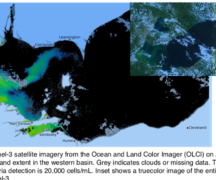
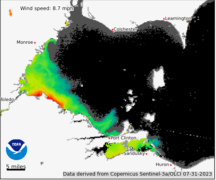
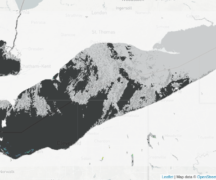
Online resources are available to monitor the location and severity of HABs in Lake Erie.
[Link: https://coastalscience.noaa.gov/science-areas/habs/hab-forecasts/lake-erie/ ]